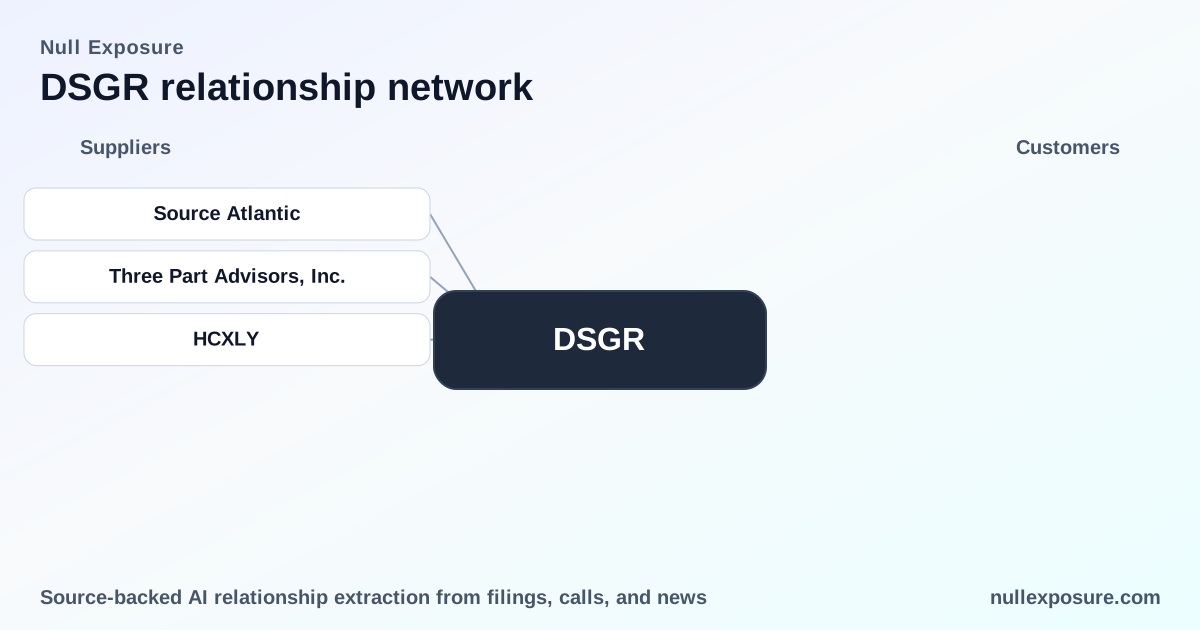
Distribution Solutions Group (DSGR): National accounts, concentrated pockets, and what customer ties mean for investors
Distribution Solutions Group monetizes by selling and servicing industrial MRO, OEM and technology products through a hybrid model of branch, national-account and contract-driven distribution and supply-chain services. Revenue derives from transaction-driven short-cycle sales and a meaningful base of long-term agreements within its services businesses, giving DSG a mix of predictable contract revenue and higher-frequency order flow; consolidated trailing revenue is roughly $2.0 billion with thin operating margins, making customer relationships a primary lever for both growth and margin expansion. For more background on relationship analytics and coverage, visit https://nullexposure.com/.
Why customer relationships are the actionable signal here
DSG operates as a distribution-first company with embedded services. That dual posture creates three investor-relevant characteristics:
- Contracting posture is mixed: the business runs high-volume short-cycle orders alongside long-term, mission-critical agreements in service segments.
- Concentration and criticality are asymmetric: parts of the business (notably Gexpro Services) exhibit customer concentration that is material to revenue, while branch and Lawson-like segments show broad retail-style customer counts.
- Geographic scale is North America-first with global capabilities, which supports resilience in domestic demand but creates execution exposure when expanding internationally.
These observations are grounded in the company’s published figures and segment disclosures: trailing revenue of $1.998 billion, modest profit margins, and segment disclosures that document both long-term agreements and short-cycle fulfillment. Investors should treat customer relationships as a primary driver of revenue stability and upside from wallet-share expansion.
What DSG management said on the most recent call
Management explicitly identified national-account expansion as a priority and named certain partners by reference. Management commented they are "focused on continuing to capture market share and expanding wallet share for our national accounts, including Lawson, Kent, and Government" during the earnings call in early May 2026. That statement signals a deliberate sales motion toward larger, repeat customers rather than pure branch-level volume. (Earnings call transcript, May 2, 2026.)
The customer relationships we found — direct and material
Below are the customer relationships cited in the public record for investor diligence. Each relationship is given a concise plain-English description with the source.
Lawson
Lawson is identified by DSG management as a named national account and part of the company’s wallet-share expansion effort; DSG has a Lawson segment that sells products to tens of thousands of customers and generates a high proportion of its Lawson-segment revenue in North America. According to company disclosures, the Lawson segment sold products to over 53,000 distinct customers and generated approximately 92% of its revenue in the United States in 2024, underscoring Lawson’s scale and domestic concentration. (Earnings call transcript, May 2, 2026; company filings and FY2024 segment disclosures.)
Kent
Kent is listed by management alongside Lawson as a national account target for growth, positioned as part of DSG’s strategy to deepen relationships with larger buyers and government channels. DSG named Kent when describing its focus on capturing market share and expanding wallet share for national accounts, indicating an active commercial pursuit or existing contractual engagement at the enterprise level. (Earnings call transcript, May 2, 2026.)
Constraints that shape how these relationships translate into value
These operating constraints are company-level signals that affect customer economics and risk.
- Contract type mix: The business supports both short-cycle transactional revenue and long-term agreements — for example, Gexpro Services had approximately 64% of its 2024 revenue under long-term agreements while the broader company emphasizes shipments within one year of order for most sales. That structure produces a blend of recurring revenue and volume sensitivity (company filings, FY2024).
- Customer concentration: Parts of the services business show material concentration — Gexpro Services’ largest customer represented roughly 23% of its 2024 revenue, and the top 20 customers accounted for about 82% of that segment’s sales — a clear single-customer risk in services contracts (company filings, FY2024).
- Role and go-to-market: DSG functions as a distributor and service provider, supplying both branch-level walk-up customers and mission-critical supply-chain services for OEMs and production lines; this dual role elevates the strategic importance of a limited set of national and government accounts (company descriptions and segment notes).
- Geography: While DSG reports a global footprint, the company is North America-centric — multiple disclosures show a very large share of revenue originating in the United States and Canada, with the Lawson segment heavily U.S.-weighted (company filings).
- Segment mix: The firm splits activity between distribution (branch and national accounts) and services (supply-chain, aftermarket and field installations), which creates differing margin and contract-tenor profiles across customers.
These constraints mean wallet-share gains at national accounts like Lawson and Kent deliver disproportionate margin upside, while service-segment concentration creates the potential for revenue volatility if a large account lapses or renegotiates.
What investors should monitor next
Focus your tracking on three variables tied to customer dynamics:
- National-account penetration: measure accounts won, incremental wallet share per named account, and changes in frequency/value of orders from Lawson and Kent.
- Contract mix and renewals: track percentage of services revenue under long-term agreements versus short-cycle orders and the renewal cadence for top Gexpro customers.
- Customer concentration metrics: watch changes in the largest-customer contribution to services revenue and any progress diversifying top-20 exposures.
These items are the most direct levers to move DSG’s margins and reduce downside from concentrated service relationships. For ongoing coverage and relationship-level updates, visit https://nullexposure.com/.
Bottom line: concentrated power, measurable levers
Distribution Solutions Group runs a hybrid revenue model that blends high-frequency transactional volume with meaningful, sometimes concentrated, long-term service contracts. Named national accounts such as Lawson and Kent are explicit focuses of management’s growth strategy, and service-segment customer concentration is material enough to warrant active monitoring. For investors, the core trade-off is clear: wallet-share wins at a few large accounts produce outsized margin impact, but concentrated services exposure amplifies downside risk if contract economics or renewal behavior deteriorate.
Key near-term signals to watch: national-account wallet-share trends, long-term contract renewals and any movement in the Gexpro Services concentration profile. These will determine whether DSG converts relationship management into durable earnings expansion.