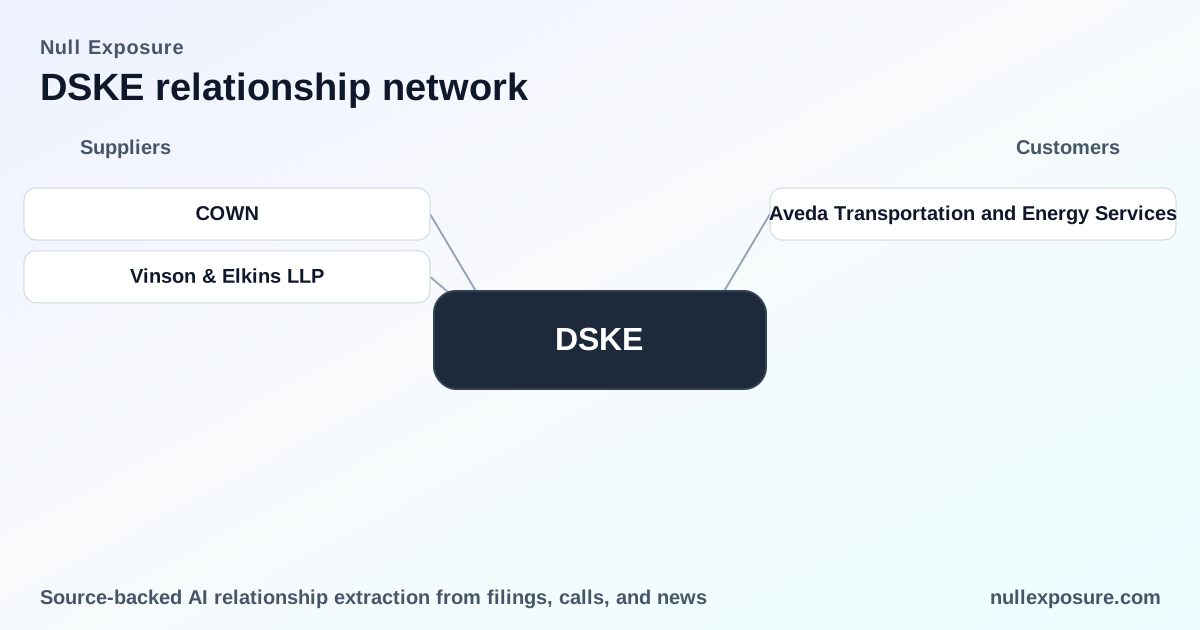
Daseke (DSKE) customer relationships — strategic customers, acquisition exit, and what it means for investors
Daseke built a specialized, asset-based freight business focused on flatbed and heavy-haul transportation, monetizing through contract carriage for industrial shippers and opportunistic spot work while expanding by acquisition. Revenue historically flowed from long-haul and specialized moves for large manufacturers and energy-sector firms; the strategic outcome was a sale to TFI International in 2023 for roughly $1.1 billion including debt. Investors evaluating DSKE should read the customer roster as a signal of sector focus, contract profile, and the commercial rationale behind consolidation in trucking.
If you want a compact, sourced dossier on counterparties and commercial positioning, visit https://nullexposure.com/ for more signal-driven company maps.
Why customers matter for a transport roll-up like Daseke
Daseke’s commercial value derived from scale in specialized flatbed services, contract penetration with capital-intensive manufacturers, and the ability to aggregate idiosyncratic local carriers into a national platform. Those traits make two investor realities unavoidable: (1) customer relationships determine utilization and pricing power in low-margin haulage, and (2) acquisitive growth can be both an engine for revenue and a source of integration risk.
From the evidence in the public record, Daseke’s customer list reads like a manufacturer-and-energy playbook: large OEMs and steelmakers that regularly move outsized, irregular freight. That client mix supports higher per-load yields than general less-than-truckload freight but also creates exposure to industrial cycles and to contract renewal cadence.
Relationship-by-relationship read — what investors need to know
Boeing
Daseke is reported to have moved freight for Boeing as part of its roster of industrial customers; the 2017 coverage highlights Boeing alongside other major shippers and places Daseke as a niche provider within a much larger $133 billion trucking market. According to a CDLLife article from FY2017, Daseke worked with Boeing among other large shippers while controlling less than 1% of the sector cited in that piece. (CDLLife, FY2017)
Caterpillar
Caterpillar appears on the same customer list used to illustrate Daseke’s industrial end markets, indicating exposure to heavy-equipment logistical flows that favor specialized flatbed capacity. The same FY2017 CDLLife report lists Caterpillar as a shipper for whom Daseke moves freight. (CDLLife, FY2017)
Nucor
Nucor, a major steel producer, is included in the FY2017 reporting as a customer, reflecting Daseke’s role in moving heavy and length‑critical steel shipments that require specialized trailers and handling. The relationship is cited in the CDLLife coverage from FY2017. (CDLLife, FY2017)
Aveda Transportation and Energy Services
Daseke expanded by acquisition into Canadian regional specialties; in FY2018 coverage, Daseke’s Aveda acquisition was contextualized by Aveda’s own outsourcing of long-distance rig moves—an addressable market Daseke targeted with its operating companies. TruckNews reported on the FY2018 Aveda transaction and noted outsourcing dynamics that created revenue capture opportunities for Daseke’s platform. (TruckNews, FY2018)
TFI International Inc.
The strategic exit for Daseke was consummated in FY2023 when TFI International agreed to acquire Daseke for $1.0–$1.1 billion including debt, folding the flatbed specialist into a larger North American truckload conglomerate. TruckingInfo and AJOT both covered the FY2023 transaction, noting the purchase price and the rationale of consolidation through acquisition. (TruckingInfo, FY2023; AJOT, FY2023)
Operating model signals and investor implications
There are no explicit regulatory or contractual constraints recorded in the materials reviewed, so the following characteristics are company-level signals derived from the relationship evidence and transaction history:
- Contracting posture — asset-based plus contracted work. Daseke operated primarily as an asset owner/operator with long-haul contracts for industrial shippers complemented by spot and outsourced runs captured from regional partners, a mix that stabilizes revenue but requires capital discipline on fleet utilization.
- Concentration and client profile. The customer roster skews toward large industrial manufacturers and energy-sector players; this raises client concentration risk in downturns but supports higher per-load yields relative to general freight.
- Criticality and differentiation. Specialized flatbed and heavy-haul capabilities create stickiness on technical loads (oversize, heavy, or regulated shipments), which raises switching costs for certain services even if overall market share was small.
- Maturity and strategic outcome. The FY2023 sale to TFI International is a clear maturity signal: the platform’s primary path to value crystallized as an acquisition rather than as a standalone scaling to market dominance.
Key risk and return takeaways for investors and operators
- Positive: higher yield niche + consolidation optionality. Specialized loads and a roll-up model delivered differentiated revenue streams that were attractive to a larger consolidator (TFI), validating the commercial thesis for investors who favor roll-up arbitrage.
- Negative: limited scale in the broader market and exposure to industrial cycles. Public reporting from FY2017 showed Daseke controlled less than 1% of the referenced $133 billion trucking niche, underscoring the fragmented nature of the opportunity and sensitivity to cyclical demand from large industrial shippers. (CDLLife, FY2017)
- Operational risk: integration and customer retention post-acquisition. The 2023 acquisition resolves equity value realization but passes integration and contract renewal execution risk to the acquirer; monitoring post‑deal customer retention will reveal whether the specialized service differentiation survives consolidation. (TruckingInfo; AJOT, FY2023)
If you want a consolidated view of counterparty exposures and sector signals for transport roll-ups, see our homepage at https://nullexposure.com/.
Bottom line
Daseke’s customer list—heavy manufacturers and energy-sector businesses—underpinned a specialized flatbed platform that scaled by acquisition and ultimately delivered value through an industrial buyer. For investors, the story is one of niche pricing power offset by market concentration and execution risk; for operators, the lesson is that specialized capability can drive strategic exits but demands tight fleet utilization and strong contract management. The FY2017–FY2023 public record (CDLLife; TruckNews; TruckingInfo; AJOT) provides the primary evidence for those conclusions.