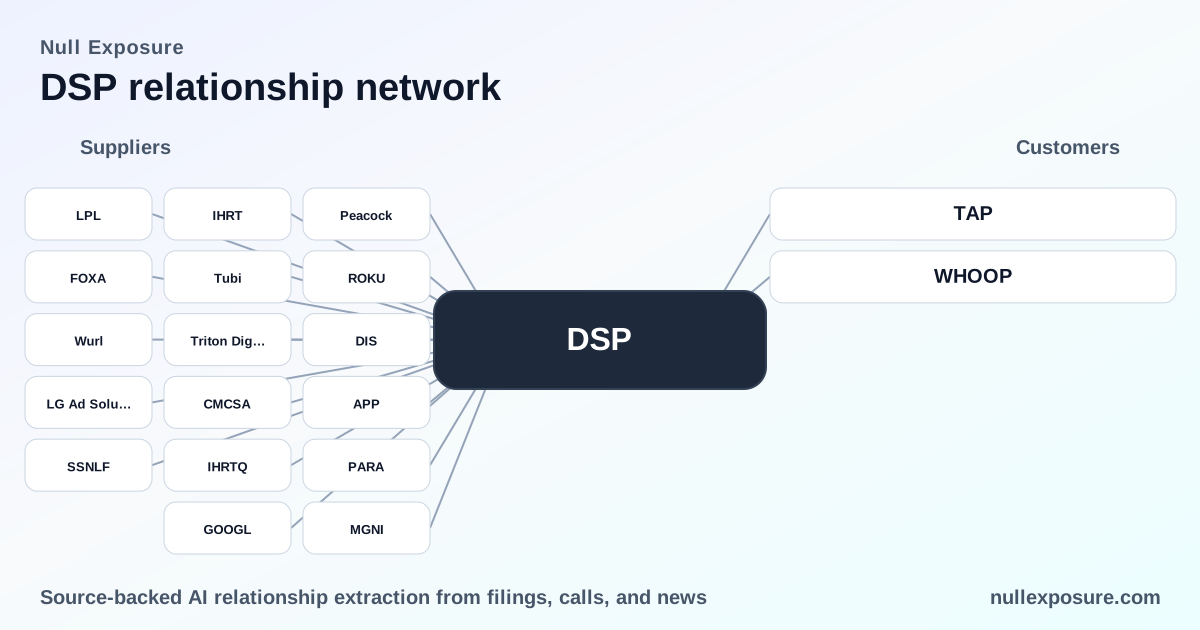
Viant Technology (DSP): Customer Relationships, Commercial Signals, and Investment Implications
Viant Technology operates a cloud-based demand-side platform that enables advertisers and agencies to plan, buy and measure digital and connected-TV advertising across channels. The company monetizes primarily through platform fees that are either a percentage of media spend or fixed CPM fees, supplemented by service fees under master service agreements; these pricing choices drive revenue volatility tied to advertiser spend. For investors, the recent slate of client wins — anchored by a flagship Molson Coors relationship and strategic ad-platform designations — materially changes Viant’s revenue growth narrative and risk profile. Learn more at https://nullexposure.com/.
Why the recent client wins matter to the P&L and roadmap
Viant’s commercial model is built for scale when large advertisers allocate meaningful budgets to a single DSP: a small number of large advertisers can drive disproportionate revenue through percentage-of-spend fees. The company’s newest agreements signal movement from mid-market breadth toward enterprise depth, which improves revenue upside but increases concentration risk. Management has emphasized short notice termination provisions in many contracts, meaning wins have to convert to sustained spend to impact long-term revenue predictability.
A second strategic vector is outcomes-driven product adoption: Viant is pushing its AI-driven outcomes solution as a margin lever with reported step-changes in cost-per-outcome for several clients — a sales pitch that helps convert advertisers from legacy buys to Viant’s fee structure. This is a structural story: enterprise wins plus product-led efficiency provide both top-line lift and a path to higher take-rates.
Catalog of customer relationships and supporting sources
Below I list every customer relationship cited in public signals, with a concise plain-English description and the source for each mention.
TAP
Viant announced a multi-year agreement identifying TAP as the designated advertising platform for Molson Coors, with activation beginning in 2026; the TAP ticker is referenced in multiple public notices around the deal. A StockTitan news item reported the designation as part of Viant’s March 2026 disclosures. (Source: StockTitan news, March 9, 2026)
Molson Coors Beverage Company
Molson Coors named Viant its advertising platform of record to activate and scale first-party data across U.S. channels, with Viant’s household identity infrastructure cited as the technical enabler and initial spend live in Q1 after the announcement. Management reiterated the deal on its Q3 2025 earnings call and in subsequent press coverage. (Sources: Q3 2025 earnings call transcript; PPC.Land and StockTitan coverage, March 2026)
WHOOP
WHOOP selected Viant as its DSP of record to deliver household-level connected-TV activation and measurement, positioning Viant to link media exposure to business outcomes for the wearable company. The partnership was disclosed in Viant’s public comments and covered in mainstream summaries of the Q4/Q3 earnings period. (Sources: The Globe and Mail earnings transcript summary, May 2026; StockTitan coverage, March 2026)
MacKenzie-Childs
MacKenzie-Childs was cited as a client in Viant’s Outcomes AI testing, where the company reported large reductions in cost per outcome versus human-managed campaigns. This example was provided as part of management’s evidence that the Outcomes AI product produces measurable efficiency gains. (Source: The Globe and Mail earnings transcript, May 2026)
UMass Global
UMass Global appears among clients referenced in Outcomes AI testing, with Viant reporting substantial reductions in cost per outcome during advertiser outcomes trials. Management used UMass Global to illustrate cross-industry applicability of the Outcomes solution. (Source: The Globe and Mail earnings transcript, May 2026)
Kampgrounds of America (KOA)
Kampgrounds of America was named as an Outcomes AI pilot client delivering large efficiency improvements, demonstrating Viant’s reach into travel and leisure advertisers. The mention supports Viant’s claim of broad vertical applicability for its outcomes offering. (Source: The Globe and Mail earnings transcript, May 2026)
Tire Discounters
Tire Discounters was included in the list of advertisers where Outcomes AI showed a 58%–95% reduction in cost per outcome versus human expert campaigns, used by management to quantify product performance. (Source: The Globe and Mail earnings transcript, May 2026)
Uqora
Uqora participated in Outcomes AI trials that were highlighted for significant reductions in cost per outcome, providing a smaller-brand use case for Viant’s platform-level efficiencies. (Source: The Globe and Mail earnings transcript, May 2026)
Alzheimer’s Association
The Alzheimer’s Association was cited among nonprofit and cause advertisers in Outcomes AI testing, with management using the example to show applicability beyond strictly commercial advertisers. (Source: The Globe and Mail earnings transcript, May 2026)
Operational constraints and what they imply for customer relationships
The company filings and public disclosures produce a consistent set of operating signals that inform how these relationships translate into revenue and risk:
- Master service agreements (MSAs) are the standard contracting vehicle, with Viant offering both percentage-of-spend and fixed CPM pricing; this creates recurring but usage-sensitive revenue tied to advertiser budgets.
- Most customer contracts are short-duration or terminable on 30–90 days’ notice, so sales wins require rapid conversion to scale to become durable revenue.
- Pricing is usage-based for many customers (percentage of spend or CPM), which amplifies revenue cyclicality but aligns Viant’s incentives with advertiser spend success.
- Commercial focus is U.S.-centric, concentrating market and regulatory exposure within North America rather than a diversified global footprint.
- Customer concentration is material: Viant acknowledges dependence on a limited number of large holding companies and enterprise advertisers, which increases downside if flagship customers reduce spend.
- Role dynamics: Viant is both a technology seller and service provider; many customers rely on Viant as their primary DSP, which increases criticality but still leaves switching risk due to short contract terms.
These constraints are company-level signals that contextualize the relationship roster above and explain why a single Molson Coors-sized win shifts investor expectations rapidly.
Investment implications and risks for operators and allocators
- Upside: Large enterprise designations like Molson Coors and WHOOP accelerate revenue scale because percentage-of-spend economics compound as advertisers consolidate spend. Outcomes AI success stories provide a credible product narrative for wallet share expansion.
- Downside: Short contract tenors and a concentrated customer base create churn risk; the company’s U.S. concentration amplifies any regional advertiser budget shocks. Investors should monitor actual spend deployment rates from new wins (not just designation announcements).
- Monitoring points: watch monthly or quarterly spend ramp from Molson Coors; adoption metrics and incremental margin from Outcomes AI; and any disclosure about MSAs converting to longer-term commitments.
Bold conclusion: Viant’s commercial momentum is meaningful — enterprise platform designations convert high-upside revenue potential into near-term re-rating catalysts — but that upside is paired with measurable concentration and contract-tenor risk that requires active monitoring.
For a deeper view on relationship signals and company-level constraints, visit https://nullexposure.com/ for the full feed and analysis.
Key takeaways:
- Flagship enterprise wins (Molson Coors, WHOOP) materially shift revenue runway.
- Short-term, usage-based contracts increase volatility despite higher take-rates from large accounts.
- Outcomes AI provides a scalable product-led margin opportunity if spend converts into long-run client commitment.