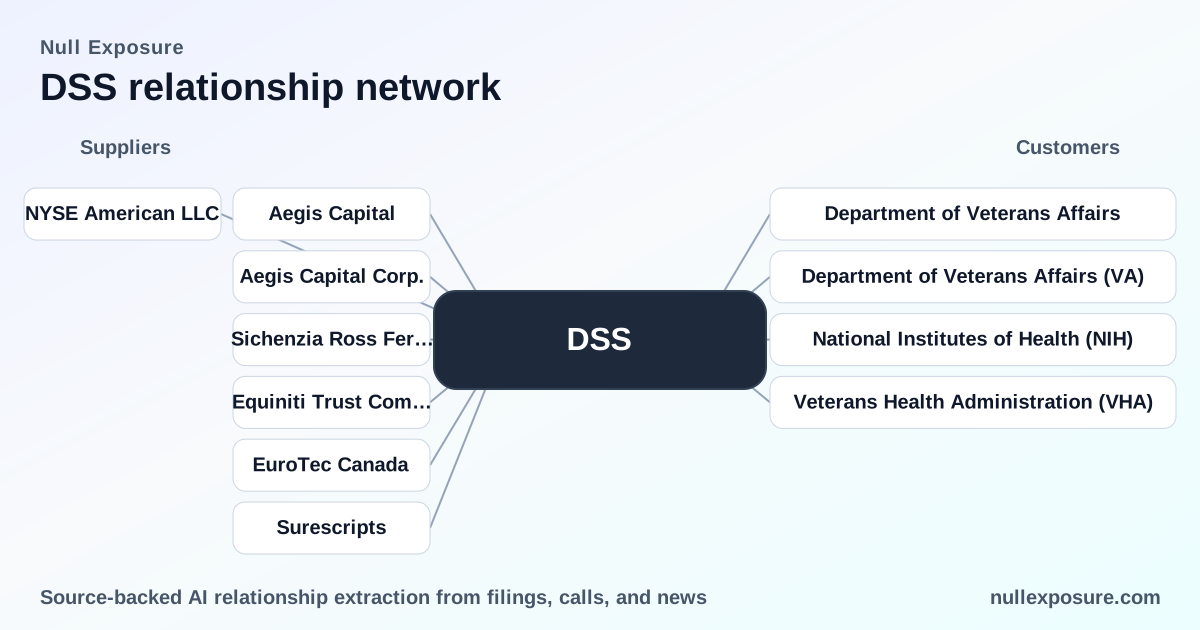
DSS Inc.: Federal wins and customer concentration define the near-term thesis
DSS Inc. operates as a hybrid packaging and document-security manufacturer that also pursues licensing and software-enabled services for regulated customers; the company monetizes through custom packaging and security printing sales, licensing of consumer-facing products via subsidiaries, and increasingly through federal health IT and software contracts. For investors the core thesis is simple: a small, cash-constrained industrial issuer is chasing higher-margin federal health contracts to offset volatile packaging revenues, creating a binary upside tied to contract awards and execution. Learn more at https://nullexposure.com/.
What the recent relationship signals say about strategy
DSS’s public footprint shows an active pivot into federal health technology while retaining its legacy packaging and licensing lines. The company is pursuing federal agencies directly and has executed financing and securities arrangements that indicate balance-sheet activity alongside business development in health-care verticals.
Department of Veterans Affairs — potential five-year, $212.6M software contract
GovConWire reported that the Department of Veterans Affairs awarded Document Storage Systems a potential five‑year, $212.6 million contract to provide a software platform to support coding, billing, auditing, reporting and project management and to integrate with VistA (FY2025 reporting). This contract, if realized and tasking occurs, represents a transformational public-sector engagement for a company of DSS’s current scale. Source: GovConWire (March 2026) — https://www.govconwire.com/articles/va-dss-hicba-virr-software-delivery-contract
ALSENT INC — securities purchase agreement announced
An Intellectia.ai item summarized a company announcement that ALSENT INC entered into a securities purchase agreement with DSS, Inc., indicating a financing or capital transaction tied to shareholder approvals in FY2026. This suggests DSS is actively managing capital structure alongside operational initiatives. Source: Intellectia.ai (May 2026) — https://intellectia.ai/news/etf/alset-inc--closing-of-deal-dependent-on-dss-stockholder-approval--sec-filing
ALSET INTERNATIONAL LIMITED — formalizes securities purchase agreement
A separate Intellectia.ai notice identifies ALSET INTERNATIONAL LIMITED signing a securities purchase agreement with DSS on March 26, 2026, reinforcing that DSS is pursuing external investment or strategic financing relationships in early 2026. Source: Intellectia.ai (May 2026) — https://intellectia.ai/news/etf/alset-inc--closing-of-deal-dependent-on-dss-stockholder-approval--sec-filing
Department of Veterans Affairs (strategic hire) — federal strategy officer appointment
ExecutiveBiz reported DSS Federal’s appointment of David Whitmer, an HHS veteran, as chief strategy officer, with CEO Mark Byers framing the hire as a move to tailor DSS’s technology to improve VA healthcare delivery and veteran outcomes. The hire signals an operational commitment to winning and executing federal health agency work. Source: ExecutiveBiz (March 2026) — https://www.executivebiz.com/articles/dss-federal-arm-appoints-hhs-vet-david-whitmer-as-chief-strategy-officer
National Institutes of Health — targeted expansion intent
In the same ExecutiveBiz coverage, Whitmer is quoted expressing plans to expand DSS services and products to other federal health agencies, including NIH, which indicates a deliberate go‑to‑market plan beyond a single federal program and a focus on multiple federal health buyers. Source: ExecutiveBiz (March 2026) — https://www.executivebiz.com/articles/dss-federal-arm-appoints-hhs-vet-david-whitmer-as-chief-strategy-officer
Veterans Health Administration — operational relevance emphasized
ExecutiveBiz also notes that Whitmer’s role is intended to sharpen understanding of the unique needs of the Veterans Health Administration (VHA)—an operational signal that DSS intends to align product development and delivery to VHA workflows and compliance requirements. Source: ExecutiveBiz (March 2026) — https://www.executivebiz.com/articles/dss-federal-arm-appoints-hhs-vet-david-whitmer-as-chief-strategy-officer
Operating constraints and what they imply for execution
The public record and company disclosures provide direct signals about how DSS contracts, where it sells, and the structural risks that investors must price.
- Contracting posture — short-term orientation. The company disclosed it had no unsatisfied performance obligations for contracts with an original expected duration greater than one year as of 12/31/2024, indicating that revenue is primarily derived from short-duration contracts or orders, which increases revenue volatility and requires constant new wins.
- Geographic footprint — global but concentrated in North America. DSS states operations across multiple regions (North America, EMEA, APAC) and operates nine distinct business lines around the globe, but its packaging subsidiaries primarily serve the U.S. market; this mix produces localized revenue risk tied to North American industrial demand along with nascent international exposure.
- Customer concentration — material single-customer risk. Company disclosures show one customer contributed ~22% of consolidated revenue and a second ~13% in 2024, and those two customers also drove a significant share of trade receivables; this is a material concentration that amplifies downside from a lost or delayed program.
- Roles and segments — diversified but operationally split. DSS acts as manufacturer and seller through its packaging arm (Premier) while also operating distribution/licensing channels (Direct Marketing/HWH World), and it is now layering licensor and software vendor roles for federal health work; that breadth creates cross‑business complexity in execution and cash allocation.
These constraints collectively indicate a company that is operationally diversified in activities but financially narrow — short-duration revenue, high customer concentration, and active capital transactions to sustain growth or execution.
Financial posture, governance and execution risk
Investors should weigh the relationship news against the hard financials: market capitalization ~ $5.96M, TTM revenue ~$20.8M, and negative EBITDA of ~$11.5M, per the latest company metrics. The equity base is tightly held (insiders ~61.5%, institutions ~1.6%), and the public float is small. That ownership structure can accelerate strategic changes but limits institutional liquidity and raises governance concentration risk. The federal contract opportunity is large relative to the firm’s market value, meaning award capture or failure will have outsized impact on equity value.
Key risk factors:
- High revenue concentration and receivable exposure to a few customers.
- Short-duration contract mix requiring continuous renewals and new wins.
- Execution complexity across manufacturing, licensing and federal software delivery.
- Tight insider ownership and limited institutional support.
Investment takeaway and monitoring checklist
DSS is a classic small‑cap operational turnaround story: a low‑value equity base trying to de‑risk cyclical packaging revenues through large federal health contracts and external financing. The VA contract headline is a potential re‑rating catalyst if awards convert into booked work and cash flow, but the company’s short-term contract posture and material customer concentration leave equity outcomes binary.
Investors should monitor:
- Contract award and task order flow from the VA (and subsequent revenue recognition).
- Completion and terms of the securities purchase agreements disclosed in March–May 2026.
- Quarterly updates to accounts receivable concentration and backlog.
- Execution hires and program delivery milestones for VHA/NIH initiatives.
For a consolidated outlook, review ongoing filings and market commentary at https://nullexposure.com/ — and return there for follow‑up coverage and deeper relationship mapping as the VA program and financing items progress.