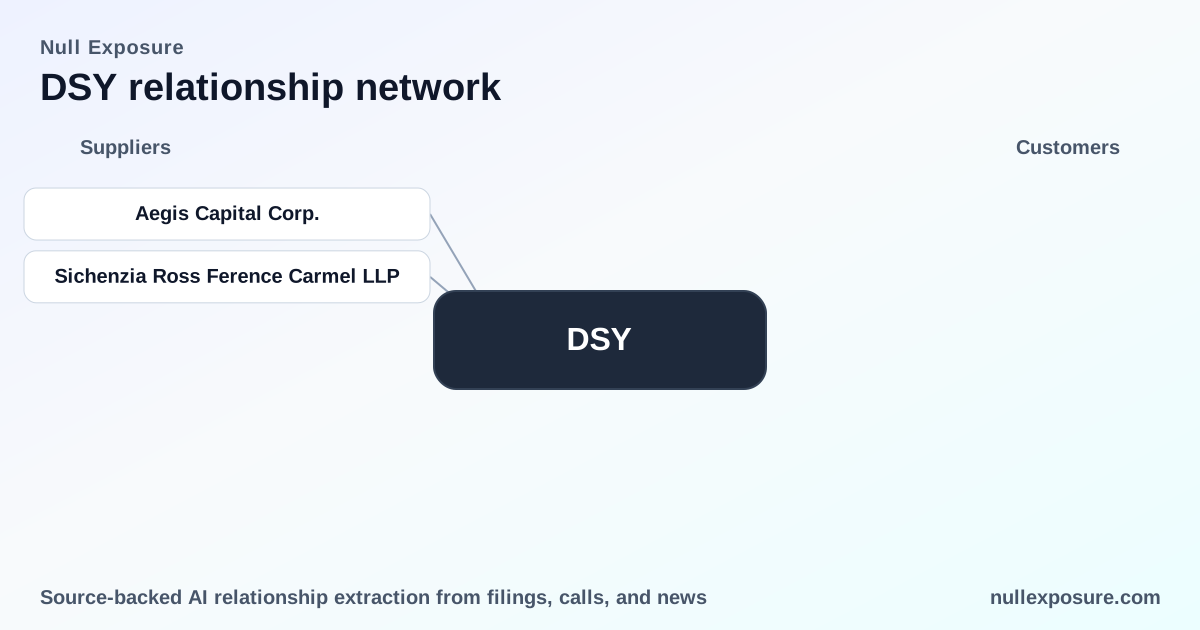
DSY — Customer Relationships Snapshot and What Investors Should Know
Big Tree Cloud Holdings Limited (ticker: DSY) manufactures and sells personal care products and consumer goods and monetizes through product sales across retail and distribution channels, levering gross margins on branded and private-label items to drive cash flow. Investors should evaluate DSY on two fronts: how concentrated and contractual its customer base is, and whether reported customer linkages map to sustainable, recurring revenue rather than one-off commercial arrangements. For ongoing tracking of relationship intelligence, see NullExposure for deeper signal coverage: https://nullexposure.com/.
Quick investment thesis: product margins versus scale risk
DSY’s business model is fundamentally retail-oriented: revenue generation comes from selling finished goods to retailers and distributors, not from recurring subscription contracts. The company reported Revenue (TTM) of 7,323,400 USD and Gross Profit (TTM) of 4,901,100 USD with the most recent quarter dated 2024-09-30, highlighting a healthy gross margin profile but a negative diluted EPS of -9.13 that reflects limited operating leverage to date. Investors should value DSY on its ability to convert distribution relationships into repeatable volume and to diversify counterparty concentration.
The customer relationships we found — one explicit hit
The relationship extraction for DSY returned a single customer-related record.
Clicks (CLIK)
A March 9, 2026 press release on MyNewsDesk links Clicks (CLIK) to a product/partner announcement: Discovery Health, Clicks and Auto & General Insurance launched an affordable private day-to-day healthcare product called Flexicare distributed through the Clicks retail network. The relationship dataset lists CLIK as a customer entry associated with DSY; the underlying citation is the MyNewsDesk release (Discovery Holdings) on March 9, 2026 (https://www.mynewsdesk.com/za/discovery-holdings-ltd/pressreleases/clicks-discovery-health-and-auto-and-general-insurance-announce-flexicare-for-consumers-new-affordable-private-healthcare-cover-3233301).
Source: MyNewsDesk press release (Discovery Holdings), March 9, 2026.
What the single-hit result implies for investor analysis
The presence of a single news-sourced customer link is a directional signal, not a full map of DSY’s commercial exposure. A solitary external citation does not prove broad retail penetration; it does indicate that DSY’s public relationship signals are sparse or that most customer agreements are not widely reported in press channels.
- Concentration: The dataset output suggests limited publicly-visible customer relationships; this is a company-level signal that raises the importance of confirming revenue concentration through filings or management disclosures.
- Contracting posture: With no explicit contractual excerpts returned, assume DSY predominantly operates on standard supply or distribution terms common to consumer goods manufacturers rather than long-term, revenue-recurring contracts.
- Criticality: Absent explicit constraints or named long-term partners, there is no evidence in the retrieved signals that any single customer represents a systemically critical counterparty to DSY’s revenue stream.
- Maturity: Sparse relationship visibility is consistent with a company still scaling distribution reach or operating in markets where customer disclosure is limited.
Financial and governance signals that matter
Pulling together public metrics helps shape investor diligence:
- Scale and margin: Revenue TTM of 7.32M USD and Gross Profit TTM of 4.90M USD indicate strong gross margin capture at the unit level but limited absolute scale.
- Profitability: Diluted EPS of -9.13 and negative operating margin TTM reflect the company is not yet converting gross profits into consistent net profits.
- Market signal: Market capitalization sits near 10.34M USD, and institutional ownership is reported at ~23.8%, suggesting some professional investor participation but limited market depth.
- Balance and disclosure: The company reports a negative book value and a small public float relative to shares outstanding, flagging governance and liquidity considerations for larger investors.
These facts together point to a high-sensitivity investment case: if DSY can translate distribution relationships into scale, equity returns could follow; absent that, margins alone are insufficient.
Operational risks tied to customer relationships
Key items for operators and analysts to verify during diligence:
- Customer concentration risk: Confirm top-10 customers and revenue share — the public relationship output is inadequate to substitute for line-item revenue disclosures.
- Contract length and terms: Determine whether sales are transactional (spot orders) or backed by multi-period purchase agreements that stabilize revenue forecasting.
- Channel mix: Retail distribution through third-party chains versus direct-to-consumer sales affects margin capture and bargaining power; validate the balance.
- Geographic exposure: Registered in China but listed on NASDAQ, DSY’s cross-jurisdictional supply chain and customer mix create FX, regulatory and logistics risks that compound counterparty exposure.
Actionable investor takeaways
- Confirm revenue concentration: Primary diligence step is to obtain customer-level revenue detail from company filings or direct engagement to quantify concentration risk.
- Verify contract types: Prioritize clarity on whether relationships are spot-sell or supported by term contracts that underwrite repeatable sales.
- Monitor disclosure cadence: Sparse public relationship signals require investors to lean on quarterly filings and management calls for clarity.
For more structured relationship intelligence and tracking of DSY’s counterparties, NullExposure provides ongoing coverage and signal aggregation — learn more at https://nullexposure.com/.
Final read
DSY’s economics rest on product-level gross margins and the company’s ability to scale distribution into steady, contractual flows. The single customer hit in public signals—the Clicks/Discovery press release—does not materially prove broad retail penetration, leaving concentration and contracting posture as the pivotal diligence items for investors. Confirming those pieces will determine whether DSY’s margin profile can support valuation expansion or whether the stock remains a liquidity- and execution-risk play.