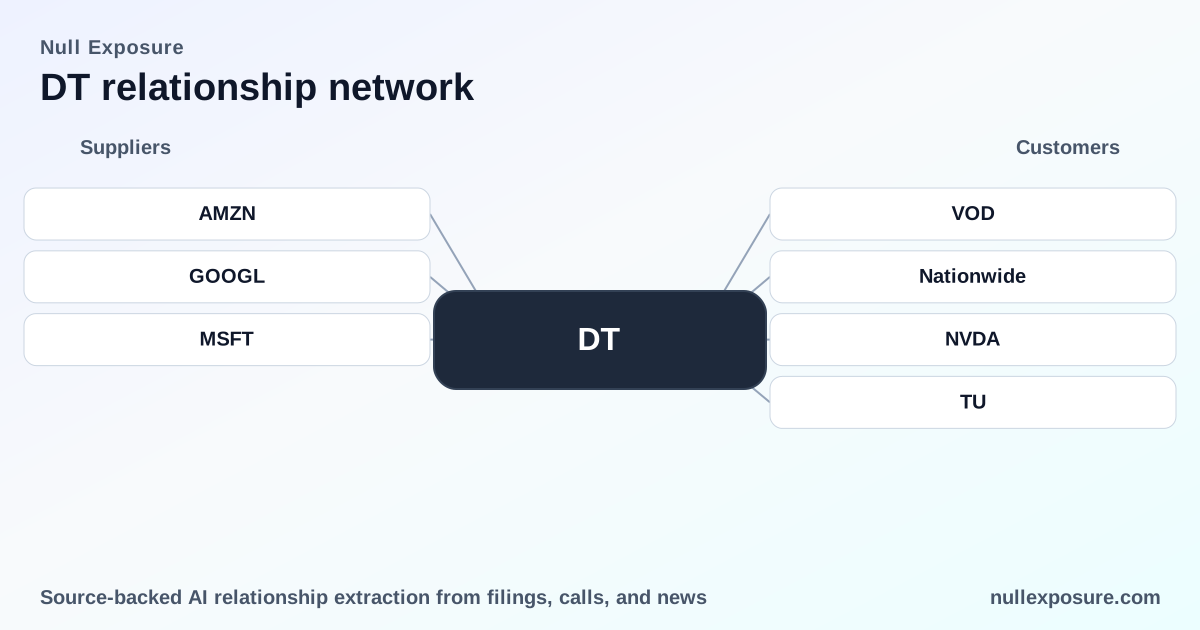
Dynatrace (DT): Customer relationships that turn observability into an enterprise control plane
Thesis: Dynatrace monetizes a SaaS-first observability and software-intelligence platform through subscription-based agreements (SaaS, term licenses, maintenance) and a usage-oriented DPS licensing model, selling primarily to large global enterprises. Revenue comes from durable subscription contracts and platform-wide consumption mechanics; strategic partnerships and marquee deployments convert technical wins into account-level stickiness and upsell opportunity. For a compact investor view, visit https://nullexposure.com/.
Why customer conversations matter for valuation
Dynatrace’s financial profile—high gross margins, rapid revenue growth, and a premium multiple—depends on its ability to convert technical integrations into enterprise-scale contracts. The company sells subscription-based observability and AI-driven automation to large organizations, which creates high gross retention potential but long sales cycles and concentration of renewal risk around enterprise decision-makers. Company filings show ~4,100 customers across 105+ countries, which signals broad adoption but also the need to defend and expand within a finite set of large accounts (company filing as of March 31, 2025).
Key operational characteristics:
- Contracting posture: Subscription-first, with DPS usage commitments that convert platform installs into recurring revenue and variable consumption upside (company disclosures).
- Counterparty profile: Focused on large enterprises—targeting the top 15,000 global accounts—so each new win can have outsized enterprise value (company disclosures).
- Geographic reach and maturity: Global footprint with active, production deployments across industries, supporting a defensible renewal base.
- Concentration: No single end-customer accounted for more than 10% of revenue for the years ended March 31, 2025, 2024, and 2023—revenue concentration is immaterial at the top-line level.
For deeper company signals and customer-level tracking, see https://nullexposure.com/.
The customer list that matters — real deployments and partnerships
Below are concise, plain-English readouts of the customer relationships surfaced in recent coverage. Each entry includes a direct source to the public report.
Vodafone — large-scale log migration and AI modernization
Vodafone migrated more than 2,500 users, 8,500 dashboards, and eight terabytes of daily log ingest from a legacy log provider to Dynatrace in a two-month project that Vodafone framed as part of AI-driven operations modernization. According to an earnings call transcript reported by InsiderMonkey in March 2026, Vodafone positioned Dynatrace as a core telemetry and log platform for large-scale operational AI use cases.
Bank Muscat — national banking command center
Bank Muscat deployed Dynatrace to build Oman’s first enterprise Command Center for banking, designed to strengthen operational resilience and accelerate incident response across critical digital services. Reuters coverage republished on TradingView in May 2026 described this as a strategic operational deployment within a national financial services environment.
Nationwide — measurable incident reduction
Nationwide reported a 74% reduction in priority-one incidents after using Dynatrace, illustrating the platform’s impact on operational risk and service continuity in insurance and financial services systems. This outcome was highlighted in an earnings call transcript covered by InsiderMonkey in March 2026.
Postman — developer workflow integration and API observability
Dynatrace expanded a technology alliance with Postman to make its Model Context Protocol Server available via the Postman API Network, embedding Dynatrace context into Postman Agent Mode so developers can access real-time observability inside AI-assisted API workflows. Coverage on SimplyWall.St in May 2026 emphasized developer productivity and observability-in-the-loop as the strategic intent.
NVIDIA — the control plane for AI factories
Dynatrace’s partnership with NVIDIA—announced in 2025 and reiterated in recent commentary—positions Dynatrace as a monitoring and control plane for AI infrastructure, including Blackwell-based AI factories. Analysis published via FinancialContent (Finterra) in March 2026 describes the relationship as central to Dynatrace’s positioning in the AI-native enterprise stack.
Telus — shrinking mean time to resolution (MTTR)
Telus reported that Dynatrace reduced average time to resolve issues from forty minutes to five minutes, moving the operator from reactive firefighting to proactive reliability engineering. This customer outcome was discussed at Dynatrace’s Perform event and cited in an InsiderMonkey transcript in March 2026.
How these relationships shape upside and risk
These customer narratives show two consistent themes: technical depth that drives operational value (reduced incidents, faster MTTR, centralized command centers) and strategic positioning (developer integrations with Postman, platform control plane tie-ins with NVIDIA). Those themes translate into measurable commercial advantages—higher retention, expansion inside accounts, and the ability to price for value.
At the same time, several company-level constraints are material to investor analysis:
- Subscription-driven revenue mix implies high visibility but requires continuous product delivery and customer success to preserve ARR (company disclosures).
- Large-enterprise focus reduces customer count elasticity and lengthens multi-year sales cycles, increasing the importance of execution in account management (company disclosures).
- Global footprint and scale diversify geographic risk but amplify the need for 24/7 operational support and localized compliance capabilities (company disclosures).
- Low top-customer concentration reduces single-counterparty revenue risk, but strategic dependence on a set of marquee accounts makes success in renewals and upsells essential (company disclosures).
Investment implications and risk checklist
-
Upside: Marquee technology and telco deployments (Vodafone, Telus) plus the NVIDIA partnership create cross-sell and platform-adjacency revenue opportunities. Developer and API integrations (Postman) broaden adoption vectors beyond classical SRE/ops teams.
-
Risk: Execution risk on long enterprise sales cycles, the need to continually demonstrate quantifiable operational improvements, and competition in the observability and AI-ops stack that can compress pricing power.
-
Balance: The company’s subscription model and immaterial top-customer concentration provide a stable revenue base; strategic, operational wins in large accounts drive higher lifetime value when Dynatrace secures platform-wide adoption.
-
Bottom line: Dynatrace’s customer relationships are not anecdotal—they are strategic proof points that validate both the product-led and account-led paths to revenue growth. Investors should watch renewal metrics, consumption growth under DPS contracts, and further marquee deployments as leading indicators of sustained commercial momentum.
For a concise portal of related customer signals and to monitor how these relationships evolve, visit https://nullexposure.com/.