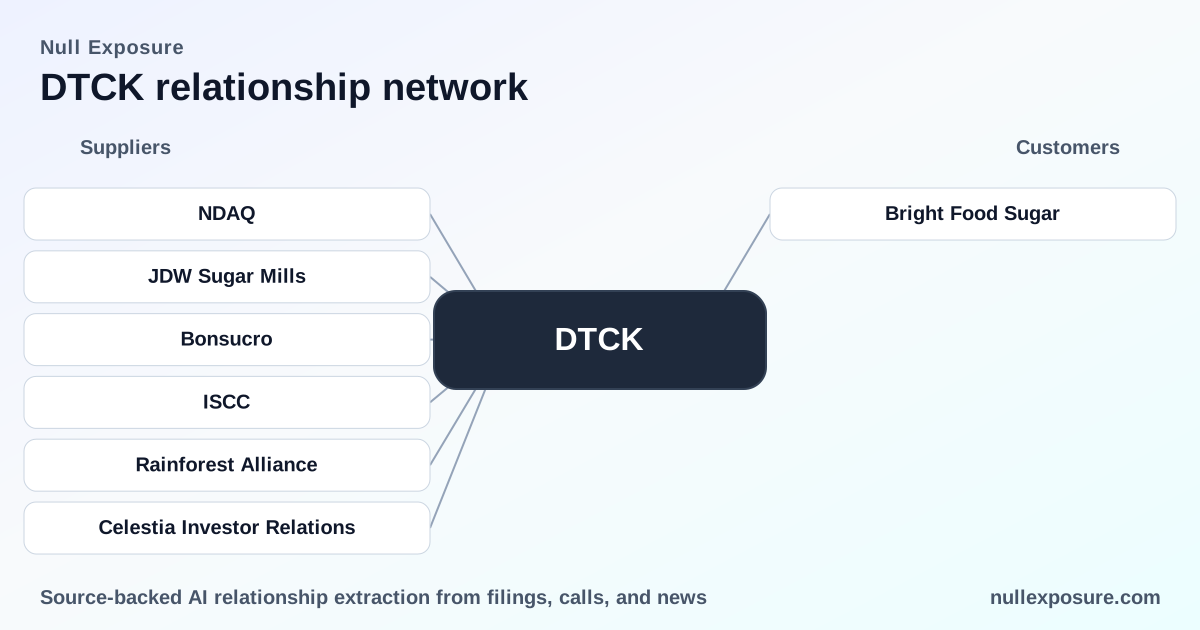
DTCK customer map: what issuers and corporate actions reveal about operational reach and risk
DTCK monetizes by acting as a central processing and depositary hub for issuers and market participants—servicing securities issuance, corporate actions and recordkeeping—and generating recurring fee income from depositary, transfer-agent interfaces and ancillary operational services. The customer evidence collected here shows DTCK embedded in routine equity maintenance (book‑entry depositary roles), corporate actions (reverse splits, fractional rounding), and meeting/ownership verification workflows; that positioning drives predictable fee streams but creates concentrated operational risk around corporate-action execution. For a deeper look at counterparty listings and event context, see NullExposure’s full customer coverage at https://nullexposure.com/.
What the public record lists as customer or counterparty touchpoints
Below I cover every relationship pulled from the public results and the explicit role each source describes.
-
Bright Food Sugar
Davis Commodities is exploring partnerships with established distributors such as Bright Food Sugar as it seeks expanded port access in Gujarat and Maharashtra to serve steady Chinese demand; the report frames Bright Food Sugar as a potential distribution collaborator in China. Source: ChiniMandi news item, March 9, 2026 — https://www.chinimandi.com/davis-commodities-to-partner-with-large-scale-indian-sugar-producers-working-to-expand-port-access-in-gujarat-and-maharashtra/. -
AREB (American Rebel Holdings, Inc.)
AREB warns investors of the risk that transfer agents, DTC or brokerages could delay or err when processing a reverse stock split or distributing rounding adjustments, placing DTC-level operational execution front and center in the corporate-action communication. Source: GlobeNewswire press release, March 19, 2026 — https://www.globenewswire.com/news-release/2026/03/19/3259135/0/en/AMERICAN-REBEL-HOLIDNGS-INC-NASDAQ-AREB-AREBW-ANNOUNCES-1-FOR-100-REVERSE-STOCK-SPLIT-OF-ITS-COMMON-STOCK-AND-PUBLICLY-TRADED-WARRANTS-WITH-ROUND-LOT-STOCKHOLDER-PROTECTION-TO-BE-E.html. -
ALMS (Alumis, Inc.)
In an S‑3/A registration statement, the company specifies that DTC will act as the depositary for securities issued in book‑entry form, signaling a standard issuer-depositary contract used for public offerings. Source: SEC filing republished on StockTitan, FY2026 (S‑3/A) — https://www.stocktitan.net/sec-filings/ALMS/s-3asr-alumis-inc-sec-filing-1698fdb0d74a.html. -
ALNT (Allient, Inc.)
The company’s prospectus language likewise states that DTC will serve as depositary for book‑entry securities, reflecting the same common issuance practice and operational dependency on the depositary network for electronic recordkeeping. Source: SEC filing republished on StockTitan, FY2026 (S‑3/A) — https://www.stocktitan.net/sec-filings/ALNT/s-3asr-allient-inc-sec-filing-2ca207923862.html. -
IFS (Intercorp Financial Services)
For its 2026 virtual shareholders’ meeting, Intercorp’s governance guidelines require verification of ownership through systems such as CAVALI or DTC and establish processes for registering attendance and appointing proxies—underscoring DTC’s role in shareholder verification and proxy workflows. Source: The Globe and Mail press release, May 2026 — https://www.theglobeandmail.com/investing/markets/stocks/IFS/pressreleases/203663/intercorp-financial-services-sets-record-date-and-virtual-framework-for-2026-shareholders-meeting/. -
OCG (Oriental Culture Holding)
When implementing a 1‑for‑3 reverse split, the company explicitly resolved to round fractional shares at the DTC participant level, signalling reliance on DTC participant mechanics to handle fractional rounding and associated adjustments. Source: The Globe and Mail press release, April/May 2026 — https://www.theglobeandmail.com/investing/markets/stocks/OCG/pressreleases/1450020/oriental-culture-holding-to-implement-1-for-3-reverse-split-to-regain-nasdaq-compliance/.
Collective signals about DTCK’s operating model and business characteristics
-
Contracting posture: The record reflects standard, issuer-facing depositary and transfer arrangements—form‑driven contractual relationships where issuers designate the depositary (DTC) in prospectuses and corporate-action notices. This produces recurring, enforceable service relationships rather than bespoke project work.
-
Concentration: Public evidence shows DTCK concentrated exposure to corporate‑action processing and depositary roles across a wide range of issuers (small-cap reverse splits, public registrations, and shareholder meeting verifications). That concentration is structural: core services are centralized and used repeatedly across issuers.
-
Criticality: The involvement in reverse splits, fractional rounding and shareholder verification places DTCK at the operational center of time‑sensitive corporate events. Disruption or errors in processing directly affect marketable share counts, investor entitlements and compliance outcomes — elevating operational risk to a financial-material level for counterparties.
-
Maturity of relationships: The source types (S‑3 prospectuses, shareholder meeting notices, and corporate-action press releases) indicate established, typical capital‑markets interactions rather than nascent pilots. Issuers naming DTC in statutory or governance documents signals mature, documented relationships.
-
Company-level constraint signal: The data payload contains no explicit constraints or contract excerpts that impose unusual limits on DTCK’s operations; the absence of captured constraints is itself a signal that public filings emphasize operational roles rather than conditional limitations.
Key investment takeaways
- Predictable, fee-backed revenue: DTCK’s role as depositary and processor for issuance and corporate actions produces steady, transaction-linked fees that scale with capital-raising and corporate-event activity.
- Operational risk is the primary credit/operational concern: Several sources explicitly flag the potential for errors or delays (reverse splits, rounding adjustments, proxy verification). Those event-level risks translate directly into reputational and settlement risk for DTCK.
- Broad issuer exposure, narrow functional concentration: The customer list spans different issuers, geographies and event types, but all converge on a narrow operational capability—depositary processing and event execution—creating economy-of-scale benefits and single-point vulnerability.
For portfolio managers and operations teams, monitor filings that reference DTC in prospectus or corporate-action language as near‑term indicators of fee flow and event risk exposure. Visit NullExposure for the live customer matrix and alerting on new issuer mentions: https://nullexposure.com/.
Practical monitoring checklist for analysts
- Track prospectus and S‑3/S‑1 filings mentioning DTC for forward visibility on issuance volume.
- Flag corporate-action press releases (reverse splits, consolidations) for mapped processing dates and potential rounding adjustments.
- Monitor shareholder-meeting notices that mandate verification through DTC/CAVALI for governance‑related operational workload.
- Prioritize operational-control disclosures and breach/processing-error announcements as early indicators of execution stress.
Conclusion: the public relationship record positions DTCK as a mission‑critical settlement and depositary operator whose revenue profile is stable and event-driven, while its primary risk vector is concentrated on flawless, time‑sensitive execution of corporate actions and shareholder services.