Precision BioSciences (DTIL): Partner-led revenue, license economics, and what customers tell investors
Precision BioSciences operates as a partner-first genome‑editing company that monetizes by licensing its proprietary ARCUS nuclease, executing collaboration agreements with biopharma partners, and collecting milestone payments, upfront fees, and royalties rather than relying on near‑term product sales. Its financial cadence is therefore lumpy and partnership‑dependent: large one‑time recognitions when collaborations conclude or milestones are achieved, with recurring upside tied to partner clinical progress and commercial launches. For investors evaluating DTIL customer relationships, the relevant lens is concentration of partner cashflows, the exclusivity of licenses granted, and the maturity / closure status of high‑value collaborations. For deeper coverage mapping and monitoring, see https://nullexposure.com/.
How the partnership playbook drives the P&L
Precision sells intellectual property and engineering work: custom ARCUS nucleases, licenses to cell‑therapy patent families, and transactional R&D collaborations. That contracting posture creates a seller‑and-licensee business model with distinct characteristics:
- Concentration risk: Periodic large revenue items correlate to a small number of partners (e.g., Novartis, TG Therapeutics, Imugene), so revenue volatility is high.
- Criticality for partners: Precision’s IP can be exclusive and territory‑or indication‑specific, which makes the company a critical supplier to licensees while transferring downstream development risk to them.
- Maturity profile: Relationships span from concluded collaborations generating final recognitions to active license agreements that will deliver future milestone and royalty streams.
Company disclosures also flag the importance of third‑party payors and reimbursement dynamics for eventual commercial products, positioning Precision as a seller in a broader ecosystem that includes government and private payors as indirect counterparties via its partners’ future commercialization plans.
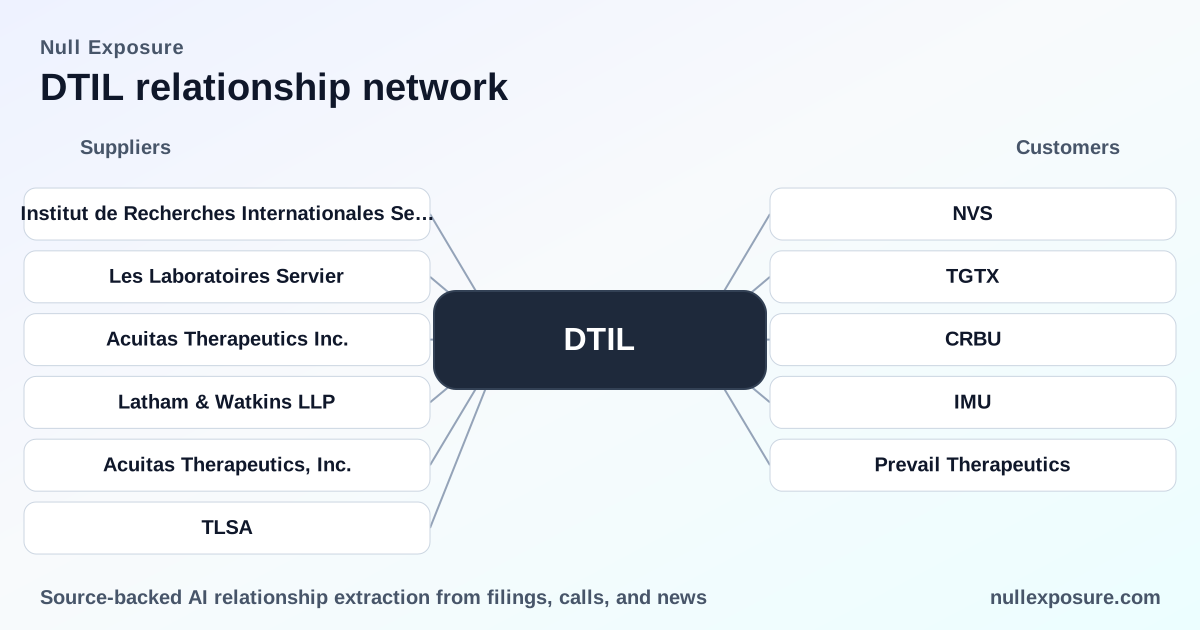
Relationship map — every partner cited in public reporting
Below are the customer and partner relationships referenced in the reporting set, with concise, investor‑oriented summaries and source notes.
-
Novartis (NVS): Precision developed a custom ARCUS nuclease for Novartis to insert therapeutic transgenes for hemoglobinopathies; Novartis paid material upfront consideration and Precision recognized significant revenue when that collaboration concluded in October 2025. According to company filings and press reports, recognition of roughly $26.2 million under the Novartis agreement was recorded in the quarter ended December 31, 2025. (See BioSpace and PharmiWeb press materials covering Precision’s FY2025/FY2026 results.)
-
TG Therapeutics (TGTX): Precision granted TG an exclusive license for azer‑cel in autoimmune and non‑oncology indications, with potential milestones up to roughly $288.6 million; in March 2026 TG triggered a clinical milestone that generated $7.5 million in proceeds to Precision (a mix of cash and stock purchase). Public filings and multiple press outlets report the milestone payment and the stock purchase component at $11.17 per share. (See TradingView coverage of Precision’s SEC filings and contemporaneous press reports summarized by Pulse2, Finviz, and StockTitan, FY2024–FY2026.)
-
Imugene Limited (IMU / IUGND): Imugene acquired Precision’s CAR‑T infrastructure and a license to a lead allogeneic CAR‑T candidate in 2023, and subsequently made a milestone payment of $8.0 million in October 2025 (including cash and ordinary shares). Precision’s FY2025 results and press releases document the sale/licensing transaction and the October 2025 milestone recognition. (See TradingView SEC summary and BioSpace press release, FY2024–FY2026.)
-
Caribou Biosciences (CRBU): In February 2024 Precision granted Caribou a non‑exclusive worldwide license to one of Precision’s foundational cell therapy patent families for CRISPR‑based therapies, demonstrating Precision’s willingness to cross‑license foundational IP in non‑exclusive arrangements. This was disclosed in Precision’s SEC reporting. (See TradingView coverage of Precision’s 10‑Q/SEC filings, FY2024.)
-
Prevail Therapeutics: Precision’s revenue profile included prior recognition related to an agreement with Prevail that concluded and contributed to year‑over‑year revenue dynamics; Precision’s FY2025 reporting attributes a decline in annual revenue largely to the conclusion of the Prevail agreement and related items. The company’s FY2025 press commentary and trading coverage note the close of that collaboration as a driver of comparatives. (See BioSpace and TradingView summaries of FY2025/FY2026 filings.)
Each relationship above is reported in Precision’s filings and press coverage; the recurring theme is license terms, milestone economics, and the timing of revenue recognition determined by contract events and collaboration conclusions.
What the relationship set tells investors about operational constraints
Precision’s public disclosures and reporting on these partners generate company‑level signals about operating constraints:
-
Contracting posture: Precision acts primarily as a seller/licensor of IP and development services—agreements are milestone‑ and license‑driven rather than volume sales. Company disclosures explicitly frame future revenue dependence on partner milestones and payor coverage for eventual products.
-
Counterparty mix: While partners are commercial biotechs and big pharma, company filings also highlight the role of third‑party payors—including federal and state programs—in eventual commercial viability, indicating indirect government exposure at a later commercialization stage.
-
Concentration and timing risk: The FY2025–FY2026 revenue narrative shows large, lumpy revenue swings tied to single partner events (e.g., Novartis collaboration conclusion, TG and Imugene milestones), which is a structural earnings risk for investors.
-
Maturity of relationships: The portfolio contains both concluded collaborations (Novartis, Prevail recognition events) and active license agreements with ongoing milestone potential (TG, Imugene, Caribou), creating a mixed maturity profile for future cash visibility.
Investment implications and risk framing
-
Upside drivers: Milestone achievements and commercialization by licensees can quickly translate into revenue and royalty streams; the TG and Imugene milestones show tangible near‑term cashflow from partner progress. Large pharma partnerships (e.g., Novartis) validate ARCUS utility and can re‑rate perceived technology value.
-
Key risks: Revenue concentration and timing volatility are principal risks—Precision’s P&L moves on contract events rather than steady product sales. Dependence on partner clinical success and future third‑party payor coverage creates multi‑stage execution risk.
-
Operational posture to monitor: Future SEC filings and press releases remain the primary lead indicators—watch for new exclusivity grants, license scope (territory/indication), and milestone schedules. For active monitoring and relationship mapping of DTIL, see the Precision coverage hub at https://nullexposure.com/.
Bottom line
Precision’s customer relationships are the company’s product: contracts, exclusivity terms, and milestone triggers determine near‑term earnings and long‑term upside. Novartis, TG Therapeutics, Imugene, Caribou, and Prevail together illustrate a partnership ecosystem that produces both validation and volatility. For investors and operators, the critical questions are whether the company can convert license economics into recurring royalty streams and whether partner concentration can be diversified through new, staged collaborations. For ongoing coverage and relationship analytics, visit https://nullexposure.com/.