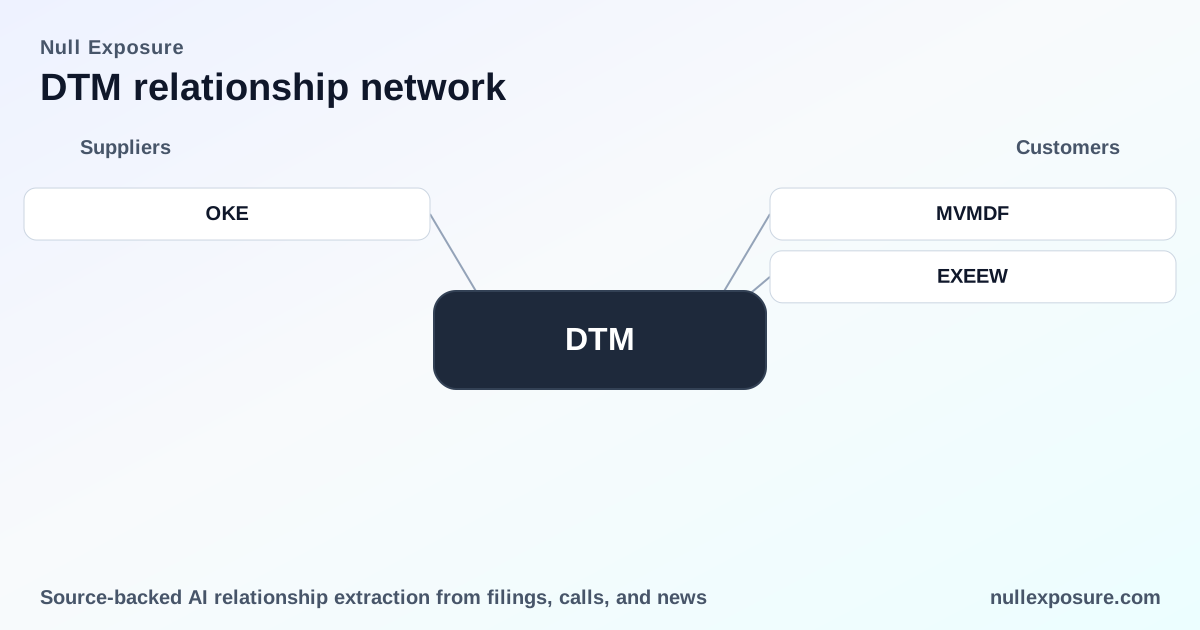
DT Midstream (DTM) — Customer Relationships and Concentration Risks
DT Midstream monetizes a backbone of long‑term, fee‑based natural gas transportation and gathering contracts, collecting fixed demand charges and minimum volume commitments (MVCs) from producers, power generators, utilities and marketers; the business is effectively an infrastructure toll road with high contractual cashflow visibility but meaningful counterparty concentration. For investors evaluating DT Midstream, the key trade-off is between predictable cash flow from long‑dated firm contracts and revenue sensitivity to a handful of large customers—monitor contract tenure, counterparty credit, and regional production trends. For a concise platform-level view of customer exposures and document sourcing, visit https://nullexposure.com/.
How DT Midstream’s operating model drives customer economics
DT Midstream runs two integrated segments — Pipeline and Gathering — that together convert physical throughput into predictable fee revenue. The company’s FY2024 disclosures show that a very large share of Pipeline revenue (about 92%) and most joint‑venture revenues are under firm service contracts, which are typically long‑term and structured around fixed demand charges or MVCs with fixed deficiency fees. That contracting posture creates high cashflow visibility and reduces volume volatility, but it also concentrates credit exposure: when a small number of counterparties account for a big share of revenue, covenant and credit events by those counterparties quickly translate to financial stress for the operator.
Geographically, DT Midstream’s assets link premium Appalachian supply (Marcellus/Utica) to Midwestern and Northeastern demand centers and connect Gulf Coast production and LNG terminals to markets — a North American footprint that amplifies both opportunity and regulatory/commodity risk tied to U.S. gas basins and export dynamics. The company’s public filings describe the business as mature and service‑oriented, with established, contract‑backed cash flows derived from integrated midstream infrastructure.
Key takeaways: DT Midstream is a service provider selling firm capacity under long‑dated contracts; this structure creates durable revenue but concentrates counterparty credit risk and regional exposure.
Customer mentions in the public record
Below I cover every customer relationship mentioned in the supplied results. Each listing is a plain‑English, 1–2 sentence summary followed by the source attribution.
Mountain Valley
DT Midstream referenced deliveries tied to the Stonewall Mountain Valley pipeline expansion, indicating the company put incremental capacity into service and that deliveries are being made to Mountain Valley for multiple customers. According to the Q4 2025 earnings call transcript reported by InsiderMonkey, the Stonewall expansion was placed into service early and on budget in February (InsiderMonkey, Q4 2025 earnings call transcript, reported March 2026).
MVMDF
The same public comment is recorded under the inferred symbol MVMDF, reflecting a duplicate reference to the Mountain Valley pipeline expansion and service commencement; the disclosure likewise notes that deliveries are being made to Mountain Valley following the early, on‑budget in‑service date. This observation is drawn from the same InsiderMonkey coverage of DT Midstream’s Q4 2025 call (InsiderMonkey, Q4 2025 earnings call transcript, reported March 2026).
Expand Energy (EXEEW)
DT Midstream’s FY2024 10‑K identifies Expand Energy as a large, named customer that accounted for approximately 56% of operating revenues in 2024, with both the Pipeline and Gathering segments providing services to that customer. The company’s Form 10‑K for the year ended December 31, 2024 documents that Expand Energy represented 10% or more of total revenue and quantifies the materiality of that relationship (DT Midstream 10‑K, FY2024).
What the constraints tell investors about risk and resilience
DT Midstream’s constraint signals collectively describe a classic midstream profile — long‑tenor contracts, service‑provider positioning, mature relationships and regional concentration — and they yield clear implications:
-
Contracting posture: The company states that approximately 92% of Pipeline revenue and 99% of unconsolidated JV revenue in 2024 derived from firm service contracts, and that many of these contracts use fixed demand charges or MVCs with fixed deficiency fees. That structure makes revenue predictable and less spot‑sensitive, but it does not eliminate counterparty credit risk. (Source: DT Midstream FY2024 10‑K.)
-
Geography and exposure: DT Midstream’s assets connect Midwestern and Northeastern demand centers and Gulf Coast export infrastructure to Appalachian and Haynesville supply basins, indicating North American regional concentration and sensitivity to basin‑level production and LNG exports. (Company 10‑K, FY2024.)
-
Materiality and concentration: The 10‑K explicitly names Expand Energy as accounting for roughly 56% of operating revenues in 2024, a level that creates a single‑counterparty concentration risk despite the prevalence of long‑term contracts. Where the filings reference an unnamed key customer in Haynesville and Marcellus, treat that as an additional company‑level signal of customer dependency that requires active monitoring. (DT Midstream 10‑K, FY2024.)
-
Relationship role and maturity: DT Midstream positions itself as a service provider with an “established history of stable, long‑term growth” and contractual cash flows from natural gas producers, utilities, power generators, industrials and national marketers — characterizing the customer book as mature and contractually anchored. (DT Midstream 10‑K, FY2024.)
-
Segment mix: The business mixes services (pipeline and gathering fee revenue) with infrastructure ownership, aligning operational incentives toward uptime, throughput reliability and long‑term capacity commitments rather than commodity exposure.
Investor implication: Long‑term contracts materially improve free cash flow visibility, supporting distributions and deleveraging plans, but single‑customer concentration (Expand Energy) is an asymmetric risk that can erode returns quickly if volumes decline or contract terms change.
For deeper diligence on contract language and counterparty disclosures, see our sourcing hub at https://nullexposure.com/.
How to monitor the exposure and what matters next
Investors and operators should prioritize a short watchlist to convert disclosure into actionable monitoring:
-
Contract expiries and MVC provisions: Track the timeline for major contracts tied to Expand Energy and any other top counterparties, including ramp schedules and deficiency fee mechanisms.
-
Counterparty credit health: Follow Expand Energy’s operational and balance‑sheet developments; even with MVCs, a counterparty default affects realized cash flows and asset utilization.
-
Pipeline in‑service events and throughput trends: The Stonewall/Mountain Valley expansion is a material capacity addition; watch actual receipt/delivery volumes versus modeled take‑rates to understand utilization and incremental revenue realization.
-
Geographic production/exports: Production trends in Marcellus/Utica and Haynesville, plus LNG export demand at Gulf Coast terminals, will drive long‑term throughput and underpin contract renewals or new firm commitments.
Bottom line — actionable investor framing
DT Midstream is a contract‑centric midstream operator that converts upstream and demand‑side needs into stable fee revenue; the business model is resilient due to long‑dated firm contracts but exposed to outsized concentration from a named customer (Expand Energy). For investors, the return profile is attractive when contract coverage and counterparty credit are intact; the principal monitoring tasks are contract rollovers, large‑customer credit trajectories, and realized throughput following new capacity additions like the Stonewall expansion.
For a consolidated view of DT Midstream’s customer links and documentary evidence, visit https://nullexposure.com/ — the source hub aggregates the filings and call transcripts referenced above.