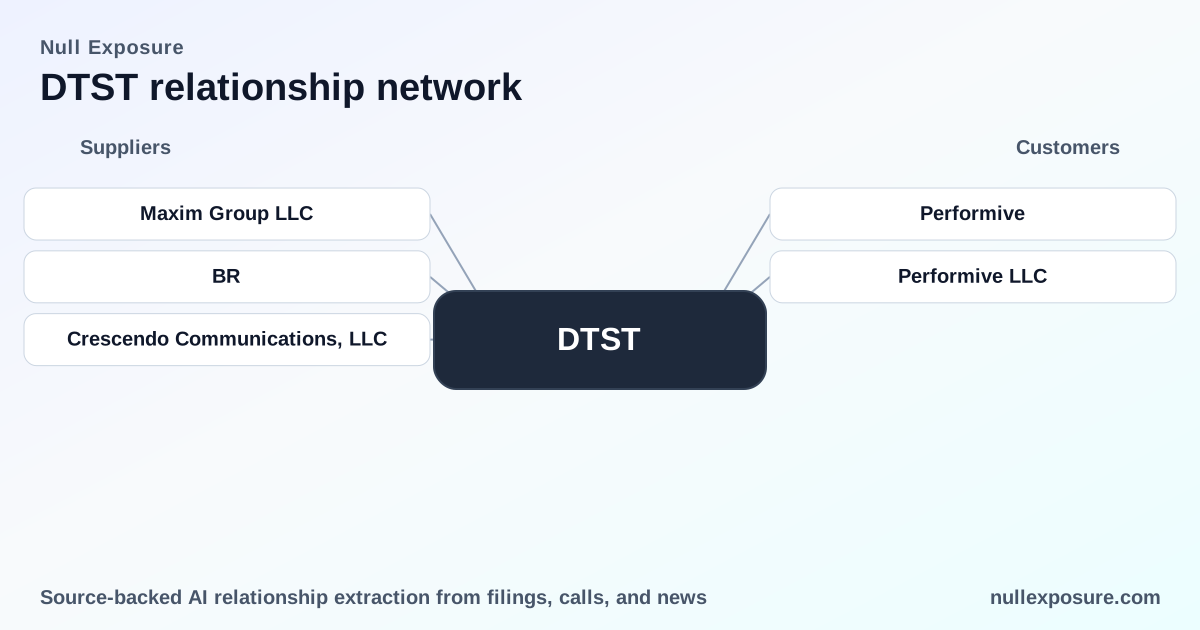
Data Storage Corporation (DTST): Cloud asset sale sharpens focus on recurring infrastructure revenue
Data Storage Corporation (NASDAQ: DTST) operates multi‑cloud IT and managed infrastructure services, monetizing primarily through long‑term subscription contracts for cloud hosting, disaster recovery and managed services. The company has crystallized that strategy by selling its CloudFirst business to Performive, converting an operational asset into roughly $40 million of gross proceeds while keeping the core recurring revenue model intact. Investors evaluating DTST customer relationships should treat the transaction as both a capital event and a strategic refocus on subscription infrastructure and services. Learn more at NullExposure.
The headline: CloudFirst sold to Performive — what changed immediately
DTST announced and closed the sale of its CloudFirst subsidiary to Performive, a cloud infrastructure provider backed by Renovus Capital Partners, in a two‑step disclosure sequence during 2025–2026. The transaction generated approximately $40 million in gross proceeds, and DTST followed the sale with corporate actions including warrant repurchases disclosed in SEC filings. According to the company press release in September 2025 and follow‑on reporting, the divestiture is positioned as a way to accelerate CloudFirst’s growth under new ownership while DTST pursues other strategic opportunities (GlobeNewswire, Sept 12, 2025; Investing.com SEC filing coverage, May 2, 2026).
How DTST runs commercial relationships: operating model signals you need to know
DTST’s customer footprint and contract posture drive its financial predictability and concentration risk:
- Revenue model: DTST sells predominantly subscription‑based, long‑duration contracts (12–36 months) for cloud, disaster recovery, cybersecurity and managed services, producing a highly recurring revenue base (>80% recurring in 2024).
- Contracting posture: Contracts are long‑term and auto‑renewing, supporting strong renewal economics (historical renewal rates cited above 90%).
- Customer mix and concentration: The customer base exceeds 425 organizations across government, healthcare, education, manufacturing and Fortune 500 enterprises; however, revenue concentration is meaningful — two customers accounted for 12% of revenue each in 2024, a materiality risk that can affect near‑term results.
- Geography: Sales are primarily U.S.‑centric, with limited international exposure; CloudFirst assets supported an EMEA footprint via UK data center operations, providing a seller‑side international presence.
- Service mix: DTST is an infrastructure and services provider — its profile blends IaaS (multi‑tenant compute and storage hosted in Tier 3 centers) with managed services, support and renewals. Reported customer spend bands align with mid‑market to enterprise engagements (commonly in the $1M–$10M range for significant customers).
These constraints are company‑level signals drawn from DTST disclosures and should be interpreted as structural features of the business rather than nuances tied to any single counterparty.
All reported relationship mentions with Performive (every source in the record)
Below are each of the reported relationship mentions in our coverage set; every entry references the same counterparty event (the CloudFirst sale) but comes from distinct press or filing sources.
- Data Storage announced completion of the CloudFirst sale to Performive in a StockTitan news piece summarizing the transaction; the item reported the close and framed Performive as the buyer (StockTitan, first seen Mar 9, 2026).
- A GlobeNewswire release dated Sept 12, 2025, formally announced DTST’s completion of the CloudFirst sale, describing CloudFirst as substantially all assets of a wholly‑owned subsidiary now transferred to Performive (GlobeNewswire, Sept 12, 2025).
- Investing.com covered DTST’s follow‑on SEC filing actions tied to the sale, reporting that DTST completed the CloudFirst sale to Performive for about $40 million in gross proceeds and disclosed subsequent warrant repurchases (Investing.com — May 2, 2026 SEC filings summary).
- GlobeNewswire’s July 15, 2025, release announced the definitive agreement entered July 11, 2025, under which CloudFirst would join Performive to accelerate growth, and described Renovus Capital Partners as Performive’s backer (GlobeNewswire, July 15, 2025).
- StockTitan carried a second notice of the definitive agreement, reiterating that CloudFirst Technologies Corporation was to be sold to Performive as part of a strategic growth transaction (StockTitan, Mar 9, 2026).
- MarketScreener reported that Performive LLC completed the acquisition of CloudFirst from DTST, noting the close in the context of DTST’s corporate disclosures (MarketScreener, Mar 9, 2026).
- A separate MarketScreener earnings‑release summary for DTST’s full‑year results referenced Performive LLC’s completion of the CloudFirst acquisition as a post‑period corporate event (MarketScreener, May 2, 2026 earnings notice).
- The UK edition of Investing.com duplicated coverage of DTST’s SEC‑filing disclosures tied to the sale and related corporate actions, again noting roughly $40 million in gross sale proceeds (Investing.com UK, May 2, 2026).
- Marketscreener’s earlier buyback/repurchase summary tied to DTST’s equity buyback closing referenced Performive LLC as the acquirer of CloudFirst, reinforcing the completion of the transaction (MarketScreener, Dec 8, 2025 announcement follow‑up).
Each mention consistently portrays Performive as the acquirer and DTST as the seller of CloudFirst; investors should treat these multiple sources as corroborating the transaction timeline and gross proceeds disclosures.
Explore DTST relationship intelligence.
Investment implications: what the sale and relationship profile mean for valuation and risk
The CloudFirst sale simplifies the operating model and converts an asset into cash that can be used for debt reduction, strategic investments, or shareholder returns. Key investment takeaways:
- Stronger free‑cash potential, but revenue base still subscription‑centric. The sale brings near‑term liquidity; however, DTST’s valuation will continue to depend on the stability of its recurring subscription contracts and renewal economics.
- Concentration risk remains material. With a history of a few customers representing high single‑digit to low‑teens percentage shares of revenue, the loss of a primary customer would materially affect results unless replaced.
- Geographic focus limits diversification. The business is predominantly U.S.‑facing; the EMEA footprint tied to CloudFirst was transferred to Performive, concentrating organic revenue risk domestically.
- Contractual defensibility is strong. Long‑term, auto‑renewing subscription contracts and high renewal rates create defensible cash flows relative to pure project businesses.
- Mid‑market and enterprise spend profile aligns with stable multi‑year contracts. The $1M–$10M spend band and the nature of infrastructure services produce predictable revenue cadence if churn remains low.
Bottom line
DTST is repositioning around its core subscription infrastructure and services economics while monetizing non‑core assets via the CloudFirst sale to Performive. Investors should value DTST as a subscription‑oriented infrastructure operator with meaningful customer concentration and limited international diversification post‑transaction. Ongoing attention should focus on renewal rates, replacement of material customer balances, and how management deploys sale proceeds.
For further relationship and exposure analytics on DTST and comparable names, visit NullExposure and review the full coverage.