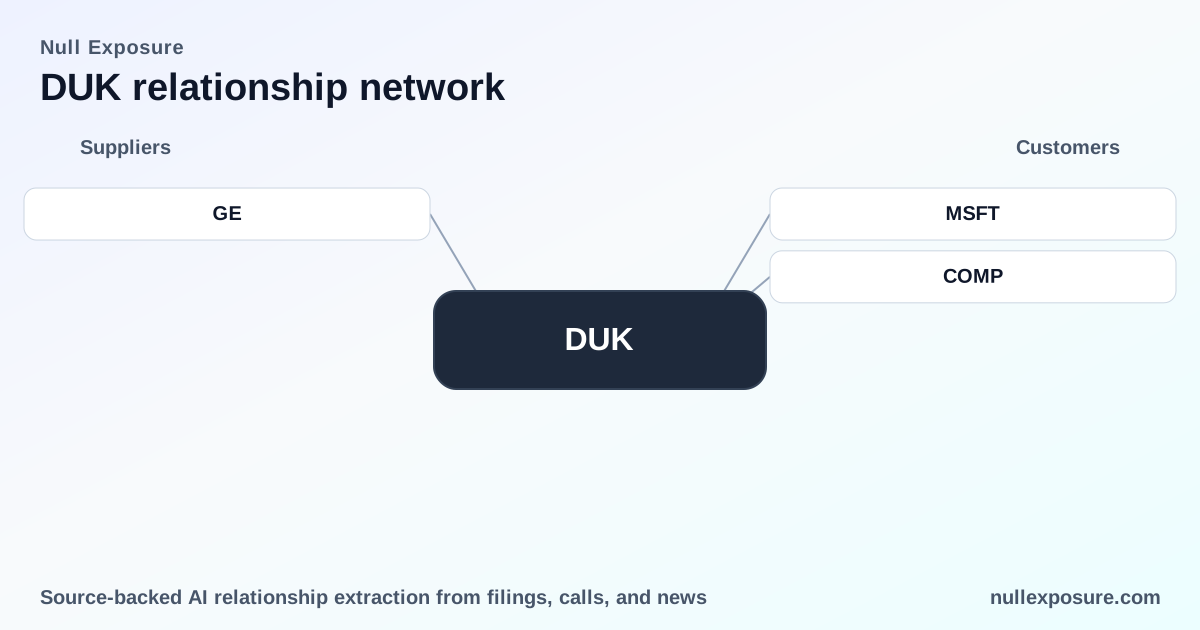
Duke Energy (DUK) — Customer Relationships and Strategic Constraints
Duke Energy operates as a regulated electric and natural gas holding company that monetizes through tariffed retail and wholesale energy sales, regulated returns on infrastructure investment, and bespoke commercial contracts such as electric service agreements (ESAs) with large energy users. The business model combines predictable, rate-regulated cash flows from millions of retail customers with targeted, long-term commercial deals that accelerate capital deployment and incremental earnings. For an investor seeking a concise view of customer counterparty exposure and the practical constraints shaping monetization, this note synthesizes public mentions and company disclosures. Learn more at https://nullexposure.com/.
How Duke’s customers drive the economics: steady rates plus selective big-ticket deals
Duke’s consolidated revenues are realized primarily through two reportable segments: Electric Utilities & Infrastructure (EU&I) and Gas Utilities & Infrastructure (GU&I), both of which operate under regulatory frameworks that deliver stable cash flow profiles. The company sells electricity and natural gas across the Southeast and Midwest U.S., recovering invested capital through regulated rates for most retail and wholesale customers. At the same time, Duke secures incremental load—and the associated long-term revenue streams—through multi-year ESAs with data center operators and large commercial customers. These ESAs convert project-level demand into bankable, long-duration cash flows that justify accelerated capital spending on transmission and distribution buildouts.
Operating constraints that matter for relationship risk and upside
Several firm-level signals define how Duke contracts and manages customer exposure:
- Contracting posture: Duke runs a dual contracting model — long-term, cost-based wholesale contracts and ESAs for large commercial loads, alongside predominantly at‑will tariff revenues for retail customers. This mix preserves base cash flow stability while enabling growth via bespoke long-duration agreements.
- Concentration and materiality: The company discloses that no single subsidiary customer represents more than 10% of revenues, indicating low single-counterparty concentration even as targeted commercial agreements grow.
- Criticality and maturity: Cash flows from regulated operations are a substantial portion of operating cash flow and are legally backed by rate mechanisms; the business is mature and infrastructure-centered, which constrains margin volatility but requires continual capital reinvestment.
- Geographic focus: Operations and primary counterparties are concentrated in North America (U.S. Southeast and Midwest), producing regulatory and regional market risk characteristics tied to state utility commissions.
- Relationship roles: Duke principally functions as a seller of electricity and gas, but also acts as a service provider (e.g., captive insurance, customer-specific invested capital recoverable through non-tariff services) and as an active buyer in limited contexts. These structural roles affect contractual complexity and regulatory recovery mechanics.
Customer relationships you should track (what public sources show)
Below are every counterparty mentioned in the collected results, summarized in plain English with concise sourcing.
WhiteFiber / WYFI
WhiteFiber’s NC-1 AI data center campus is supported by a 99 MW capacity agreement with Duke Energy, and WhiteFiber’s management states the site may support up to 200 MW of total electrical supply over time, subject to infrastructure upgrades and conditions. This is a clear example of Duke enabling data center load through capacity commitments. Source: PR Newswire and Coindesk coverage of WhiteFiber’s colocation agreement (Dec 2025 / Mar 2026).
Microsoft / MSFT
Duke disclosed in its Q4 2025 earnings call that it has signed an additional 1.5 gigawatts of electric service agreements with data center customers, including Microsoft, bringing Duke’s secured data center load to approximately 4.5 GW under ESAs. This underscores Microsoft as an anchor commercial counterparty driving substantial incremental utility capital deployment. Source: Duke Energy Q4 2025 earnings call (Mar 8, 2026).
Compass
Compass was named alongside Microsoft in Duke’s Q4 2025 earnings call as one of the data center customers included in a recent 1.5 GW package of ESAs, reflecting participation by multiple hyperscale and enterprise cloud players in Duke’s commercial pipeline. Source: Duke Energy Q4 2025 earnings call (Mar 8, 2026).
Spire Inc. / SR
Duke completed the sale of its Tennessee Piedmont Natural Gas business to Spire Inc. for $2.48 billion effective March 31, 2026, transferring a regional gas distribution footprint and monetizing non-core gas assets. The divestiture reduces Duke’s GU&I footprint in Tennessee and converts regulated asset exposure into cash proceeds. Source: Spire press release and multiple news reports (Mar 31–May 2026).
Chewy / CHWY
Duke Energy provided project funding support through its Carolinas Investment Fund for Chewy’s North Carolina fulfillment center, indicating Duke’s role in local economic development financing that links customer site investment with incremental utility demand. Source: Business Journals reporting on Chewy’s NC facility (referenced FY2019 project coverage).
Pavemetrics / PAVM
Pavemetrics’ Q3 2025 commentary references a research partnership with Dr. Adam Wax at Duke, which is an academic/technology collaboration tied to Duke University rather than a classic utility-offtake relationship; the mention highlights Duke-branded research collaborations that intersect corporate customers and local innovation ecosystems. Source: Pavemetrics Q3 2025 earnings call transcript (Mar 2026 note).
What this means for investors: growth levers and downside checks
- Growth levers: The combination of large ESAs (multi-gigawatt data center load) and regulated rate recovery supports predictable earnings accretion as Duke deploys capital into T&D upgrades and new generation. ESAs translate into contracted load that utilities can underwrite with long-term investments.
- Stability and constraints: The core retail and wholesale tariff base provides durable cash flows, limiting revenue volatility; however, regulated accounting and state commission oversight constrain margin expansion and timing of cost recovery.
- Asset mix shifts: The sale of Piedmont Natural Gas to Spire is a meaningful portfolio action that reduces regulated gas exposure in Tennessee and increases liquidity for redeployment into electric infrastructure and commercial growth areas.
- Risk profile: Low customer concentration at the subsidiary level and the geographically concentrated U.S. footprint mean regulatory and regional demand shocks are the primary risks rather than counterparty credit risk from a single tenant.
Bottom line and next steps
Duke Energy’s customer relationships are anchored in regulated, infrastructure-driven revenue while selectively leveraging long-term commercial ESAs to capture outsized growth from data center and large enterprise load. Investors should weigh the upside from contracted data-center demand and the stabilizing effect of regulated returns against the capital intensity and regulatory timing inherent to the business. For a deeper view of counterparty exposures and relationship signals, visit https://nullexposure.com/ for additional analysis and tracking tools.
Bold takeaway: Duke’s model blends low-volatility regulated earnings with selective, long-term commercial contracts that materially increase electric load and justify incremental infrastructure investment.