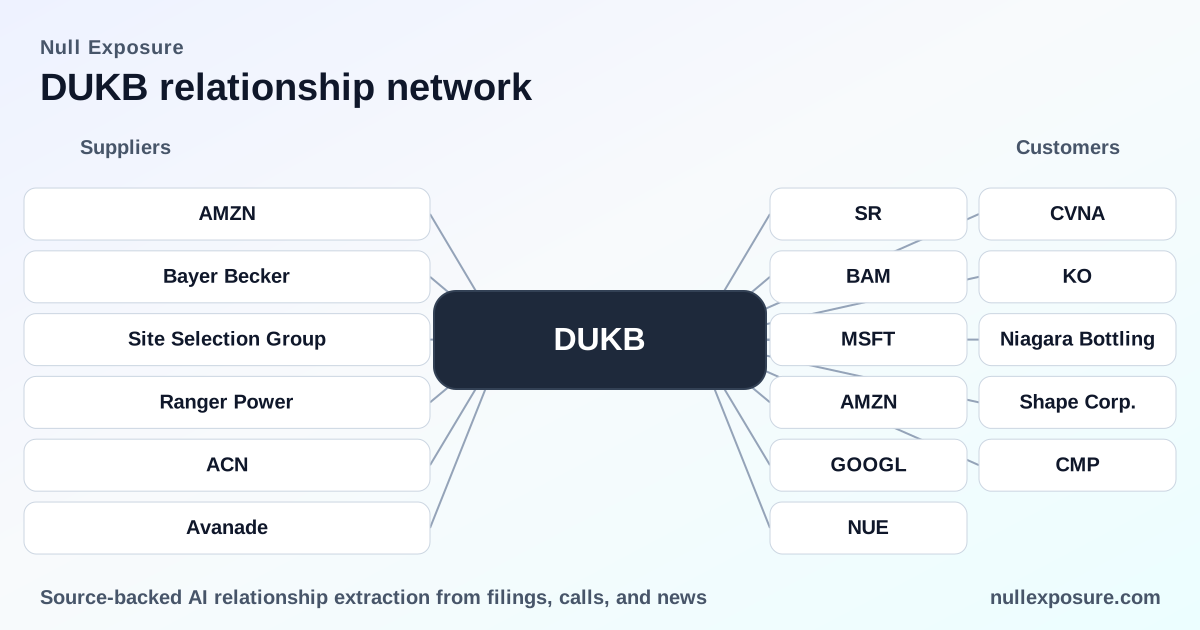
Duke Energy (DUKB) — Customer relationships that reshape revenue mix and balance-sheet strategy
Duke Energy operates as a regulated electric and gas utility across the U.S. Southeast and Midwest and monetizes through a hybrid model of tariffed retail delivery, wholesale contracts and targeted long-term supply arrangements with large corporate customers. The company preserves steady cash flow from regulated rate bases while selectively locking in multi‑gigawatt electric service agreements (ESAs) with hyperscalers and industrials, and is actively reshaping its balance sheet through asset sales and minority investments to fund the transition to carbon‑free generation.
For a concise corporate-customer view and ongoing monitoring of Duke’s counterparty exposures, see NullExposure’s overview: https://nullexposure.com/
Why these relationships matter to investors
Duke’s business blends stable regulated cash flows with project-level risk and opportunity. Large corporate off-takers such as Microsoft, Amazon and Google convert capital-intensive generation into visible, long-duration cashflow, supporting renewables investment and improving project economics. Conversely, the regulated tariff base and spot-market sales maintain liquidity and offset concentration risk: no single customer accounts for more than 10% of revenue. The net effect is a utility that is de‑risking capital programs through corporate partnerships while retaining the defensive characteristics investors prize.
The customer map — each relationship and what it signals
Below are every relationship noted in the collected results, each with a concise take and source.
-
Microsoft (MSFT / Microsoft) — Duke reported signing an additional 1.5 gigawatts of electric service agreements that include Microsoft, bringing total data center load secured under ESAs to roughly 4.5 GW. This underlines Duke’s success in winning long‑term, high‑visibility off‑takers for clean energy capacity (2025 Q4 earnings call, transcript published March 8, 2026).
-
Compass (CMP / Compass) — Compass was cited alongside Microsoft as a data‑center ESA counterparty in the company’s 2025 Q4 earnings call that raised Duke’s secured data center load to approximately 4.5 GW, signaling multiple large-scale hyperscaler relationships rather than a single-customer dependency (2025 Q4 earnings call, March 8, 2026).
-
Spire Inc. (SR / Spire) — Duke agreed to sell its Tennessee Piedmont Natural Gas unit to Spire for $2.5 billion, a transaction Duke has positioned as strengthening its credit profile and meeting 2026 equity needs. The sale monetizes noncore gas assets and reduces execution and regulatory complexity for Duke (Bloomberg, July 29, 2025; referenced in Duke’s 2025 Q4 earnings call, March 8, 2026).
-
Brookfield (BAM / Brookfield Asset Management) — Brookfield committed a minority interest investment in Duke Energy Florida, noted by management as a credit-strengthening measure that supports Duke’s 2026 equity plan. That external capital infusion accelerates balance-sheet optionality while preserving Duke’s operating control (2025 Q4 earnings call, March 8, 2026).
-
Google (GOOGL / Google) — Duke has structured frameworks that enable large customers like Google to directly support investments in new carbon‑free generation, reflecting an institutionalized path for corporate capital to underwrite renewables and grid upgrades (Klover analysis, FY2025).
-
Amazon (AMZN / Amazon) — Amazon is named among large customers that can support new carbon‑free generation under Duke’s corporate investment framework, indicating hyperscaler demand is an explicit part of Duke’s strategic planning for clean energy deployment (Klover analysis, FY2025).
-
Nucor (NUE / Nucor) — Duke has signed landmark agreements that include industrial heavyweight Nucor alongside hyperscalers to accelerate clean energy deployment in the Carolinas, showing Duke’s market approach extends to energy‑intensive industrials as well as data centers (Klover analysis, FY2025).
-
Carvana (CVNA / Carvana) — Carvana was listed as an example customer in Duke’s 2025 site‑readiness program announcements, illustrating demand from fast‑growing industrials and advanced manufacturing for utility site preparation and power supply services (NKYTribune, September 2025).
-
Coca‑Cola (KO / Coca‑Cola) — Coca‑Cola is cited similarly as a beneficiary of Duke’s site‑readiness initiative, reflecting the company’s focus on enabling industrial customers that require reliable, scalable service for expansion projects (NKYTribune, September 2025).
-
Niagara Bottling (no ticker) — Niagara Bottling appears among companies identified in Duke’s site‑readiness program, supporting the thesis that Duke competes to attract and service packaged‑goods manufacturers and other large electricity consumers (NKYTribune, September 2025).
-
Shape Corp. (no ticker listed in results) — Shape Corp. is named as an example participant in Duke’s industrial site program, further demonstrating the utility’s outreach to manufacturing customers as part of economic development and load growth strategies (NKYTribune, September 2025).
Each of the links above reflects public disclosures or press coverage; together they describe a deliberate customer mix: regulated mass‑market customers, industrial and commercial offtakers, and targeted long‑term corporate contracts that underwrite new capacity.
For more detail and ongoing tracking of Duke’s counterparty relationships visit our portal: https://nullexposure.com/
Contracting posture, concentration and other business model signals
The collected evidence yields a coherent operating profile for Duke Energy:
-
Contracting posture: Duke runs a hybrid contracting strategy — a large proportion of retail revenue is collected under at‑will tariffed arrangements with expected duration of one year or less, but the company also executes long‑term, cost‑based wholesale contracts and multi‑year ESAs with large corporates. Duke sells excess generation into the spot market as part of portfolio optimization.
-
Counterparty mix and concentration: The customer base ranges from individual residential accounts to large industrial and hyperscaler counterparties, but no single customer represented more than 10% of revenue in 2024, limiting concentration risk while enabling selective, material project partnerships.
-
Geography and criticality: Operations and customers are concentrated in the U.S. Southeast and Midwest; Duke’s distribution and transmission assets are critical infrastructure, meaning reliability and security are high‑priority operational risks and value drivers.
-
Relationship role and maturity: Duke functions principally as a seller of electricity and gas and operates mature Electric Utilities and Infrastructure and Gas Utilities and Infrastructure segments; the business is capital‑intensive with multi‑decade asset lives.
-
Materiality and strategic intent: Asset dispositions and minority investments (e.g., Piedmont sale and Brookfield minority stake) are being used to delever and fund the clean energy transition, illustrating disciplined capital recycling.
Investment implications — what investors should watch next
- Opportunity: Institutionalized ESAs with hyperscalers and industrials increase project bankability and support Duke’s renewable buildout economics, translating into clearer cashflow visibility for discrete projects.
- Risk: The company remains exposed to regulatory outcomes in its primary states and to execution risk on large renewables and grid modernization programs; asset sales reduce near‑term leverage but require careful redeployment.
- Catalysts: Watch ESA announcements, progress on the Piedmont sale, and the timing/structure of minority investments for signals on balance‑sheet strength and capital allocation discipline.
For a single‑page view of Duke’s counterparty exposures and the documents underpinning these relationships, visit NullExposure’s company page: https://nullexposure.com/
Bold takeaway: Duke combines a defensive regulated revenue base with an increasingly explicit commercial strategy to monetize corporate demand for clean electricity — a blend that reduces single‑customer revenue risk while creating project-level upside tied to the energy transition.