DoubleVerify (DV): Platform economics backed by large ad platforms and global advertisers
DoubleVerify sells digital media measurement and assurance to advertisers and major ad platforms, monetizing primarily through usage-based measured-transaction fees supplemented by subscription contracts with minimum guarantees. The business combines long-tenured, enterprise-scale customer relationships with a global delivery footprint, producing high gross retention and exposure to the largest digital publishers — a model that drives predictable revenue growth tied directly to ad spend.
Learn more about coverage and signals at https://nullexposure.com/.
How DV’s commercial model actually works — the economics that matter to investors
DoubleVerify operates as a measurement and verification service provider embedded across digital ad supply chains. Its revenue profile mixes per-impression analysis fees (Measured Transaction Fees) with subscription contracts that often carry minimum guarantees and multi-year terms. This hybrid structure produces countervailing dynamics: usage sensitivity to digital ad volumes on one hand, and revenue durability via long-standing contracts on the other.
Key operating characteristics to underwrite:
- Contracting posture: Predominantly usage-based billing, with significant subscription elements and minimum guarantees that smooth revenue recognition.
- Customer concentration: Broad blue-chip roster across 2,000+ customers, yet no single customer exceeds 10% of revenue, limiting single-counterparty risk.
- Criticality: Advertiser customers account for roughly 91% of revenue, making the service materially critical to DV’s top-line.
- Relationship maturity and retention: Average tenure for top customers is approximately eight years, with >95% gross revenue retention and renewal patterns that anchor recurring revenue.
- Geography and scale: Global operations with a U.S.-heavy customer base, while servicing platforms and advertisers across 25+ countries.
These points combine into a scalably defensive revenue mix: growth tracks global digital ad budgets, but downside is limited by subscription floors and deep enterprise relationships.
Customer map — the platform partners and publisher relationships that move the needle
Below are the captured relationship mentions from market and press signals. Each entry is a plain-English summary tied to its source.
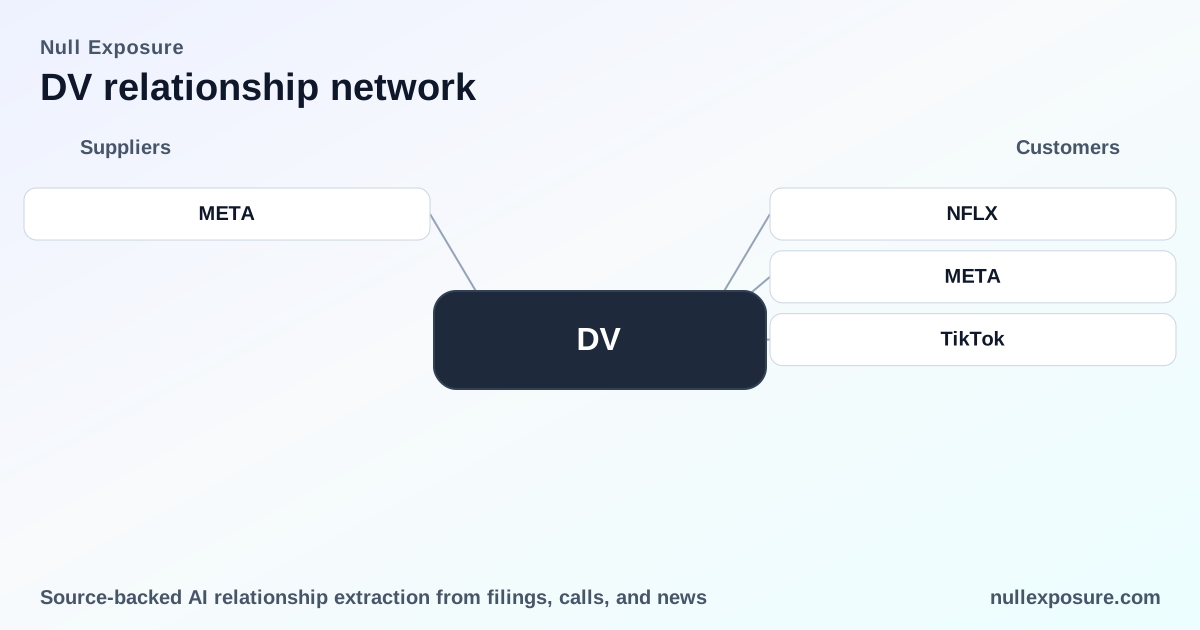
Netflix — measurement partner cited in Entrepreneur (Mar 2026)
DoubleVerify was named alongside Integral Ad Science as a vendor responsible for tracking when and where ads run on Netflix’s ad-supported tier, indicating integration into Netflix’s ad measurement stack (Entrepreneur, Mar 2026: https://www.entrepreneur.com/finance/netflix-collaboration-fuels-ias-doubleverify-stock-surge/453753).
Meta Platforms — expanded brand safety coverage reported on TradingView (Mar 2026)
DoubleVerify expanded brand safety and suitability coverage across Facebook and Instagram feeds and Reels, reflecting deeper integration with Meta’s inventory and advertiser controls (TradingView, Mar 2026: https://www.tradingview.com/symbols/NYSE-DV/).
Netflix (duplicate mention) — reinforcement of the same partnership narrative (Mar 2026)
The Entrepreneur piece repeats the Netflix collaboration context, reinforcing that DV is one of the third-party verifiers tapped for ad tracking on Netflix’s ad-supported product (Entrepreneur, Mar 2026: https://www.entrepreneur.com/finance/netflix-collaboration-fuels-ias-doubleverify-stock-surge/453753).
META (duplicate TradingView mention) — confirmation of platform work with Meta (Mar 2026)
A second TradingView mention reiterates DV’s expanded suitability coverage on Meta’s properties, underscoring the company’s role as a platform-level verifier (TradingView, Mar 2026: https://www.tradingview.com/symbols/NYSE-DV/).
Google — launched Pre-Screen Safety for Search Partner Network (May 2026)
DoubleVerify announced a Pre-Screen Safety and Suitability solution for Google’s Search Partner Network, positioning DV to protect advertiser ROI across search-ad adjacencies and extended publisher pools (Simply Wall St / company announcements, May 2026: https://simplywall.st/stocks/us/media/nyse-dv/doubleverify-holdings).
Snap — debut of attention measurement for social (Jul 2026)
DV introduced attention measurement calibrated for social platforms, launching the product with Snap — a first-of-its-kind offering that provides advertisers impression-level attention metrics on Snap’s inventory (Simply Wall St / product release, Jul 2026: https://simplywall.st/stocks/us/media/nyse-dv/doubleverify-holdings).
TikTok — MRC accreditation for video viewability (Apr 2026)
DoubleVerify became the first measurement vendor to earn MRC accreditation for TikTok video viewability reporting, which establishes DV as an accredited supplier for advertisers buying TikTok video inventory (MarketBeat / GlobeNewswire, Apr 2026: https://www.marketbeat.com/instant-alerts/doubleverify-nysedv-cut-to-hold-at-barclays-2026-01-13/).
TikTok — added DV Authentic Attention as first badged TikTok Marketing Partner (Mar 2026)
DoubleVerify expanded its DV Authentic Attention product to TikTok and was named the first badged TikTok Marketing Partner for impression-level attention insights, giving advertisers creative- and objective-level attention data (StockTitan / news, Mar 2026: https://www.stocktitan.net/news/DV/double-verify-appoints-stuart-flint-to-lead-emea-7iwitjplck4g.html).
TikTok — product expansion noted in corporate client announcements (May 2026)
Company client announcements confirm the expansion of DV Authentic Attention to TikTok, reinforcing the platform-level partnership and advertiser-facing measurement capabilities (Simply Wall St / client announcements, May 2026: https://simplywall.st/stocks/us/media/nyse-dv/doubleverify-holdings).
TikTok — MRC accreditation cited across market wires (Apr 2026)
Finviz picked up the GlobeNewswire announcement that DV earned MRC accreditation for TikTok video viewability reporting, a market-distributed confirmation of the TikTok milestone (Finviz, Apr 2026: https://finviz.com/news/324389/doubleverify-nyse-dv-misses-q4-cy2025-sales-expectations).
TikTok — broader press coverage reiterates MRC accreditation (Apr 2026)
Additional Finviz spotlights repeated the MRC accreditation story as a driver behind positive trading headlines, indicating market sensitivity to verification accreditation on major social platforms (Finviz, Apr 2026: https://finviz.com/news/331140/why-doubleverify-dv-stock-is-trading-up-today).
TikTok — MRC accreditation highlighted in retail-coverage pieces (Apr 2026)
Further editorial pieces included the GlobeNewswire accreditation language, underlining that multiple outlets treated the TikTok milestone as a substantive vendor win for DV (Finviz / editorial summaries, Apr 2026: https://finviz.com/news/333959/3-stocks-under-50-we-approach-with-caution).
What investors should take away from the relationship map
- Platform-parity across major publishers is a clear strategic goal: Google, Meta, Snap, TikTok and Netflix references show DV is accepted as a verification standard across social, search, streaming and publisher channels. Those platform connections translate directly into usage-based revenue as ad volumes grow.
- Accreditations and badging matter. MRC accreditation for TikTok viewability and official partner status with TikTok and other platforms reduce vendor selection friction for large advertisers and support higher retention and upsell.
- Revenue durability is structural. The company’s mix of measured-transaction fees and subscription minimums plus long average client tenures produces a revenue stream that scales with ad spend while remaining anchored by long-term contracts.
For a deeper signal-driven assessment and consolidated intelligence on relationships and revenue exposure, visit https://nullexposure.com/.
Bottom line
DoubleVerify’s customer relationships demonstrate a platform-centric go-to-market: enterprise advertisers and the largest digital publishers rely on DV for verification, producing a business that is both usage-sensitive to ad spend and anchored by subscription-like durability. For investors, the combination of market accreditations, multi-platform integrations, and high retention rates creates a high-quality SaaS-like revenue profile within the ad-tech vertical.