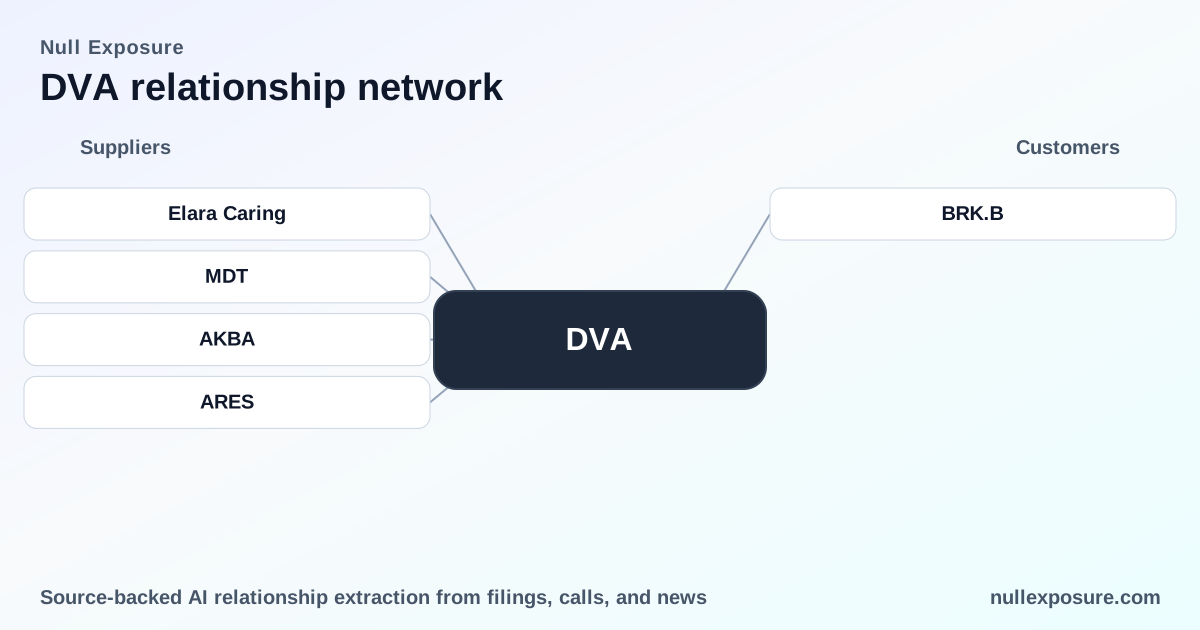
DaVita (DVA): Customer relationships, contract posture, and what investors should price in
DaVita operates and monetizes a national network of outpatient dialysis centers by charging per-treatment fees to government programs, commercial insurers, hospitals and individual patients, and by generating ancillary management and laboratory revenues. The business is highly concentrated in U.S. government payers, runs largely usage‑based commercial relationships with hospitals and payers, and maintains active operational scale (2,657 U.S. centers serving ~200,500 patients as of year‑end 2025). For investors, the core thesis is simple: predictable cash flow from treatment volumes under government reimbursement rules, offset by payor concentration and policy/exposure risk; operational execution and contract terms determine margin upside. For an at‑a‑glance view of coverage and tools that track these counterparty relationships, see https://nullexposure.com/.
How DaVita earns margins and why customers matter to valuation
DaVita’s top line—about $13.64 billion trailing twelve months—comes predominantly from patient services: dialysis treatments, related labs, administration of pharmaceuticals and management fees. Government programs (Medicare, Medicaid, Medicare Advantage and other government payers) account for the majority of revenue, representing about 68% of U.S. dialysis patient service revenues and driving roughly 86% of consolidated revenues. The company’s unit economics are therefore tied to treatment volume, negotiated per‑treatment fees, reimbursement rates set by public programs, and cost control across an extensive clinic network.
Key operating levers for investors:
- Volume stability from an installed base of chronic kidney disease and ESKD patients under long‑term treatment.
- Reimbursement exposure to federal and state payers that determine realized revenue per treatment.
- Contracting posture: most hospital and VA agreements are negotiated per treatment and include termination rights in some government contracts, creating both flexibility and renewal risk.
- Capital allocation: active share repurchases interact with major shareholders and ownership constraints, which influence leverage and free cash flow returns to investors.
What DaVita disclosed about counterparties this cycle
DaVita’s 2025 Q4 earnings call included a controlled disclosure about share repurchases involving a major shareholder. The company stated that a portion of recent repurchases were executed under a publicly filed repurchase agreement that keeps one large holder’s ownership at or below 45%.
Berkshire Hathaway: During the 2025 Q4 earnings call, management confirmed that a portion of share repurchases was executed from Berkshire Hathaway under a repurchase agreement that formulaically maintains Berkshire’s ownership at or below 45%; the remarks were included in the call transcript filed in March 2026. (Earnings call, 2025 Q4; first reported March 8, 2026.)
BRK.B: The same filing referenced Berkshire’s stake twice using the BRK.B ticker notation, reiterating that repurchases since quarter‑end included share purchases from Berkshire under the same agreement and that the arrangement is part of routine capital management. (Earnings call, 2025 Q4; first reported March 8, 2026.)
Takeaway: The company’s capital return program is operationally integrated with a strategic large shareholder, and repurchase mechanics are explicitly structured to keep that shareholder below a defined ownership threshold.
Constraints that define DaVita’s customer and revenue profile
DaVita’s public disclosures and filing language provide company‑level signals about contract structure, counterparty composition and geographic focus that should shape valuation and risk assessment:
- Usage‑based contracting is core to the operating model. Management stated that hospital inpatient dialysis is rendered under individually negotiated per‑treatment fees across roughly 740 hospitals as of December 31, 2025, reflecting a volume‑sensitive revenue stream and operational billing cadence.
- Some government contracts include short‑term termination rights. The VA agreement was described as compliant with federal acquisition requirements, giving the VA the right to terminate without cause on short notice—this is a direct contractual feature that increases renewal and execution risk for government work.
- Counterparty concentration skews to government payers. Multiple disclosures show that government‑based programs are the principal source of U.S. dialysis revenues, making reimbursement policy and regulatory adjustments a primary revenue risk vector.
- Geographic concentration is U.S.‑centric but with global aspirations. The company operates 2,657 U.S. centers in 46 states plus D.C., serving ~200,500 patients, while positioning itself as a global provider in broader corporate language—investors should treat the core business as North American and policy‑sensitive.
- Revenue criticality is high. U.S. dialysis revenues represented approximately 86% of consolidated revenues for the year ended December 31, 2025, establishing dialysis services as the critical core of enterprise value.
- Customer role and segment. The firm is primarily a seller and service provider of dialysis and ancillary services; its segment reporting centers on U.S. dialysis and related labs, integrated kidney care and ancillary operations.
These constraints are company‑level signals drawn from the firm’s 2025 year‑end disclosures and filings.
How these relationships and constraints change the investment calculus
- Reimbursement risk is the dominant valuation lever. With roughly two‑thirds of U.S. dialysis revenue from government programs, changes to Medicare/Medicaid payment rules or rate pressure from managed care will directly compress or expand margins.
- Operational leverage is meaningful. Per‑treatment pricing combined with scale (2,657 clinics) means incremental volume or productivity improvements convert to operating profit quickly; conversely, volume declines bite margins.
- Counterparty concentration creates single‑point exposure. The government payer mix reduces counterparty bargaining flexibility and raises sensitivity to regulation and policy cycles.
- Contract features introduce renewal and termination risk. Short‑notice termination rights in federal contracts (e.g., the VA) are explicit sources of contract fragility that investors must value.
- Capital allocation interactions with large shareholders matter. The structured repurchase agreement with Berkshire Hathaway and the disclosure that repurchases occur from that holder under an ownership cap influence free cash flow deployment and potential governance dynamics.
Conclusion: what investors should do next
DaVita is a scale provider whose cash flows are predictable in stable policy regimes but sensitive to reimbursement shifts and concentrated payer risk. For investors focused on downside protection, stress test model assumptions for Medicare/Medicaid rate scenarios and incorporate contract termination risk for government relationships. For upside, evaluate operational improvements and potential margin expansion through ancillary services and management fees.
For a concise, continuously updated view of these counterparty disclosures and how they affect issuer exposure, visit https://nullexposure.com/.
Actionable next step: review the company’s 2025 10‑K and the 2025 Q4 earnings call transcript to quantify per‑treatment reimbursement trends and the mechanics of the Berkshire repurchase arrangement; the earnings call filed in March 2026 contains the repurchase language cited above.