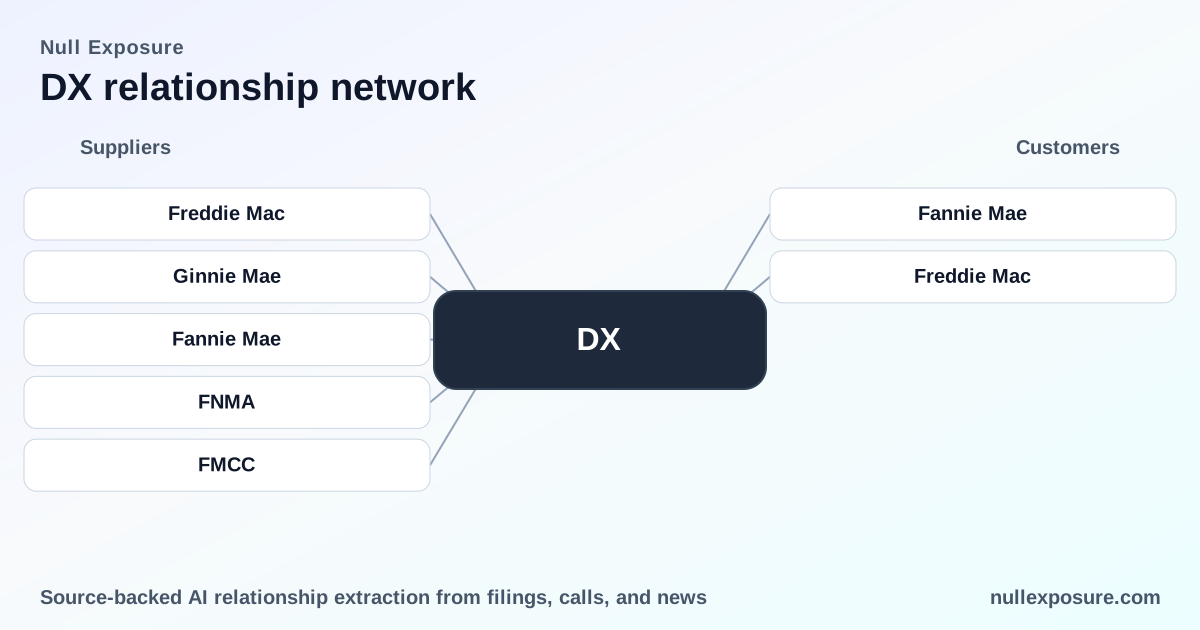
Dynex Capital (DX): Agency MBS Concentration Defines the Customer Map
Dynex Capital is a leveraged mortgage REIT that earns through net interest margin and dividend distribution by investing primarily in mortgage-backed securities (MBS). The company monetizes spread between financing costs and yields on agency and agency-like MBS, distributing a high cash yield to shareholders while running balance-sheet duration and spread risk. For investors and operators evaluating Dynex customer relationships, the relevant signal is that Dynex’s asset base is heavily weighted toward agency-credit paper, which makes Fannie Mae and Freddie Mac important counterparties in economic exposure and market liquidity. For a deeper portfolio analytics offering, visit https://nullexposure.com/.
How Dynex makes money and how that shapes its counterparty posture
Dynex operates as a mortgage REIT that buys MBS on a leveraged basis and finances those holdings with repo and other short-term funding. Revenue is generated by capture of net interest spread and periodic prepayment and convexity effects, while earnings are returned to shareholders largely through dividends (DividendPerShare $2.04; DividendYield 15%). The company’s P/E and book metrics (Trailing PE 6.41; Price/Book ~1.12) reflect an income-focused valuation driven by interest-rate and spread dynamics rather than operating revenue growth.
This operating model creates a contracting posture that is fundamentally market-driven and funding-sensitive: counterparties that provide liquidity, price discovery, and agency guarantees are operationally critical, and access to efficient financing determines near-term earnings volatility. Concentration in agency-like paper increases dependency on the functioning of the agency and agency-backed marketplace rather than on a diversified pool of retail customers.
Where Dynex’s customer relationships land in practice
A 2026 press profile and commentary on Dynex’s portfolio composition identifies the firm as concentrated in agency-credit MBS. These relationships are not customer contracts in the corporate-supplier sense; they are exposure relationships — counterparties and guarantors that define cash flows and credit backstop.
Fannie Mae
Dynex reports being “almost exclusively invested in… Fannie Mae-type paper,” which positions Fannie as a de facto economic counterparty because agency guarantees and market liquidity for Fannie-backed securities directly influence Dynex’s asset values and funding economics. A National Mortgage News profile (March 9, 2026) documented this concentration in agency-credit paper. https://www.nationalmortgagenews.com/list/how-one-reit-investor-prepares-to-buy-mbs-as-fed-shrinks-portfolio
Freddie Mac
Dynex likewise concentrates in Freddie Mac-style securities; the company cited being “up in credit… almost exclusively invested in Freddie and Fannie Mae-type paper,” making Freddie an equivalent economic counterparty for liquidity, spread-setting, and guarantee structure. This relationship was noted in the same National Mortgage News piece on March 9, 2026. https://www.nationalmortgagenews.com/list/how-one-reit-investor-prepares-to-buy-mbs-as-fed-shrinks-portfolio
Operational constraints and what they signal about business model characteristics
There are no explicit contract constraints or third-party mandates disclosed in the relationship dataset provided. Treated as a company-level signal, the absence of contract-level constraints combined with the portfolio disclosures implies the following operating characteristics:
- Contracting posture: Market-facing and transactional; Dynex relies on liquid securitized markets and short-term funding rather than bespoke long-term customer contracts.
- Concentration: High concentration in agency and agency-like MBS is a structural feature of the business model; counterparty concentration risk is material because Fannie and Freddie paper dominate asset holdings.
- Criticality: Counterparties that support agency MBS liquidity and guarantee frameworks are critical to Dynex’s earnings; disruptions in agency markets or changes to agency guarantees directly affect valuation and dividend capacity.
- Maturity: An established mortgage REIT operating in a mature agency-backed securitization market; balance-sheet management and funding sophistication are core capabilities.
These signals point to a firm whose revenue reliability is tied to macro interest-rate and spread behavior and the continued functioning of agency markets rather than to diversified customer revenues.
What investors should watch next
- Agency liquidity and guarantee policy: Regulatory or agency-guarantee changes at Fannie/Freddie translate immediately into valuation re-rates for Dynex.
- Funding spreads and repo access: Dynex’s levered posture makes short-term financing costs a principal driver of dividend sustainability and EPS.
- Interest-rate path and prepayment speeds: Duration and convexity exposures affect mark-to-market and cash yields; these are the primary business-cycle risks.
- Portfolio composition disclosures and transparency: Continued public commentary that Dynex is “almost exclusively” in agency paper is a signal of concentrated exposure; monitor quarterly portfolio breakdowns for shifts into non-agency or credit-first products.
For investors needing consolidated counterparty exposure views across mortgage REITs and a structured way to compare sovereign/agency concentration, see Null Exposure’s research center: https://nullexposure.com/.
Practical takeaways for operators and portfolio managers
- Exposure to Fannie and Freddie is economic and structural, not a contractual customer relationship. That means risk management should focus on market liquidity, guarantee-rule changes, and repo counterparties rather than on renegotiating counterparty contracts.
- High dividend yield reflects spread-centric earnings, but also elevated sensitivity to funding and spread shocks. Delta in short-term funding rates can compress distributable earnings quickly.
- Stress scenarios should combine agency-guarantee shock with repo-funding freeze and rising prepayments to model worst-case dividend and book-value impacts.
Bottom line
Dynex’s business model is simple and concentrated: it earns by levering agency and agency-like MBS and returning cash to shareholders. Fannie Mae and Freddie Mac are the two economic relationships that matter for Dynex — they define the guarantee framework and liquidity of the company’s primary assets. Investors evaluating DX should prioritize scenario analysis around agency policy, funding spreads, and interest-rate-driven prepayment dynamics. For comparative exposure tools and forward-looking counterparty analysis, visit Null Exposure at https://nullexposure.com/.