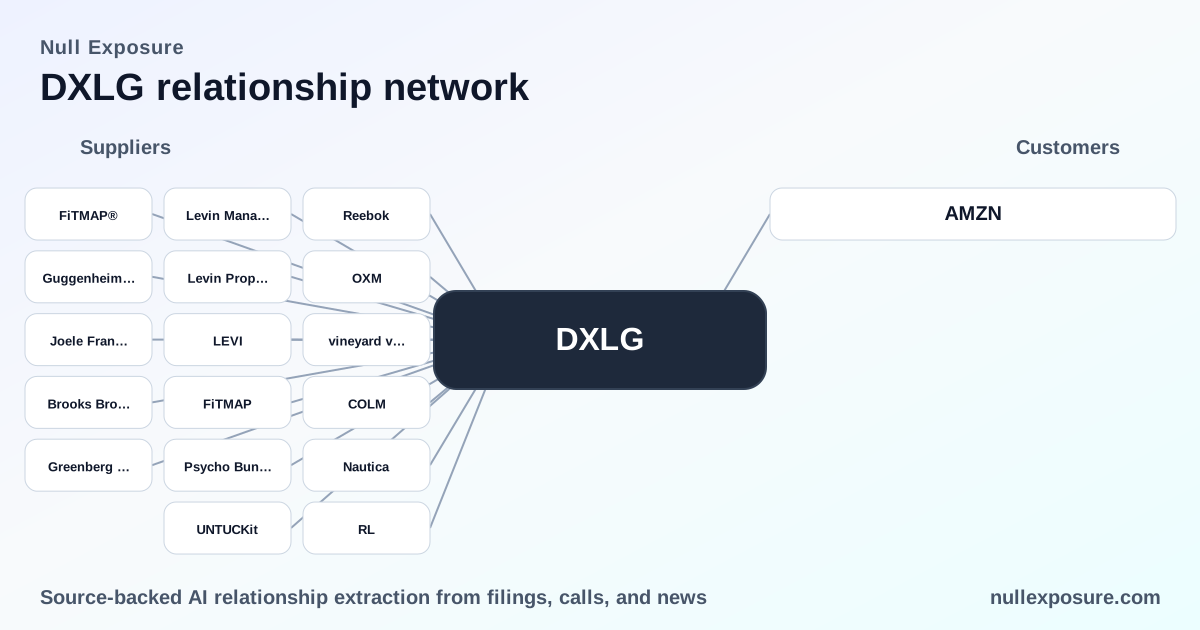
Destination XL Group (DXLG): Marketplace partnerships and the customer footprint investors should price
Destination XL Group operates and monetizes as a specialty big + tall men’s apparel retailer, generating revenue from a combination of physical stores and a direct digital business (www.dxl.com and mobile channels), while selectively participating on third‑party marketplaces to widen distribution. The company’s economics hinge on its direct channel for new-customer acquisition and digital engagement, with marketplace relationships used tactically rather than as the core revenue engine. Learn more at https://nullexposure.com/
Management’s channel playbook: owned channels first, marketplaces second
Management has articulated a deliberate shift to prioritize owned digital channels and in-store experience while maintaining targeted marketplace activity that complements those channels. During the company’s Q4 2025 commentary, executives highlighted active participation on Nordstrom’s online marketplace as a way to test assortment and learn consumer preferences, while having exited a wholesale arrangement with Amazon in an earlier strategic recalibration. The net effect is a hybrid distribution posture — proprietary commerce is the critical growth engine; marketplaces are executional levers for reach and product discovery.
Relationship snapshots investors should track
Nordstrom — a tactical marketplace partner
Destination XL is active on Nordstrom’s marketplace and is working with Nordstrom on a coordinated go‑to‑market program that includes personalized content and email support to drive discovery and conversion. According to an InsiderMonkey transcript of DXLG’s Q4 2025 earnings call (May 2026), management described onboarding brands and styles on Nordstrom’s platform to understand what resonates with that customer base, and a Globe and Mail / Motley transcript from the same call noted that much discovery on Nordstrom occurs through nordstrom.com search and browse. These references signal a strategic, market-access relationship rather than wholesale dependence (InsiderMonkey Q4 2025 earnings call transcript; Globe and Mail / Motley transcript, May 2026).
Amazon — exited wholesale, focusing on owned channels
DXL abandoned its wholesale relationship with Amazon as part of a broader digital strategy that concentrates on its own e‑commerce and app channels. Sourcing Journal covered the company’s disclosure that management would end the Amazon wholesale arrangement to prioritize direct customer relationships, a decision tied to the company’s longer‑term margin and brand control objectives (Sourcing Journal, March 9, 2026 — referencing the FY2022 strategy shift). This is a clearing of channel noise in favor of margin retention and customer data control.
How the relationship map ties back to the business model
The documented relationships fit the broader operating model captured in company filings and investor communications. DXL is an integrated commerce retailer where stores and direct channels generate substantially all revenue; marketplace arrangements are used selectively to broaden visibility and to experiment with assortment. The company’s public financials show revenue of roughly $435 million TTM with negative net margins, underscoring the need to prioritize higher‑margin direct sales and reduce dilution from third‑party wholesale channels.
Constraints that define how DXLG conducts customer commerce
The company disclosures and earnings commentary produce consistent, company‑level signals about how customers buy from DXLG and how DXLG contracts with them:
- Contracting posture — spot transactional sales. Revenue is recognized when control of goods transfers to the customer, reflecting a focus on immediate, transactional purchases rather than long‑term contracted revenue. Company filings describe revenue recognition at point of transfer (company filings, FY2025).
- Counterparty profile — primarily individual consumers. Management describes a premium, personalized shopping experience across stores and digital channels targeted at individual big + tall customers, not institutional buyers.
- Geographic concentration — North America centric. The retail footprint and e‑commerce strategy are focused on the United States (with a small Canadian presence historically), consistent with the company’s store network.
- Materiality — direct business is critical. Management explicitly characterizes the direct channel as a critical growth engine for new customer acquisition and digital engagement; stores plus direct commerce generate substantially all revenue.
- Relationship role — DXLG is the seller. The company operates as an integrated merchant selling branded and third‑party brands through its own retail and digital channels.
- Relationship stage — active and operational. The footprint of stores and active online platforms signals live, ongoing customer relationships rather than nascent pilots.
- Segment focus — core product retail. The business centers on the company’s core product line of big + tall men’s apparel and footwear.
These constraints indicate a mature, retail‑centric operating posture: transactional contracts, high reliance on individual consumers in North America, and a strategic emphasis on proprietary channels to protect margins and customer data.
Investment implications and risk considerations
- Channel concentration and criticality. Because stores and the direct channel produce the majority of revenue, any disruption in physical retail or e‑commerce conversion directly pressures top line and margins. The company’s negative profit margin and operating margin highlight limited financial cushion.
- Marketplace utility vs. dependency. Nordstrom functions as a targeted distribution amplifier rather than a replacement for DXLG’s owned channels. The exit from Amazon wholesale reduces channel dilution and supports margin improvement, but it also removes a high‑reach venue that could accelerate scale.
- Operational maturity and predictability. The business exhibits mature retail characteristics — large store count historically and an established direct‑to‑consumer platform — which supports predictable operational cadence but also locks in fixed retail costs.
- Strategic tradeoffs. Prioritizing owned channels improves customer lifetime value and data capture but requires investment in digital marketing and merchandising. The Amazon exit illustrates a preference for margin and brand control over traffic volume.
Bottom line and recommended monitoring
DXLG is a vertically integrated specialty retailer that monetizes primarily through its store base and owned digital channels, using marketplace partnerships like Nordstrom for targeted distribution while having exited broader wholesale on Amazon to protect margins and customer ownership. Key items for investors to monitor: 1) contribution of the direct channel to gross margin and customer acquisition cost; 2) the performance of Nordstrom marketplace placements versus owned‑channel conversion; and 3) whether the company sustains margin improvement as it scales e‑commerce traffic organically.
For ongoing tracking of partner dynamics and customer relationship evidence, visit https://nullexposure.com/ — the resource frames marketplace moves and partner disclosures against company filings and earnings commentary.
Bold takeaways: DXLG’s customer relationships are active, North America‑focused, and strategically aligned to protect margins and customer data through owned channels while leveraging selective marketplace partnerships for reach.