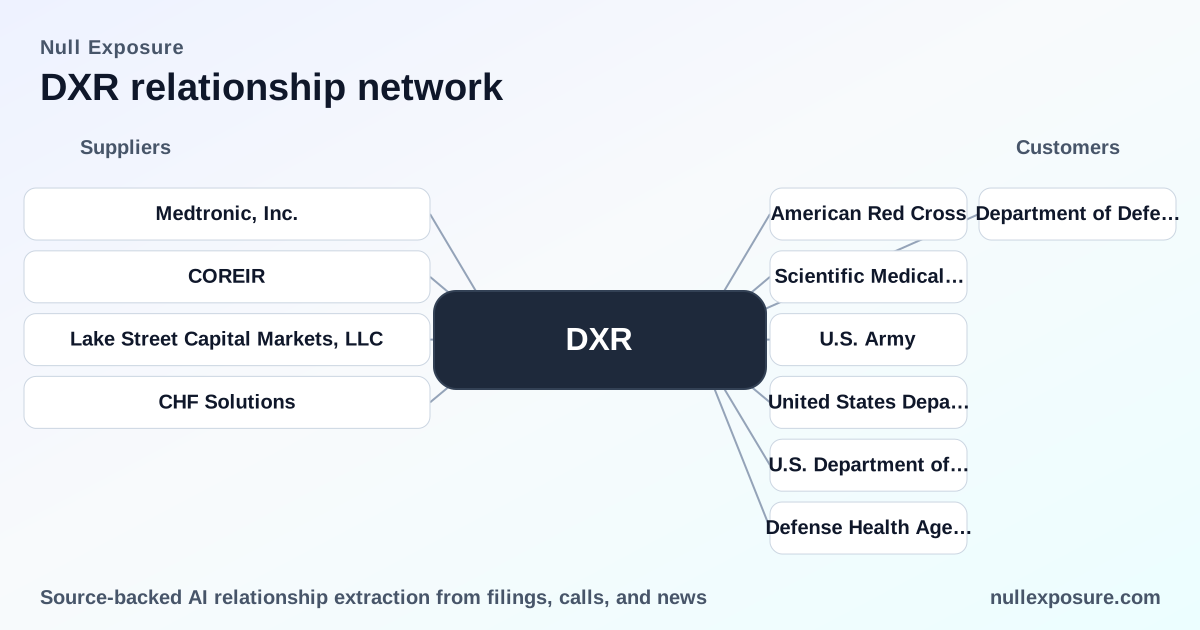
Daxor (DXR) customer anatomy: government contracts, concentrated hospital demand, and recurring consumables
Daxor Corporation operates as a niche medical-device company that sells the Blood Volume Analyzer (BVA) and single-use Volumex® kits, provides post-sale service contracts, and runs cryobanking and frozen blood storage through a subsidiary. The company monetizes through equipment sales, high-margin consumable kits, one‑year service contracts (renewable), and targeted government development contracts, creating a mix of transactional and recurring revenue streams. For investors evaluating customer relationships, the critical facts are concentration around a small number of hospital customers and a growing, strategically important set of Department of Defense / military health contracts. Learn more at the NullExposure homepage: https://nullexposure.com/.
How Daxor sells and what constrains its growth
Daxor’s operating model is defined by a handful of commercial realities drawn from company disclosures. Contracting posture is hybrid: customers can purchase equipment outright, lease it, or rent on a month‑to‑month basis, while service coverage is sold in annual increments and recognized as deferred revenue. That structure produces both lump-sum revenue (equipment sales) and predictable recurring revenue (kits and service contracts). Company filings identify the United States as the most significant market — roughly 8,500 hospitals and radiology centers — while also noting a meaningful international opportunity of 10,000–14,000 potential users.
Concentration and criticality are important risk signals. In FY2011, Blood Volume Kit sales comprised 67% of consolidated operating revenue, and four hospitals accounted for 63.7% of kit revenue, indicating a legacy of customer concentration that compresses negotiating leverage and increases revenue volatility. Product maturity is mixed: the BVA is an established core product sold alongside consumables (Volumex®), while the company also pursues development contracts (notably with the U.S. Department of Defense) that position it in advanced trials and military use cases. Finally, Daxor operates in two segments — Equipment Sales & Related Services and Cryobanking & Related Services — giving the business both device/consumable economics and service/subsistence revenues through its subsidiary operations.
What each customer relationship tells investors
Below are the relationships identified in public disclosures and press. Each entry is a concise, plain‑English summary with the source noted.
American Red Cross
The company’s FY2011 10‑K explicitly contrasts Daxor with the American Red Cross, noting the Red Cross’s dominant market presence and greater public resources, suggesting the Red Cross functions as a large, influential participant in the blood services market rather than a Daxor customer. According to Daxor’s 2011 10‑K, the American Red Cross and affiliates “dominate the market” and possess greater exposure and resources.
Scientific Medical Systems
Scientific Medical Systems is a wholly owned Daxor subsidiary that operates the Idant Semen Bank and a Blood Bank division, representing the company’s cryobanking and related services capability and internal service provider role. The FY2011 10‑K identifies Scientific Medical Systems as a Daxor subsidiary operating these units.
U.S. Army
Daxor developed a new rapid, lightweight Blood Volume Analysis system under contract with military health organizations specifically including the U.S. Army, indicating direct engagement with army healthcare requirements and battlefield or field‑deployable device constraints. A GlobeNewswire release (Aug 7, 2025) and a Yahoo Finance summary (May 2026) reported that the new system was developed under contract with the U.S. Army and the Defense Health Agency.
U.S. Department of Defense
Daxor is under contract with the U.S. Department of Defense to develop analyzers aimed at improving combat casualty care, a strategic commercial relationship that can deliver non‑dilutive development revenue and validation for military medical applications. MarketScreener and GlobeNewswire pieces from 2025–2026 document ongoing DoD contracts supporting analyzer development.
Defense Health Agency
The Defense Health Agency (DHA) is named alongside the U.S. Army in multiple announcements as a direct contracting or sponsoring body for the new BVA system, positioning Daxor within the Defense Health enterprise rather than solely conventional civilian procurement channels. GlobeNewswire (Aug 7, 2025) and Yahoo Finance (May 2026) note development under contract with the Defense Health Agency.
Department of Defense (historical reference)
Daxor’s engagement with the Department of Defense is not new: company statements as early as FY2020 confirm active DoD projects to develop BVA capability for military applications, indicating continuity of government work over several years. RTTNews referenced Daxor’s FY2020 comment that it was “currently under contract with the Department of Defense developing BVA for the military.”
United States Department of Defense (FY2026 reference)
Recent fiscal‑year reporting and press note continued DoD involvement in FY2026, describing ongoing trials in heart‑failure and other clinical areas supported by NIH and continued DoD contracts for combat casualty care‑oriented analyzers, reinforcing DoD as both a development partner and a potential buyer. A MarketScreener report (FY2026) summarized these ongoing trials and stated Daxor is under contract with the United States Department of Defense.
(Each relationship summary is drawn from Daxor filings and public press: FY2011 10‑K and news releases from GlobeNewswire, Yahoo Finance, MarketScreener, and RTTNews in 2020–2026.)
For a broader matrix of Daxor’s customer exposures and how they map to its revenue streams, visit https://nullexposure.com/.
Investment implications — what investors should weigh
- Revenue mix is lumpy but anchored by consumables. Equipment sales are one‑time, but Volumex® kits and annual service contracts produce recurring revenue and higher margin per procedure. Historical filings show kits dominated revenue in earlier years, underscoring the consumable economics.
- Customer concentration is a material risk. Past disclosure of four hospitals accounting for the majority of kit revenue signals vulnerability to customer loss; investors should monitor current customer concentration metrics in recent reports.
- Government contracts are strategically valuable but cyclical. DoD and DHA contracts provide R&D funding, product validation, and potential procurement, but defense procurement timelines and program cancellations create revenue timing risk.
- Geography: strong domestic footprint with scalable international upside. The firm targets the U.S. market as primary while recognizing a significant international addressable market, which implies growth via regulatory clearances and distribution partnerships.
- Diversification through cryobanking reduces dependence on BVA alone. The Scientific Medical Systems subsidiary provides service‑oriented revenue streams that complement device/kit economics.
Bottom line: focused niche with high upside and concentration risk
Daxor’s business model combines device sales, a high‑margin consumable, and recurring service contracts while leveraging government development contracts to extend addressable use cases into military and critical‑care settings. The company’s strategic strength lies in consumable economics and DoD validation; its principal weakness remains customer concentration and the timing of government procurement. Investors should track current customer diversification, renewal rates for service contracts, and the pipeline of DoD purchases and clinical trials.
For deeper customer‑level insights and ongoing tracking of DXR relationships, NullExposure maintains a living dashboard at https://nullexposure.com/.