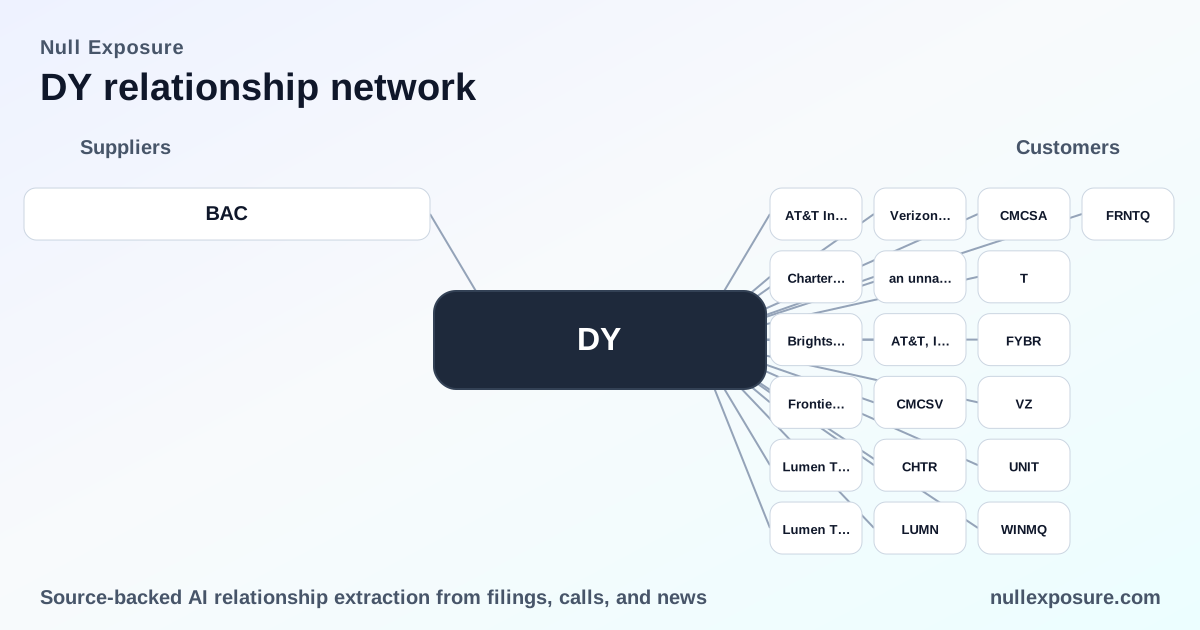
Dycom (DY): Customer Concentration, Contracting Posture and What the Telco Mix Means for Investors
Dycom Industries operates as a specialty contracting services provider to the U.S. telecommunications and utility sectors, supplying labor, tools and equipment to execute large-scale network build and maintenance work under master service agreements and project-level contracts. The company monetizes through contract revenue from major carriers and cable operators, converting backlog into quarterly billing; customer concentration drives both revenue visibility and idiosyncratic risk. For deeper company coverage visit NullExposure.
Why the customer list is the story here
Dycom’s revenue base is centered on a small set of very large telcos and cable operators. According to Dycom’s FY2025 Form 10‑K, AT&T accounted for roughly 20.1% of total contract revenues in fiscal 2025, while Lumen and Comcast accounted for material mid‑single and high‑single percentage shares. Management commentary in early‑2026 shows the same clients driving quarter‑to‑quarter variability: AT&T, Verizon and Lumen each exceeded 10% of revenue in the most recent fiscal quarter, with Brightspeed, Charter, Comcast and Uniti each contributing above 5% in that period. These dynamics create high revenue concentration but also predictable backlog conversion, with Dycom reporting a multi‑billion dollar backlog that underpins near‑term revenue (FY2025 backlog cited in filings).
How Dycom contracts and backlog constrain outcomes
Dycom operates predominantly as a service provider under a mix of master service agreements and longer‑term contracts, supplemented by shorter project work. The FY2025 filing states the majority of backlog is under master service agreements and long‑term contracts, and that contracts commonly include retainage of 5–10% until project closeout. That contracting posture creates a few structural characteristics for investors:
- Concentration and counterparty risk: a handful of customers represent a large share of revenues, increasing sensitivity to procurement cycles at major carriers.
- Revenue visibility and maturity: a $7.760 billion backlog (as of January 25, 2025) gives multi‑quarter visibility and drives predictable conversion of work into cashflows, with roughly 60% expected to be completed in the next 12 months (FY2025 filing).
- Geographic focus and operational scale: Dycom’s business is U.S. centric, executing nationwide projects that demand equipment, crews and local management—this favors scale but raises execution and labor management risk.
These company‑level signals come directly from the company’s FY2025 disclosures and public earnings commentary and should guide risk assessment for credit, operations and equity valuation.
Customer-by-customer: what the filings, calls and press say
Below are concise, source‑anchored notes on every customer relationship that appears in the available results.
AT&T (T)
AT&T represented approximately 20.1% of Dycom’s total contract revenues in fiscal 2025, making it the largest single customer in that year; management reiterated AT&T exceeded 10% of revenues in the recent fiscal quarter. Source: Dycom FY2025 Form 10‑K (filed Jan 25, 2025) and Dycom FY2026 earnings call (March 2026).
Lumen Technologies (LUMN)
Dycom derived 12.1% of contract revenues from Lumen in FY2025, and management described active execution on the Lumen overpull and fiber programs during the latest quarter. Source: Dycom FY2025 Form 10‑K (Jan 25, 2025) and Q1 FY2026 earnings call (March 2026).
Comcast (CMCSA / CMCSV)
Comcast accounted for roughly 8.5% of contract revenues in FY2025, down from prior years but still a material, recurring client for maintenance and build projects; filings list Comcast explicitly and earnings commentary includes Comcast among >5% customers in recent quarters. Source: Dycom FY2025 Form 10‑K (Jan 25, 2025) and Q1 FY2026 earnings call (March 2026).
Verizon (VZ)
Verizon is repeatedly cited in earnings commentary for fiber‑to‑the‑home and maintenance awards, and combined Verizon/Frontier revenue after Verizon’s acquisition of Frontier exceeded 10% in the quarter cited by management. Source: Dycom Q1 FY2026 earnings call (March 2026) and press coverage summarizing the quarter (InsiderMonkey, March 2026).
Charter Communications (CHTR / Charter)
Charter contributed about 7.3% of total contract revenues in FY2025 and was listed among customers exceeding 5% of quarterly revenue in recent quarterly commentary. Source: Dycom FY2025 Form 10‑K (Jan 25, 2025) and Q1 FY2026 earnings call (March 2026).
Brightspeed
Brightspeed produced 6.6% of contract revenues in FY2025 and was specifically named as a >5% customer in the most recent quarter; management referenced Brightspeed in earnings commentary. Source: Dycom FY2025 Form 10‑K (Jan 25, 2025) and Q1 FY2026 earnings call (March 2026).
Frontier Communications (FRNTQ / Frontier)
Frontier represented 6.0% of contract revenues in FY2025, and following its acquisition by Verizon the combined contribution from Verizon/Frontier was cited above the 10% threshold for the quarter. Source: Dycom FY2025 Form 10‑K (Jan 25, 2025) and earnings/press coverage (InsiderMonkey, March 2026).
Uniti (UNIT)
Uniti was identified in public commentary as a >5% customer in the quarter, listed among Brightspeed, Charter and Comcast in press summaries of the most recent quarter. Source: Q1 FY2026 earnings call reporting and subsequent press (InsiderMonkey and Bitget coverage, March 2026).
Windstream (WINMQ)
Windstream was mentioned in earnings commentary as a counterparty for fiber‑to‑the‑home and maintenance work, indicating active project work rather than a single lump‑sum engagement. Source: Dycom Q1 FY2026 earnings call (March 2026).
Lumos
Management cited fiber‑to‑the‑home awards with Lumos in the earnings call, signaling smaller regional cable/telco customer relationships that complement the large national carriers. Source: Dycom Q1 FY2026 earnings call (March 2026).
An unnamed customer
Dycom’s earnings call noted an unnamed customer that exceeded 5% of quarterly revenues, suggesting the company sometimes aggregates or withholds customer identity in public remarks even when concentration is non‑trivial. Source: Dycom Q1 FY2026 earnings call (March 2026).
(For multiple press summaries of the quarter and additional context, see March–May 2026 press coverage compiled by TradingView, Bitget and The Globe and Mail.)
Investment implications and what operators should watch
- Concentration is the dominant risk factor. AT&T, Lumen and Verizon together account for a substantial portion of revenues at points in the year; a significant slowdown or scope reduction at any of these carriers would materially affect Dycom’s topline. (See FY2025 10‑K and Q1 FY2026 commentary.)
- Backlog and long‑term MSAs provide meaningful revenue visibility. Dycom’s multi‑billion backlog and the prevalence of master service agreements blunt immediate downside and support near‑term cashflow expectations, but contractual retainage and closeout terms can pace cash conversion.
- Operational execution is critical. The business converts backlog into margin through field execution; labour, equipment utilization and safety performance will materially influence operating margin and EBITDA conversion across quarters.
- Counterparty mix is largely large U.S. carriers and cable operators, which is a double‑edged sword: stable counterparties but concentrated exposure to capex cycles and fiber build cadences.
Bold takeaways for investors: Dycom provides predictable revenue conversion via backlog and MSAs, but equity returns are tightly coupled to project award cycles at a handful of major telcos. Operators evaluating Dycom relationships should assess contract length, retainage schedules, and change‑order processes for commercial resilience.
For a structured view of Dycom’s customer exposures and to track how those exposures evolve through filings and calls, visit NullExposure for integrated relationship summaries and source links.