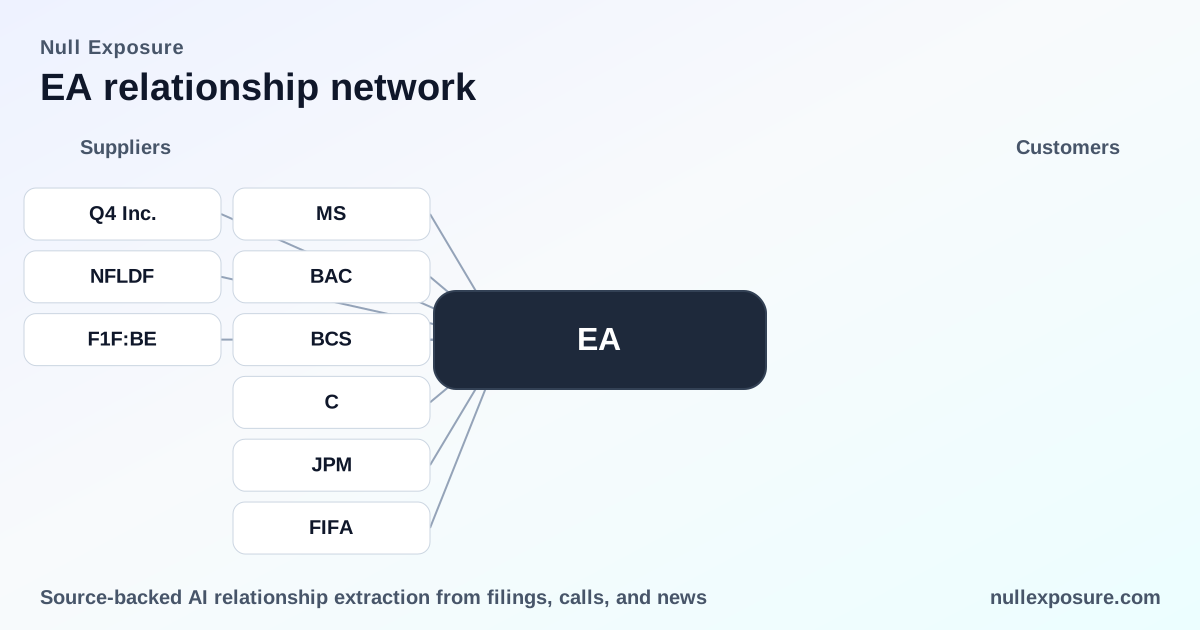
Electronic Arts (EA): Customer Relationships That Drive Valuation and Risk
Electronic Arts monetizes a global portfolio of game IP, live services, and subscriptions through direct sales, in‑game microtransactions, and platform distribution. Revenue flows from boxed and digital game sales, recurring subscription fees and live-service purchases, and platform partners who collect and remit payments for mobile downloads. This operating mix creates high gross margins from digital goods, coupled with concentration and platform dependency risks that investors must price. For a sharper counterparty map and ongoing monitoring, see https://nullexposure.com/.
Why counterparty anatomy matters more than ever
EA’s business is not a simple product sale; it is a hybrid of short-term transactional revenues and longer-duration subscription economics. The company itself discloses that most transactions have payment terms under one year, which limits embedded financing risk but increases the importance of near‑term cash generation for working capital. At the same time, EA recognizes subscription revenue ratably over the subscription term, so subscription sales create predictable recurring top‑line that complements volatile one‑time purchases (company filings, fiscal disclosures).
Two additional facts shape credit and strategic risk: at March 31, 2025 EA reported two customers that together represented roughly 35% and 28% of consolidated gross receivables, respectively — a material concentration in receivables that investors must treat as counterparty exposure. Separately, EA reports net revenue splits of North America $3,078 and International $4,385 (net $7,463) in the referenced period, signaling that international markets were the larger revenue source in that reporting window (company disclosure excerpts).
Contracting posture, counterparty criticality, and maturity of relationships
- Contracting posture: predominantly short‑term, with distribution agreements often terminable on short notice, especially for mobile channels. This imposes an operational requirement to keep product pipelines and live‑service engagement high to maintain cash flow.
- Criticality: platform distributors (for example, Apple and Google on mobile storefronts) act as pass‑through payment collectors and gatekeepers for millions of consumers; these relationships are operationally critical given the distribution economics disclosed.
- Concentration: material receivable concentration creates asymmetric counterparty risk; collection shortfalls from a small set of counterparties would meaningfully affect liquidity.
- Maturity: EA’s core segment is software and live services — a mature, high‑margin digital business with recurring elements, but one that depends on continuous content investment and platform access to sustain monetization.
These operating characteristics explain why investors value EA on a premium multiple for durable IP and live-service economics, yet apply haircuts for concentration and platform risk given the receivables profile and distributorship structure.
Key third‑party relationships that move the needle
Below are the relationships surfaced in recent reporting and media coverage. Each relationship matters for either ownership, platform access, or competitive positioning.
-
Affinity Partners — Financing participant in acquisition consortium. According to an IndexBox news piece (May 2, 2026), Affinity Partners was part of a consortium that financed the acquisition of Electronic Arts alongside Silver Lake and Saudi Arabia’s Public Investment Fund. Takeaway: Affinity’s role is as a financial partner in a buyer consortium rather than an operating counterparty. (IndexBox, May 2, 2026: https://www.indexbox.io/blog/jpmorgan-executes-ea-buyout-debt-sale-after-presidential-signal/)
-
Saudi Arabia’s Public Investment Fund (PIF) — Consortium financier and strategic owner. IndexBox reported that the PIF was part of the financing package used to acquire EA (May 2, 2026). Takeaway: The presence of a sovereign investor alters governance incentives and access to private capital, and can reduce public liquidity while increasing political and strategic oversight. (IndexBox, May 2, 2026: https://www.indexbox.io/blog/jpmorgan-executes-ea-buyout-debt-sale-after-presidential-signal/)
-
Microsoft (MSFT) — Platform partner and competitor. A FinancialContent deep dive (March 10, 2026) described the relationship as a “frenemy”: EA supplies key titles to Xbox Game Pass while also competing directly with Microsoft‑backed franchises through Battlefield vs. Call of Duty. This dynamic creates both distribution upside and direct strategic competition. (FinancialContent / Finterra, March 10, 2026: https://markets.financialcontent.com/stocks/article/finterra-2026-3-9-the-privatization-of-a-giant-a-deep-dive-into-electronic-arts-ea-in-2026)
-
Silver Lake — Financial partner in takeover financing. IndexBox coverage notes Silver Lake as a member of the investor group that financed EA’s acquisition (May 2, 2026). Takeaway: Silver Lake’s involvement signals private‑equity style focus on operational optimization and longer‑term value extraction. (IndexBox, May 2, 2026: https://www.indexbox.io/blog/jpmorgan-executes-ea-buyout-debt-sale-after-presidential-signal/)
What the relationship map implies for investors
- Ownership transition changes the comparables set. Consortium financing and involvement by sovereign capital and private equity reduce the likelihood of a liquid public float and shift valuation into a private‑market multiple regime focused on cash flow and operational efficiency.
- Platform partners are both enablers and competitive threats. Microsoft’s inclusion on Game Pass provides a meaningful distribution channel but does not remove head‑to‑head competition for premium franchise players; investors must model both upside to recurring monetization and downside to franchise share loss.
- Distribution and receivables concentration create execution risk. Short‑term, terminable distribution agreements combined with two large receivables positions mean that platform or customer distress could produce near‑term cash volatility; this is a structural exposure to monitor in working capital stress tests.
- Subscription economics provide ballast. Ratable recognition of subscriptions firms up revenue visibility and reduces churn sensitivity for a portion of the top line, supporting higher valuation multiples for recurring cash flow.
If you want a counterparty‑level monitor and alerts tied to these exact relationships and their evolving public signals, visit https://nullexposure.com/ for live coverage and exposure analytics.
Bottom line for investors and operators
Electronic Arts operates a high‑margin digital entertainment business that monetizes through one‑time sales, in‑game purchases, and subscriptions; its value is concentrated in IP and recurring revenue, but ownership changes and concentrated receivables raise governance and counterparty risk. The consortium financing by PIF, Silver Lake and Affinity Partners transforms the capital structure and strategic backdrop; platform partners such as Microsoft continue to be simultaneously critical distributors and direct competitors. Investors should underwrite EA’s cash flow with sensitivity to customer concentration, platform termination risk, and the durability of subscription economics.