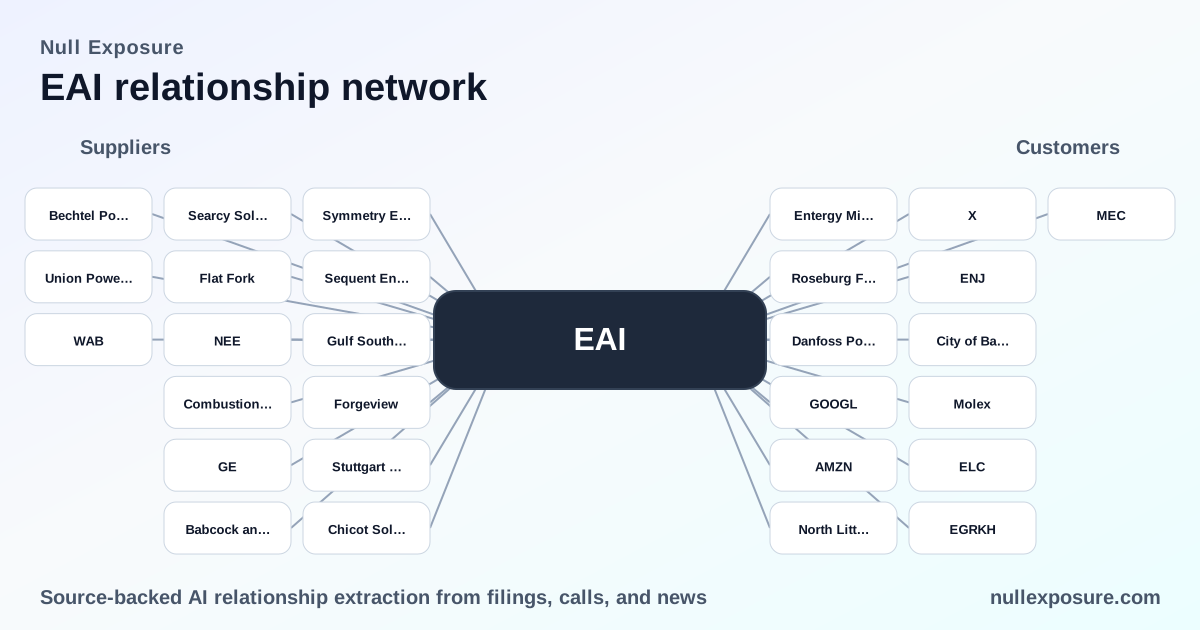
Entergy Arkansas (EAI) — customer relationships that underwrite growth and risk
Entergy Arkansas LLC operates and monetizes as a regulated electric utility: it sells generation, transmission and distribution services to retail and large commercial customers under regulated tariffs and negotiated electric service agreements, and recovers major project costs through approved riders and rate mechanisms. Revenue derives from retail electric sales and contractual capacity/energy arrangements, while large data‑center and industrial customers drive incremental infrastructure investment and concentrated load growth.
For a concise vendor and counterparty intelligence briefing, see Null Exposure’s platform for relationship maps and document-level sourcing: https://nullexposure.com/
Executive takeaway — why investors should care
Entergy Arkansas’ commercial footprint combines steady regulated cash flows with episodic, high‑capital commitments to serve a small group of large enterprise customers. The business model blends predictable tariff revenue with concentrated counterparty exposure, meaning upside from data‑center load growth is paired with material project execution and credit concentration risk. Regulators and riders provide a stable recovery path for many investments, but the company’s financial outcomes will track project completion and customer load realization.
Consider a mid‑cycle check on the platform for deeper document provenance: https://nullexposure.com/
Business model characteristics and operating constraints
- Contracting posture — long‑term and framework-based: Regulatory filings and disclosures describe multi‑year frameworks and riders (including a five‑year resilience plan and forward‑looking riders with semi‑annual true‑ups), indicating long‑dated cost recovery mechanisms. These are company‑level signals of a contracting posture oriented toward durable, regulator‑backed recoveries.
- Counterparty mix — from individuals to very large enterprises: Disclosures treat customers as residential, business, large C&I, and government; the company explicitly targets large enterprise and data center customers, which increases credit concentration. The March 2024 disclosure that Entergy Mississippi executed a large customer supply and service agreement to serve two data centers is a contract‑level example of that strategy (constraint evidence).
- Concentration and materiality — mixed signals: The company states no single customer exceeds 10% of revenues (an immateriality signal), while also warning that a small number of large data center customers could represent a high percentage of sales for particular operating companies (a materiality flag). Investors must reconcile diversified retail cash flows with localized concentration risk from new large loads.
- Geography and regulatory environment — North America and regulated rates: Entergy derives substantially all revenue in the U.S., and rates are set or influenced through state commissions and FERC; this creates regulated revenue stability but exposes the company to regulatory timing and approval risk.
- Segment exposure — core electricity sales, distribution and infrastructure: The firm’s economics depend on retail electric sales and large capital programs (resilience, transmission and generation buildouts). Spend profiles indicate >$100m program scale for multi‑year resilience and data‑center enablement projects.
- Relationship maturity — active, ramping and prospective: Many customer agreements are active; other projects are in ramping or prospect stages pending regulatory approvals.
Relationship roll call — what each document and news item shows
Below are every counterparty referenced in the compiled results with a short, source‑specific summary.
-
Entergy Mississippi — System Energy sells capacity and energy to Entergy Mississippi under the Unit Power Sales Agreement; costs related to Grand Gulf are recovered through rates charged to Entergy Mississippi. Source: FY2024 Form 10‑K (Unit Power Sales Agreement language).
-
Southwest Steel Processing, LLC — Entergy Arkansas provided energy‑efficiency incentives (roughly $111,787) that reduced energy requirements at the Newport manufacturing plant. Source: Entergy news release (FY2017).
-
Amazon (AMZN) — Local reporting indicates an Amazon distribution center in Lot 1 will continue to receive electric service from Entergy, preserving an industrial/commercial load. Source: KATV local news (FY2022).
-
North Little Rock Electric — The City of North Little Rock paid Entergy Arkansas $350,000 for permission to sell electric services in Tulip Farm Lots 2–4, reflecting local franchise and territory negotiations. Source: KATV local news (FY2022).
-
X — Regional reporting on a large solar farm project notes renewable energy will supply companies such as U.S. Steel; the project context is a local Mississippi County renewable development. Source: KAIT8 regional news (FY2022).
-
Danfoss Power Solutions — As a participant in Entergy Arkansas’ Continuous Energy Improvement program, Danfoss received $37,785 in incentives and avoided over 1 million kWh, demonstrating the utility’s commercial incentives platform. Source: Entergy press release (FY2024).
-
Google (GOOGL) — Entergy Arkansas announced it will supply power for Google’s planned $4 billion investment and data center in Arkansas; the commitment implicates significant new load and infrastructure enablement. Sources: Entergy press release (FY2025) and regional energy press coverage (FY2025).
-
Roseburg Forest Products — Participation in Entergy’s CEI program generated nearly $400,000 in incentives and approximately 19 million kWh in estimated annual savings for the El Dorado facility. Source: Entergy press release (FY2024).
-
Entergy New Orleans (ENJ) — The Unit Power Sales Agreement also allocates Grand Gulf capacity and energy to Entergy New Orleans, with cost recovery reflected through rates charged under the agreement. Source: FY2024 Form 10‑K.
-
J.P. Morgan Securities LLC (JPM) — EDGAR reporting lists J.P. Morgan Securities as an allocated participant in a financing transaction with an $108,000,000 figure, consistent with debt underwriting activity. Source: EDGAR/financial news summary (2020 filing referenced).
-
Loop Capital Markets LLC — Documented allocation of $27,000,000 tied to underwriting or distribution activity in the referenced financing. Source: EDGAR/financial news summary (2020).
-
Regions Securities LLC (RF) — Regions Securities listed with an $108,000,000 allocation in the financing context, indicating participation among underwriters. Source: EDGAR/financial news summary (2020).
-
Scotia Capital (USA) Inc. (BNS) — Scotia Capital is shown with an $108,000,000 allocation in the same financing disclosure. Source: EDGAR/financial news summary (2020).
-
SMBC Nikko Securities America, Inc. (SMFG) — SMBC Nikko appears with an $108,000,000 allocation in the financing disclosure. Source: EDGAR/financial news summary (2020).
-
Stephens Inc. — Stephens is listed with an $108,000,000 allocation in the financing record, reflecting its role in the transaction syndicate. Source: EDGAR/financial news summary (2020).
-
U.S. Bancorp Investments, Inc. (USB) — U.S. Bancorp Investments is identified with an $108,000,000 allocation tied to the same financing activity. Source: EDGAR/financial news summary (2020).
-
Google (DailyEnergyInsider citation) — Regional energy press reiterated Entergy Arkansas will electrify Google’s $4 billion data center and noted ~300 anticipated employees at build‑out. Source: DailyEnergyInsider (FY2025).
-
City of Batesville — Entergy’s CEI program lists Batesville as a recipient of incentives (~$7,006) with estimated annual savings of around 58,389 kWh. Source: Entergy press release (FY2024).
-
Molex — Molex’s Maumelle, Arkansas facility received approximately $300,426 in incentives with estimated annual savings near 15 million kWh under Entergy’s CEI initiative. Source: Entergy press release (FY2024).
-
Mayville Engineering / MEC — Mayville Engineering (MEC) in Heber Springs received an incentive of $127,715 and estimated annual savings of ~1,012,730 kWh through Entergy’s CEI program. Source: Entergy press release (FY2024).
-
U.S. Steel — Local reporting on the Mississippi County solar farm cited U.S. Steel as a prospective beneficiary of renewable energy from the new installation. Source: KAIT8 regional news (FY2022).
-
Entergy Louisiana (ELC) — The FY2024 Form 10‑K confirms Entergy Louisiana is a counterparty under the Unit Power Sales Agreement for Grand Gulf capacity and energy, with cost recovery implications. Source: FY2024 Form 10‑K.
-
Entergy Arkansas (EGRKH) — The 10‑K describes Entergy Arkansas (and the EGRKH ticker reference in the dataset) as a buyer of Grand Gulf capacity/energy under the Unit Power Sales Agreement and a participant in tariff‑based cost recovery. Source: FY2024 Form 10‑K.
Investment implications and risk checklist
- Growth vector: Large data centers (e.g., Google) provide high incremental load and justify capex; successful load realization converts capex into regulated earnings.
- Execution risk: Infrastructure investments are large (>$100m program scales) and require regulatory approvals and timely construction.
- Concentration risk: While no single customer exceeds 10% of total company revenue, several operating companies show dependence on a small number of large customers — a real credit and demand concentration.
- Regulatory mitigant: Riders and framework approvals provide clear recovery paths for many investments, supporting cash flow predictability once approved.
Bottom line
Entergy Arkansas’ customer relationships combine stable regulated revenue with targeted exposure to large enterprise load — a dual thesis of regulated cashflow plus leveraged growth via data‑center enablement. Investors should track regulatory approvals, the pace of data‑center load realization, and counterparty credit as the primary drivers of upside and downside for these customer‑driven investments.