Eventbrite (EB) — Customer relationships and what they mean for investors
Eventbrite operates a two-sided marketplace that helps creators sell tickets and market live experiences while collecting service and payment processing fees; revenue comes from per-ticket charges, optional subscriptions for enhanced marketing and support, and ancillary advertising and marketplace services. For investors, the core thesis is simple: Eventbrite monetizes volume and engagement on a global marketplace through a hybrid pricing mix — transactional ticket fees plus optional subscription uplifts — which creates predictable recurring revenue components layered on top of volatile event-driven gross ticket sales. For an at-a-glance view of the platform and related disclosures, see the NullExposure homepage: https://nullexposure.com/.
How Eventbrite actually gets paid — and why that matters
Eventbrite generates revenue in three principal ways: ticketing service fees and payment processing fees collected on each paid ticket; optional subscription plans that offer creators enhanced marketing and support; and advertising/marketplace fees. The company’s public disclosures for 2024 show a sizable base: nearly 5 million events and about 270 million tickets issued, which translated into roughly $3.2 billion in gross ticket sales for the year and consolidated net revenue of $325.1 million (U.S. $236.5 million domestic, $88.6 million international). Those figures underline why the platform’s core commercial health ties directly to creator engagement and consumer discovery dynamics.
- The per-ticket fee structure provides usage-linked revenue that scales with event activity.
- Subscription plans create recurring revenue that improves margin visibility and customer lifetime value.
- Advertising and marketplace services serve as incremental monetization for high-traffic creators and event categories.
One customer relationship in focus — the acquisition headline
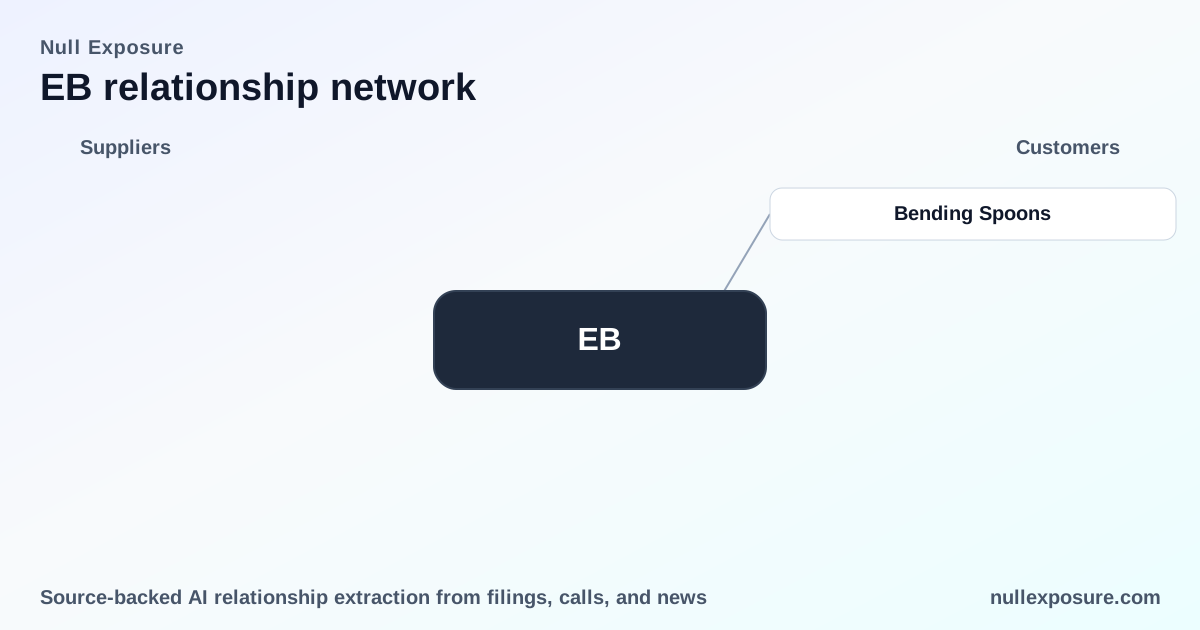
Bending Spoons — A December 17, 2025 news item reported Eventbrite’s sale to Bending Spoons for $4.50 in cash per share. This transaction-level relationship represents an exit event for public investors and shifts the company from a listed marketplace to an ownership structure under a single acquirer, with implications for contract continuity and strategic direction. (Source: Sahm Capital news item dated December 17, 2025.)
What the contract and counterparty signals tell investors
The public constraint signals extracted from Eventbrite’s disclosures provide a clear read on operating model characteristics that matter when evaluating customers and counterparties:
- Contracting posture — mixed, with both subscription and usage-based pricing. The company explicitly offers Pro subscription plans on monthly or annual terms while also collecting flat plus percentage ticket fees on each sale, creating a hybrid contracting posture that balances recurring revenue and transactional upside.
- Counterparty profile — largely individual creators and event seekers plus small-to-medium promoters. Eventbrite’s platform accommodates millions of individual creators and consumers, which produces low individual counterparty concentration but higher operational complexity.
- Geographic footprint — global with a U.S. concentration. Eventbrite positions itself as a global marketplace, having issued hundreds of millions of tickets worldwide, but its net revenue breakdown indicates material U.S. concentration (about $236.5 million of $325.1 million in 2024).
- Role dynamics — predominantly a service provider and seller of ticketing services. The company functions as both a seller (collecting fees) and a service provider (platform tools, payment processing, marketing suites).
- Lifecycle and maturity — active marketplace with scale but event-driven volatility. High activity metrics (millions of events, hundreds of millions of tickets) signal operational maturity and scale, yet revenue remains sensitive to event cycles and macro conditions.
These are company-level signals; none attribute a constraint to a specific third party unless directly stated in source excerpts.
Concentration, criticality and what to watch in vendor/customer risk
Eventbrite’s business benefits from broad creator diversity, which reduces counterparty concentration risk versus enterprise SaaS vendors that are top-customer dependent. However, the model creates other structural exposures investors must monitor:
- Revenue sensitivity to ticket volume and consumer demand. Usage-linked fees mean that macro shocks to live events translate quickly into revenue swings.
- Subscription adoption as an insulation mechanism. Growth in Pro plan uptake materially improves revenue predictability and reduces the volatility inherent in ticket sales.
- Geographic concentration risk. With a majority of net revenue generated in the U.S., policy or market shifts in North America have outsized earnings impact.
- Payment processing and platform uptime criticality. The platform is a payment and distribution gateway for creators; operational disruptions have immediate monetization consequences.
Relationship summaries investors need on the record
- Bending Spoons — The company’s sale to Bending Spoons for $4.50 per share was reported in December 2025, representing an acquiror relationship that transfers control and sets the strategic horizon under a new owner. (Source: Sahm Capital news item, December 17, 2025.)
Implications for valuation and diligence
Investors and operators assessing Eventbrite customer relationships should prioritize three diligence vectors:
- Subscription penetration metrics — the share of creators on Pro or equivalent plans directly influences recurring revenue quality.
- Gross ticket sales and take-rate trends — these determine the scaling of the transactional revenue engine.
- Geographic revenue mix and growth cadence — an improving international mix reduces U.S.-centric revenue concentration.
For transaction or partnership diligence, confirm contract terms for subscriptions (monthly vs. annual churn), average take-rates, and the resilience of payment processing arrangements under high-load event scenarios.
Explore more structured summaries and related corporate signals at the NullExposure homepage: https://nullexposure.com/.
Bottom line: trade-offs and the investor checklist
Eventbrite offers a clear monetization vector rooted in volume-led transaction fees augmented by subscription revenue, delivering both growth upside and cyclical exposure. The Bending Spoons acquisition alters governance and strategic optionality, but the underlying commercial model—hybrid pricing, global reach with U.S. concentration, and a predominantly individual creator counterparty base—remains the primary determinant of future revenue and risk. Investors should focus on subscription adoption, take-rate durability, and geographic diversification as the three actionable indicators to monitor going forward.