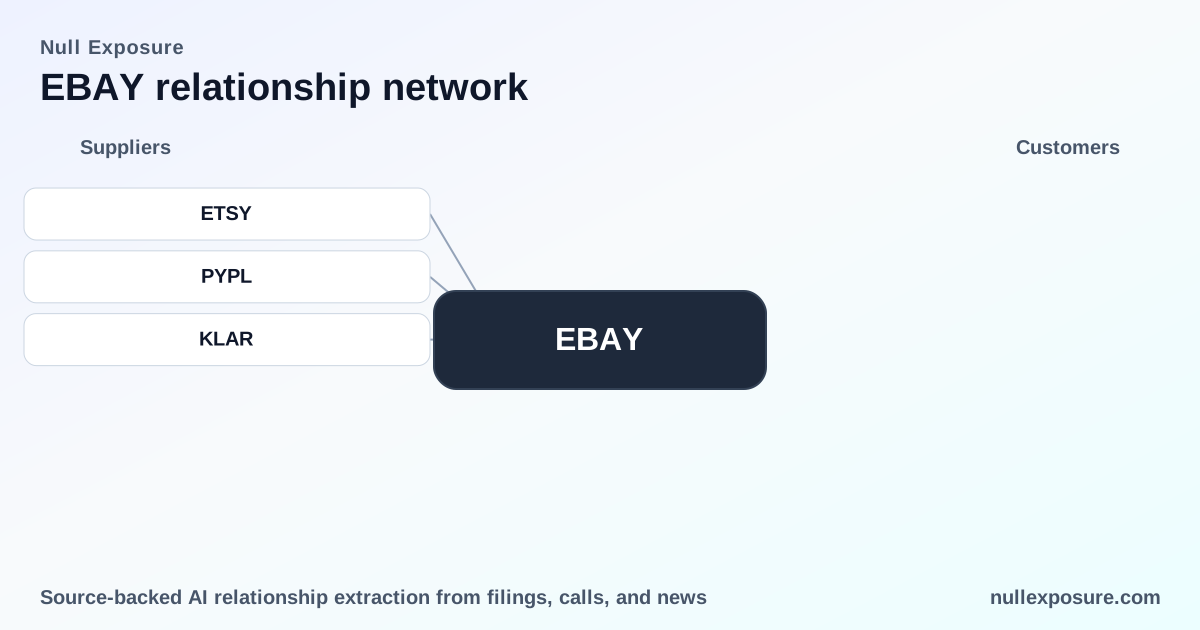
eBay’s commercial map: how partner relationships feed marketplace growth and risk
eBay operates a global online marketplace that monetizes primarily through transaction fees, payment processing, store subscriptions and first‑party advertising. The company drives revenue by enabling buyer and seller activity across both consumer and small‑business sellers, while progressively layering new distribution channels (eBay Live, off‑platform integrations) and branded activations to boost gross merchandise volume (GMV) and take rates. For a concise strategic data kit and extended partner matrices, visit https://nullexposure.com/.
Why partner relationships matter to eBay’s economics
eBay’s business model is highly correlated with seller health and distribution reach. Company disclosures and recent commentary show a mix of short‑term contract dynamics (many obligations satisfied in subsequent reporting periods) alongside recurring revenue components such as store subscriptions and advertising. This creates a hybrid contracting posture: frequent, transactional interactions with sellers, combined with subscription‑style revenues that smooth cash flow.
Other company‑level signals:
- eBay is a global platform, operating in more than 190 markets, which diversifies geo‑exposure but increases regulatory/tax complexity. (Company overview; FY periods cited in filings.)
- The economics are material: eBay’s model is structured so that the company succeeds when sellers succeed, tying revenue directly to transactional success and advertising uptake.
- Counterparty concentration is low in headline terms because the platform serves millions of buyers and sellers, including a meaningful small‑business seller base and programmatic enablement efforts for SMBs.
- Relationship roles are dual: buyers and sellers both interact with eBay at scale, and the company bears buyer‑protection obligations that influence returns and margins.
- The platform is operationally mature and active—eBay reported 134 million active buyers and billions of live listings at year end—so partnerships are executed in a high‑scale environment where marginal improvements to distribution and discovery drive measurable GMV impact.
Detailed partner rundown: every relationship mentioned in the coverage
Marks & Spencer — live commerce pilot accelerates fashion GMV
eBay ran its first direct‑from‑brand live shopping event with Marks & Spencer in the U.K., and leadership says eBay Live is becoming a meaningful GMV driver in select fashion categories. This was disclosed in eBay’s Q1 2026 earnings call transcript. (Investing.com, Q1 2026 earnings call transcript, 2026-05-02.)
WeShop (WSHP) — aggregator partnerships extend inventory reach in the U.K.
WeShop publicly lists eBay among the major retailers integrated into its U.K. marketplace, giving consumers off‑platform access to eBay listings alongside other high‑profile retailers. This relationship emphasizes distribution breadth rather than exclusivity, increasing eBay inventory exposure to third‑party channels. (SEC Form F‑1 and TradingView reports, FY2025 filings and March 2026 press coverage.)
Facebook / Facebook Marketplace (META) — search integration broadens discovery
eBay inventory is now enabled within the Facebook Marketplace search box for a majority of users in the U.S., Germany and France, placing eBay listings directly in social‑platform discovery flows and expanding buyer access beyond eBay properties. (eBay Q1 2026 earnings call transcripts published on Investing.com and InsiderMonkey, Q1 2026.)
New York Times references — eBay as a consumer‑facing partner in sports/entertainment bundles
Press coverage in The New York Times and associated Athletic reporting lists eBay among platform partners (for collectibles and ticketing contexts referenced alongside BetMGM, Fubo, StubHub), signaling brand positioning in high‑visibility consumer categories. (The New York Times / The Athletic, October 2025.)
Goldin — high‑value auction facilitation highlighted in quarter
Management cited Goldin in quarterly commentary as facilitating several landmark sales (including a record trading‑card auction), underscoring eBay’s presence and facilitation in the high‑value collectibles market where auction credibility and ancillary services drive elevated take rates. (Fool transcript of eBay Q1 2026 earnings call, 2026-04-29.)
TCGplayer — coordinated activations across collectible channels
eBay referenced coordinated activations across its core marketplace, eBay Live, TCGplayer and Goldin, indicating an omnichannel activation strategy that leverages owned and partner platforms to boost GMV in collectibles and gaming categories. (Fool transcript, Q1 2026 earnings call, 2026-04-29.)
GameStop (GME) — resale pipeline and fee structures for graded cards
Analysts and coverage note services that enable instant grading, storage and resale where sellers can sell either directly to GameStop for a specified cut plus trading fees, or list via eBay for a 6% fee, illustrating alternate resale routes and fee comparators that influence seller decisions and category economics. (InsiderMonkey coverage summarizing resale pathways and terms, FY2025/2026 commentary.)
What this network means for investors: levers and risks
- Growth levers: eBay is expanding discovery beyond its own properties (Facebook integration, WeShop partnerships) and scaling new formats (eBay Live, branded activations with major retailers) that lift GMV and advertising inventory. These moves increase buyer access and provide new monetizable touchpoints.
- Revenue profile: the company’s revenues are transactionally driven but supplemented by subscription and advertising, which tempers volatility from purely episodic transactions.
- Operational constraints: the firm operates with a mix of short‑term contracting (transactional sales) and subscription elements, which allows flexibility but requires continuous engagement to sustain seller activity. This is a company‑level characteristic, not tied to any single partner.
- Concentration and criticality: while no single partner dominates the platform, eBay’s reliance on millions of sellers—including SMBs—means seller health is critical; programs to support small businesses are strategically material.
- Regulatory and tax exposure: global scale increases tax and regulatory complexity, and buyer‑protection policies impose operational cost and return‑rate risks that influence margins.
Bottom line and next steps
eBay’s partner mentions reflect an operating model transitioning from pure marketplace listings to an integrated distribution and activation network that includes social search, live commerce and curated collectibles channels—each contributing to discoverability and monetization. The company’s revenue mechanics combine short‑term transactional flows with subscription and advertising that improve predictability while keeping the business sensitive to seller outcomes and regulatory dynamics.
For a strategic partner map and to benchmark these relationships against marketplace peers, visit https://nullexposure.com/ for our curated investor brief.