Eastern Bankshares (EBC) — Customer relationships that underwrite a New England growth story
Eastern Bankshares (EBC) operates as the holding company for Eastern Bank, a regional full-service bank that monetizes through net interest income on lending and deposits, recurring fee income from wealth and trust services, and commercial banking lending relationships concentrated in the greater Boston region. The customer roster disclosed in public reporting and contemporaneous news coverage highlights a mix of mid‑market commercial lending, construction and affordable housing finance, small‑business working capital, and specialty commercial deposit relationships that together shape Eastern’s balance‑sheet risk and funding profile. For a deeper look at relationship-level intelligence, see NullExposure’s research hub: https://nullexposure.com/.
Why customer detail matters for investors
Eastern’s business model is highly regional and relationship-driven. The company positions itself as a multi-product lead bank for customers with annual revenues typically in the $10 million–$500 million range while also serving individuals, small businesses and public entities across New England. That positioning creates three investment-relevant dynamics:
- Funding concentration and criticality: Deposits sourced through the branch network remain a primary funding engine for lending activity, which makes customer deposit behavior a critical operational lever.
- Range of relationship sizes: Loan exposure information shows average commercial and construction balances consistent with $1m–$100m spend bands, implying a mix of smaller business loans and larger mid‑market commercial exposures.
- Service orientation and fee mix: Wealth, trust and card services generate usage‑linked fee income—an important complement to interest margins and a signal of sticky customer engagement.
These are company‑level signals drawn from Eastern’s filings and public disclosures; they reflect contracting posture (short term commitments for some products), usage‑based fee economics for investment custody, geography concentration (New England) and a relationship mix that spans individuals, non‑profits, small businesses and mid‑market firms. For direct access to relationship analytics and source tracing, visit NullExposure’s portal: https://nullexposure.com/.
Relationship-by-relationship notes (source-backed)
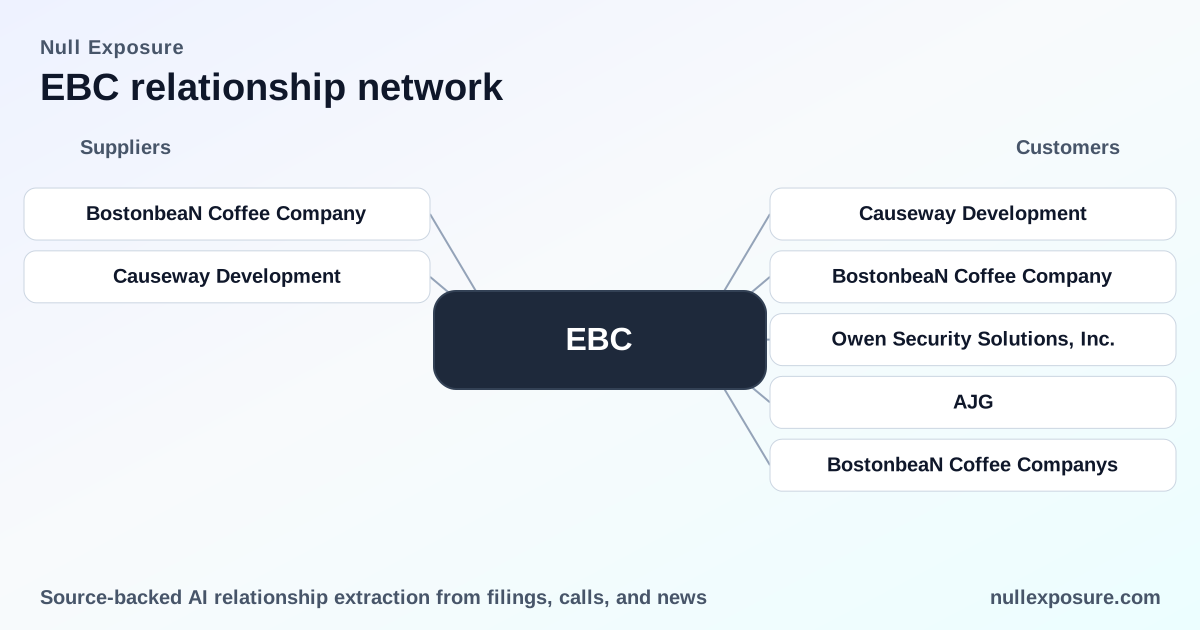
Causeway Development
Eastern provided a $15.5 million construction loan to Causeway Development for an affordable housing project, a transaction that reflects Eastern’s active role in community and construction finance in its footprint. Source: Finviz coverage of Eastern’s Q4/FY2026 reporting (March 2026) — https://finviz.com/news/287310/ebc-q4-deep-dive-organic-growth-and-integration-shape-2026-priorities.
BostonbeaN Coffee Company
Eastern financed BostonbeaN Coffee Company’s transition to 100% employee ownership, structuring a term loan for the ESOP plus a revolving line for working capital, demonstrating Eastern’s willingness to underwrite owner succession and ESOP conversions for small businesses. Source: Intellectia.ai reporting (March 2026) and corroborating Finviz items summarizing the FY2026 disclosures — https://intellectia.ai/news/stock/eastern-bank-provides-comprehensive-banking-solutions-to-owen-security-solutions-inc and https://finviz.com/news/281948/eastern-bank-ebc-to-report-earnings-tomorrow-here-is-what-to-expect.
Owen Security Solutions, Inc.
Eastern announced a new commercial banking relationship with Owen Security Solutions, providing “comprehensive banking solutions” to support growth in the security alarm sector—an example of Eastern adding industry‑specific commercial clients and cross‑selling deposit and lending products. Source: Intellectia.ai news note on client relationships (March 2026) — https://intellectia.ai/news/stock/eastern-bank-provides-comprehensive-banking-solutions-to-owen-security-solutions-inc.
Arthur J. Gallagher & Co. (AJG)
Market commentary traced Eastern’s strategic disposition of its insurance business, noting the $510 million sale of Eastern’s insurance division to Arthur J. Gallagher & Co. in 2023, a disposal that materially reshaped fee income and segment composition and reduced Eastern’s direct exposure to insurance brokerage operations. Source: Markets.FinancialContent reporting (January 2026) referencing the AJG transaction — https://markets.financialcontent.com/wral/article/marketminute-2026-1-1-eastern-bankshares-ebc-hits-triple-digit-profits-the-116-million-conviction-story.
Operating model constraints investors should factor in
Eastern’s disclosure and public reporting generate a set of company-level constraints and operating signals that determine how customer relationships translate to earnings and risk:
- Contracting posture — short-term commitments exist: Some customer commitments (for example, certain lines or commitments) are short-term in nature and often expire within 30–60 days, which implies rolling renewal risk for portions of contingent funding.
- Usage‑based fee components: Wealth management and custody revenues are tied to monthly valuation of assets, introducing sensitivity to market values that affects non‑interest income.
- Counterparty mix and concentration: The bank’s client base explicitly includes individuals, municipalities, small businesses, non‑profits and mid‑market firms, concentrated geographically in eastern Massachusetts, southern New Hampshire and northern Rhode Island—a concentration that amplifies local economic cycles.
- Materiality of deposits: Deposits collected through the branch network are a principal, critical source of funding for lending activities, making customer deposit retention and local competitive dynamics central to balance‑sheet stability.
- Relationship maturity and scale: The loan portfolio includes a large number of commercial relationships (roughly 11,000 reported), with typical exposures spanning from sub‑$1m small business loans to tens of millions for top construction and C&I credits, indicating a diversified but regionally concentrated balance‑sheet mix.
These operating characteristics are derived from Eastern’s public filing language and the relationship evidence summarized above; they should be treated as structural attributes rather than statements tied to any single customer unless the original disclosure explicitly identifies that customer.
Investment implications — what investors and operators should take away
- Top‑line: Eastern leverages a diversified set of commercial and retail customer relationships to generate both interest income and fee revenue; relationship lending and deposit capture are core earnings drivers.
- Risk profile: Geographic concentration and reliance on branch‑sourced deposits create idiosyncratic regional risk, while usage‑based wealth fees introduce market‑value sensitivity to non‑interest income.
- Execution focus: Continued success depends on organic growth, integration of acquired businesses, and the bank’s ability to convert commercial origination into stable deposit and fee relationships—all visible in the recent transactions highlighted above.
For investors seeking granular relationship intelligence and source‑level traceability on EBC’s customer positioning, NullExposure provides curated extraction and annotation of customer disclosures and press coverage: https://nullexposure.com/.
Overall, Eastern’s recent customer activity — construction financing, ESOP and small‑business lending, new commercial relationships, and strategic disposals — reinforces a business model centered on regional lending depth and diversified fee streams, a profile that supports stable profitability if local economic conditions remain supportive.