Ennis Inc (EBF): Trade-printer cash flows, distributor-led scale, and a targeted tuck‑in strategy
Ennis Inc operates as a trade printer that designs, manufactures and sells custom and semi‑custom printed business products predominantly to independent distributors across the continental United States. The business monetizes through point‑of‑sale product sales to distributors and, to a much lesser extent, modest storage and fulfillment fees; operating cash flow is driven by manufacturing throughput, distributor relationships and recurring order cadence. For investors evaluating customer relationships, the key lens is channel exposure — Ennis sells through intermediaries rather than direct retail — coupled with short‑term contracting and a predominantly North American footprint. Learn more at NullExposure.
Company snapshot and what matters to investors
- Ennis is a small‑cap industrials business with market capitalization roughly $519M and TTM revenue near $392M. Profitability metrics show a ~11% net margin and an operating margin ~12.5%, with a trailing P/E of ~12.4 and a ~4.7% dividend yield.
- The firm’s economics depend on manufacturing efficiency and stable distributor demand; low beta (0.29) signals an earnings profile that is less cyclical than pure industrial peers.
- Key monetization drivers: product pricing to distributors, volume from repeat orders, and incremental storage/fulfillment activity (immaterial today but operationally relevant).
How Ennis’ operating model shapes customer risk and upside
- Short‑term contracting posture: Ennis’ customer contracts are generally short‑term, which constrains revenue visibility but increases pricing flexibility in inflationary environments. This operational characteristic creates higher order churn relative to long‑term supply contracts and requires active distributor management to sustain volumes (stated in company filings).
- Distributor/reseller channel concentration: The business sells mostly to independent distributors and resellers throughout the U.S., positioning Ennis as a middle‑mile manufacturer rather than a consumer brand owner. That channel orientation reduces marketing capex but increases dependence on third‑party distribution economics and relationships (10‑K disclosures).
- North American concentration: Substantially all revenue is commercial printing sold in the continental United States, concentrating macro and policy risk geographically while simplifying logistics and regulatory exposure.
- Manufacturing and service mix: The single operating segment is manufacturing‑centric; service revenues such as storage or just‑in‑time fulfillment exist but are immaterial to consolidated financials. The company’s role is therefore largely capital‑intensive production plus order management.
- Selective direct large enterprise sales: While the distribution model dominates, certain subsidiaries and business lines sell direct to a small number of large enterprise customers (for example, banking organizations) where distributors are not acceptable, indicating a hybrid channel model for strategic accounts.
Customer and acquisition relationships — what’s in play This section covers the relationships disclosed in the research feed and how each affects channel exposure and revenue composition.
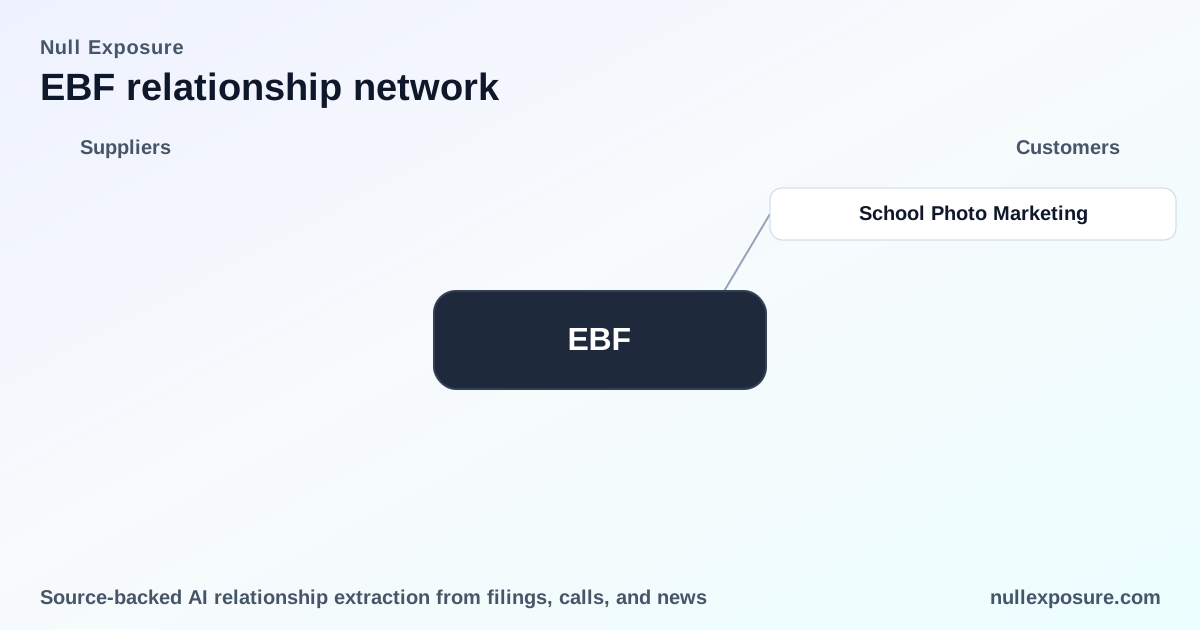
School Photo Marketing — a targeted vertical tuck‑in Ennis acquired School Photo Marketing, a Morganville, New Jersey firm that provides printing, yearbook publishing and marketing‑related services to more than 1,400 school and sports photographers serving schools across the United States. This purchase expands Ennis’ reach into the school photography and yearbook vertical and reinforces its distributor/reseller strategy by adding a specialized supplier network and recurring seasonal volume. According to an industry newsletter (ASI Central Promogram, December 2022), Ennis completed the acquisition to broaden its product and customer footprint in niche education printing services. Source: ASI Central Promogram newsletter (Dec 2022).
Operational and strategic implications of the School Photo Marketing acquisition
- Demand seasonality and cadence: School and sports photography is inherently seasonal and volume‑driven; integrating this vertical introduces predictable annual peaks that manufacturing and working capital processes must absorb.
- Distributor economics reinforced: The target services a large base of photographers who, in turn, sell to schools and families—this maps to Ennis’ core strength as a trade printer and is consistent with the company’s reseller/distributor orientation.
- Limited scale risk: While the acquisition adds reach into a niche market, the impact on consolidated revenue and margins is incremental unless Ennis pursues further consolidating acquisitions in adjacent verticals.
Constraints and company‑level signals investors must price in The following are company‑level characteristics drawn from Ennis’ public disclosures; they describe how the business contracts, where it sells, and the customer archetypes it serves.
- Contract type — short term: The company explicitly states that customer contracts are generally short‑term in nature, reducing near‑term revenue visibility but preserving pricing flexibility.
- Counterparty type — large enterprise exposure in pockets: Ennis notes that certain subsidiaries sell directly to large banking organizations when a distributor is not acceptable; this indicates selective high‑touch, high‑credit customers alongside the broad distributor base.
- Geographic concentration — North America: Revenue is primarily derived from the continental United States; geographic risk is concentrated, simplifying operations yet limiting international diversification.
- Relationship roles — distributor/reseller heavy: The core customer base is independent distributors, resellers and related intermediaries; distributors handle end‑customer sales while Ennis focuses on production and fulfillment.
- Service provider role — limited but present: Ennis performs storage and customer‑specified future delivery in a small number of cases; storage revenue is recognized over time for those customers but remains immaterial to consolidated results.
- Segment focus — manufacturing: The company operates a single reportable segment centered on manufacturing printed products, underscoring capital requirements and margin sensitivity to input costs.
Key investment takeaways
- Channel leverage is the defining feature: Ennis’ returns and risks are tied to distributor economics, order frequency and retention. Successful distributor partnerships materially amplify scale without direct retail exposure.
- Revenue visibility is lower but margins remain resilient: Short‑term contracts limit predictability, yet Ennis generates mid‑teens operating margins historically and sustains a cash dividend, which is attractive to income‑oriented investors.
- Acquisitions that extend distributor reach are logical: The School Photo Marketing purchase is consistent with a tuck‑in strategy that augments seasonal volume and domain expertise in specialty printing.
- Concentration and seasonality are the primary risks: Geographic concentration in the U.S. and vertical seasonality (education and yearbooks) require robust working capital management and operational flexibility.
If you want a deeper, relationship‑level breakdown across Ennis’ customers and recent deals, NullExposure maintains a structured view of customer links and corporate filings — visit NullExposure homepage for the full research suite.