Emergent BioSolutions: customer relationships that define revenue resilience and program risk
Emergent BioSolutions operates as a dual-purpose biopharma and contract manufacturer: it sells core medical countermeasures (notably BioThrax and NARCAN) into government and commercial channels, and it monetizes contract development and manufacturing services for third-party biopharma clients. Revenue drivers are concentrated on government procurements and multi-year services agreements, while services contracts provide margin diversification and capacity utilization. For an investor or operator, the relationship map below explains who pays, why contracts are durable, and where program risk concentrates. Learn more at https://nullexposure.com/.
What to watch: thesis in one paragraph
Emergent’s business model blends government-guaranteed volumes for biodefense products with fee-for-service manufacturing for commercial vaccine and biologic sponsors; this mix produces steady cash flow from multiyear government buys and episodic, higher-margin manufacturing wins. The company’s exposure is therefore a function of government procurement concentration, the health of its third‑party manufacturing pipeline, and reputational/mfg execution risks that can amplify volatility.
How the company-level constraints shape the commercial picture
- Contracts are typically long-term and option-driven. Emergent discloses that U.S. government purchases are generally made under long-term, firm fixed‑price procurement contracts with annual options, which supports predictable topline in biodefense products.
- Framework/IDIQ mechanisms are in play. The company references a BioThrax IDIQ award effective January 2024, giving Emergent recurring access to government delivery orders.
- Government customers are material and concentrated. The U.S. government accounted for roughly 39% of revenue in 2024, signaling high counterparty concentration and attendant policy/budget risk.
- Geography skews North America but is globally positioned. Revenue attribution is primarily U.S.-based, though product authorizations and contracts exist in EMEA and other markets.
- Dual operating segments: Core marketed products (NARCAN, BioThrax) drive recurring sales to public-sector and individual channels, while the Services segment supplies contract manufacturing and development across mammalian, microbial, viral and plasma platforms.
These constraints frame Emergent as a government-centric supplier with a services business that both mitigates and concentrates operational risk.
Relationship roll call — every reported customer, one by one
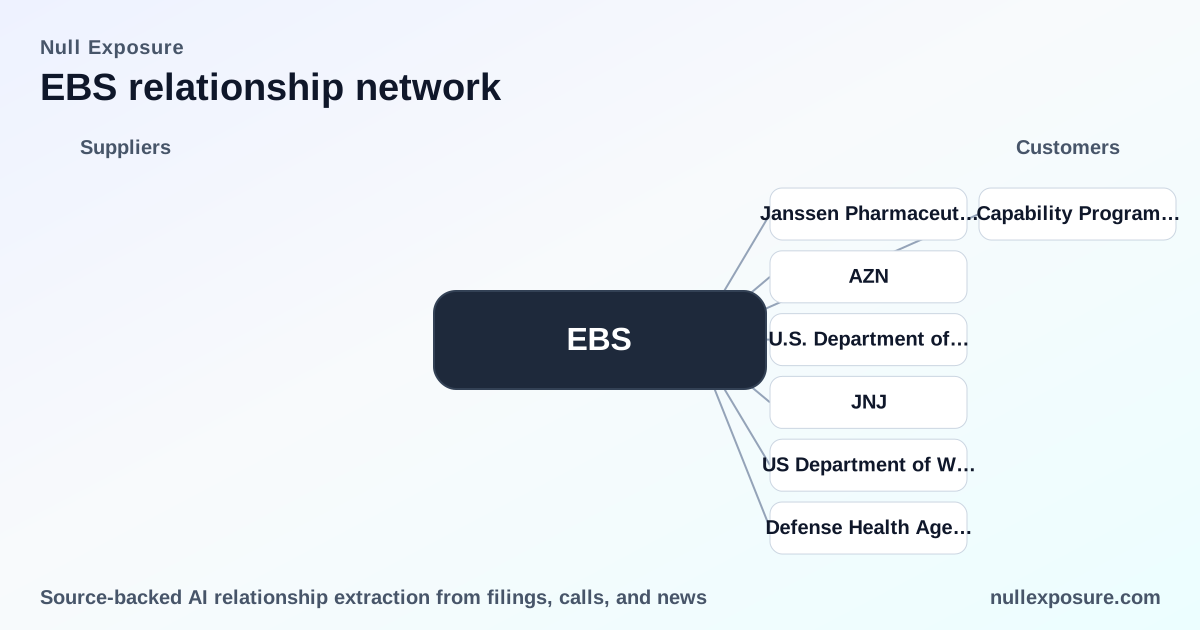
Below are each of the reported customer relationships pulled from filings and media coverage, with plain-English descriptions and source context.
-
Janssen Pharmaceuticals, Inc. — Emergent’s wholly owned manufacturing arm entered a July 2020 agreement to provide large-scale drug substance manufacturing for Janssen’s SARS‑CoV‑2 vaccine program, evidencing the company’s role as a strategic contract manufacturer for big‑pharma vaccine programs. Source: Emergent 2024 Form 10‑K (fiscal 2024 filing).
-
AstraZeneca (AZN) — Emergent signed contracts in 2020 worth approximately $261 million to manufacture AstraZeneca’s COVID‑19 vaccine, underlining the firm’s participation in pandemic-era large-scale vaccine production. Source: StockTwits news article reporting on contract history (reported FY2026).
-
AZN (duplicate entry) — Same contract reference to AstraZeneca’s COVID‑19 vaccine manufacturing, appearing across multiple media feeds noting Emergent’s role in producing third‑party COVID shots. Source: StockTwits news article (FY2026).
-
Substipharm Biologics — Emergent agreed to produce drug substance for Substipharm’s Japanese Encephalitis vaccine (IMOJEV) at its Canton, Massachusetts facility, demonstrating services reach into international vaccine supply chains. Source: Investing.com coverage citing the manufacturing agreement (FY2026).
-
AstraZeneca (again, from FiercePharma) — Media coverage reiterates that Emergent produced COVID vaccines for AstraZeneca and Johnson & Johnson, framing the company historically as a pandemic contract manufacturer. Source: FiercePharma article on executive legal matters (FY2026).
-
AZN (duplicate FiercePharma mention) — Restates the AstraZeneca manufacturing engagement as reported in FiercePharma. Source: FiercePharma (FY2026).
-
Johnson & Johnson (JNJ) — FiercePharma notes Emergent manufactured COVID‑19 shots for Janssen/Johnson & Johnson as part of its contract manufacturing activities during the pandemic. Source: FiercePharma (FY2026).
-
US Department of War — Trade press reported an order worth up to $21.5 million from an entity styled as the “US Department of War” to Emergent; the coverage describes a government delivery order for BioThrax supply in 2026. Source: InsiderMonkey reporting on the order (FY2026).
-
SABS (Sab Biotherapeutics) — Marketscreener and other outlets reported a multi‑year manufacturing agreement with Sab Biotherapeutics, positioning Emergent to provide end‑to‑end development and cGMP manufacturing services for SAB‑142 and other candidates. Source: MarketScreener and Investing News releases (FY2026).
-
U.S. Department of War (Yahoo Finance) — Emergent announced a delivery order valued up to $21.5 million to supply BioThrax in 2026, confirming government demand through existing contract vehicles. Source: Yahoo Finance press release coverage (FY2026).
-
SABS (Investing.com) — Investing.com noted Emergent’s long‑term strategic manufacturing contract with Sab Biotherapeutics to advance a Type‑1 diabetes candidate, highlighting the company’s role in novel therapeutic manufacturing. Source: Investing.com feature (FY2026).
-
SAB Biotherapeutics (citybiz/press) — CityBiz and other local business outlets reported the same multi‑year manufacturing and development agreement with SAB Biotherapeutics supporting production of SAB‑142, cited as a roughly $50 million contract value in some coverage. Source: CityBiz and press releases (FY2026).
-
SAB Biotherapeutics (earnings call transcript) — Company management reiterated the second strategic manufacturing partnership with SAB Biotherapeutics during the Q1 2026 earnings call, signaling active expansion of services pipeline. Source: Earnings call transcript coverage on Investing.com (FY2026).
-
Administration for Strategic Preparedness and Response (ASPR) — Emergent secured a contract valued at approximately $54 million to deliver Vaccinia Immune Globulin Intravenous for smallpox preparedness, reflecting continued federal buys for biodefense stockpiling. Source: Investing.com analyst note summarizing contract awards (FY2026).
-
Government of Canada — Emergent executed multi‑year agreements with the Government of Canada valued up to CAN$140 million to support national biologic threat preparedness and response infrastructure, indicating international government customer traction. Source: Investing.com reporting on contract awards (FY2026).
-
Amazon (AMZN) — Emergent launched a NARCAN Nasal Spray carrying case and multipacks that are now available on Amazon, showing commercial channel distribution for its overdose‑reversal product to consumer and institutional buyers. Source: GlobeNewswire and business press coverage noting Amazon listing (FY2026).
-
Defense Health Agency — The delivery order for BioThrax is administered under an existing IDIQ contract led by the CPE CBRND in collaboration with the Defense Health Agency, demonstrating the company’s integration into military health procurement channels. Source: Yahoo Finance press summary (FY2026).
-
Capability Program Executive Chemical, Biological, Radiological and Nuclear Defense (CPE CBRND) — The BioThrax delivery order falls under IDIQ contract W911SR24D0001 led by CPE CBRND (formerly JPEO‑CBRND), affirming Emergent’s slot on defense procurement frameworks. Source: Yahoo Finance press coverage summarizing the IDIQ (FY2026).
-
Amazon (duplicate GlobeNewswire entry) — Additional press distribution confirms the NARCAN carrying case availability on Amazon, reinforcing retail/commercial placement for the product line. Source: GlobeNewswire press release (FY2026).
Key takeaways for investors and operators
- Government demand is foundational and material. Public-sector contracts, IDIQ frameworks, and annual option structures create a predictable revenue baseline but concentrate political and budget risk.
- Services contracts broaden addressable market but concentrate operational execution risk. Large, multi‑year manufacturing agreements with sponsors such as AstraZeneca, Janssen, and SAB Biotherapeutics generate utilization and higher-margin revenue but require flawless GMP compliance.
- Commercial channels complement biodefense sales. NARCAN’s retail availability on Amazon highlights a consumer/direct‑to‑institution revenue stream that diversifies counterparty mix.
- Watch contract cadence and award notices. Future delivery orders under IDIQs and new multi‑year service agreements will materially affect revenue visibility and margin trajectory.
For a deeper read on how these relationships translate to balance‑sheet stability and program execution risk, visit https://nullexposure.com/ for detailed intelligence and model-ready summaries.