Enterprise Bancorp (EBTC): Local lending relationships that reinforce a community-bank revenue model
Enterprise Bancorp operates through Enterprise Bank as a classic regional community bank: it earns net interest margin and fee income by taking local deposits, underwriting small-business and nonprofit loans, and cross-selling treasury and deposit services. Enterprise’s customer footprint documented here—PPP borrowers and a long-term community partner—confirms a business model driven by relationship lending, deposit capture, and modest fee-based services. For investors this pattern supports stable core revenue and a low-beta profile, while exposing the company to credit concentration in small commercial portfolios and to local economic cycles. Learn more at https://nullexposure.com/.
Why these customer relationships matter for investors
Enterprise Bank has reported 126 consecutive profitable quarters and presents as a steady regional franchise with a conservative balance-sheet orientation. The customer examples in public reporting and local press are not marquee corporate clients; they are small businesses and nonprofits that generate low-margin but predictable loan interest, transactional deposit flows, and long-term relationship value. That combination supports the bank’s valuation multiples (trailing P/E ~12.1; price-to-book ~1.29) and explains why institutional ownership sits in the mid-thirties percent range.
- Revenue drivers: interest income from commercial loans and deposits; cross-sell of cash management and trust services.
- Risk profile: high exposure to local economic conditions and sector-specific stress among small businesses; credit underwriting and deposit stability are key.
- Balance-sheet implication: community-bank scale and customer mix point to incremental, relationship-driven growth rather than large-ticket corporate lending.
If you want a concise mapping of local customer ties to strategic priorities, visit https://nullexposure.com/ for a focused view.
What the lack of explicit constraints tells us about the operating posture
The dataset returned no explicit contractual or third-party constraint excerpts for EBTC’s customer relationships. That absence is a company-level signal: there is no evidence in this sample of material vendor or counterparty constraints disclosed alongside these customer relationship mentions, which aligns with Enterprise Bank’s community banking model where customer interactions are bilateral and not typically mediated by complex third-party arrangements. Investors should interpret this as a sign of operational maturity in a low-complexity franchise rather than as proof of absence of risk—the bank’s key exposures are credit concentration and local economic cycles rather than large-scale vendor dependency.
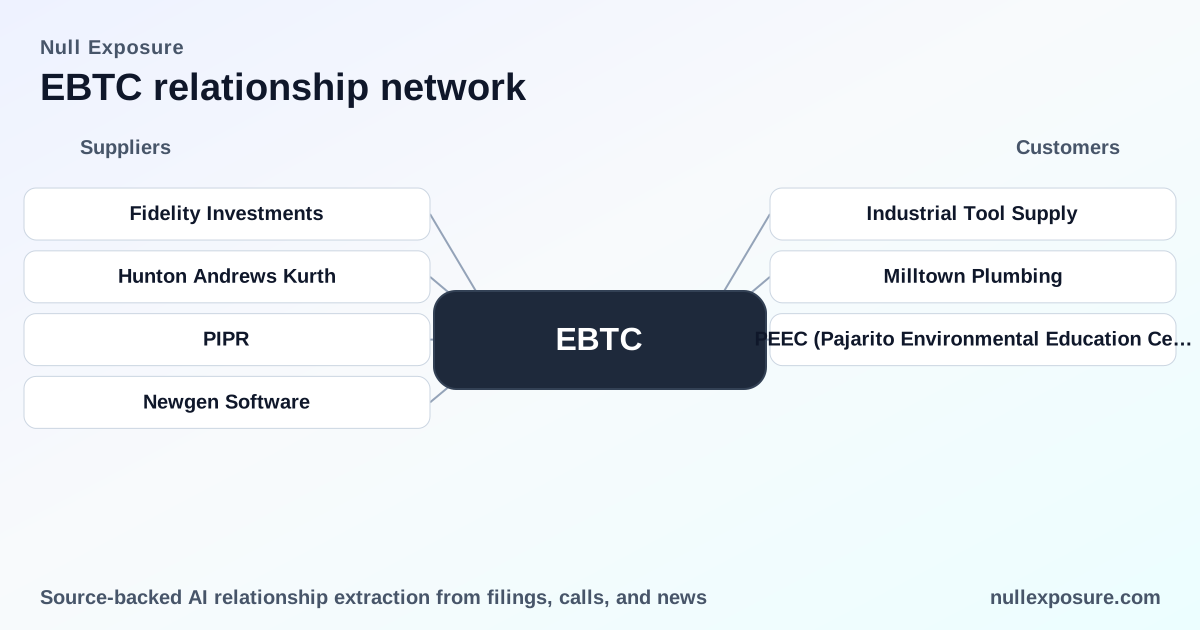
The customer relationships documented (four local partners)
Below I cover each referenced relationship in plain English with source context.
Industrial Tool Supply — a borrower that credited Enterprise for PPP assistance
Enterprise Bank processed a PPP application for Industrial Tool Supply and received public praise for helping the company navigate the loan process during the pandemic. This episode is evidence of Enterprise’s role as a frontline lender servicing small industrial and trade businesses (Lowell Sun, Feb 8, 2021; article recounting customer testimonial: https://www.lowellsun.com/2021/02/08/enterprise-bank-a-lifesaver-for-small-businesses/).
Milltown Plumbing — small commercial client preserved payroll through a bank-facilitated PPP loan
A Milltown Plumbing owner applied for and received Paycheck Protection Program financing through Enterprise Bank within ten days, illustrating the bank’s operational capacity to deliver timely small-business credit in crisis periods (Lowell Sun, Feb 8, 2021; report on PPP customer experiences: https://www.lowellsun.com/2021/02/08/enterprise-bank-a-lifesaver-for-small-businesses/).
The Boys and Girls Club of Greater Lowell — nonprofit borrower supported by PPP lending
The Boys and Girls Club of Greater Lowell was identified as one of the nonprofits that obtained PPP financing processed by Enterprise, which shows the bank’s engagement with mission-driven local organizations and its role in regional social infrastructure financing (Lowell Sun, May 16, 2020; local reporting on PPP volume: https://www.lowellsun.com/2020/05/16/enterprise-bank-helps-with-over-500m-in-small-business-loans/).
PEEC (Pajarito Environmental Education Center) — long-term community partnership
PEEC has been described as Enterprise Bank’s environmental educational partner since its inception, underscoring a multi-year, noncommercial community relationship that supports enterprise branding, local deposit gathering, and reputational capital (Los Alamos Daily Post, FY2025 coverage of PEEC’s 10th anniversary; article: https://ladailypost.com/peecs-los-alamos-nature-center-marks-10th-year-with-gratitude/).
What these relationships collectively signal about maturity, concentration, and criticality
Taken together, the relationships highlight three practical business-model characteristics:
- Maturity: The mix of long-term community partnerships and consistent small-business lending is consistent with a mature regional bank that prioritizes stable, relationship-driven growth over aggressive risk-taking.
- Concentration: Exposure is concentrated in locally based small commercial and nonprofit borrowers rather than diversified national corporate credits; that concentration is manageable within a community bank model but raises sensitivity to regional economic shocks.
- Criticality: For the bank, these customers are strategically valuable for deposit gathering, fee income, and community reputation; for the customers, Enterprise functions as a critical local credit and cash-management provider, especially during stress periods like the PPP rollout.
Investment implications and risk focus
Enterprise Bancorp’s documented customer interactions reinforce its position as a conservative, community-focused bank that monetizes through interest spread and cross-sold services. That profile supports steady earnings and dividend distributions (recent dividend per share ~0.97; yield ~2.45%). Key investor focus areas are:
- Monitor local economic indicators and small-business credit performance for signs of stress in the bank’s core portfolio.
- Track deposit trends and loan growth cadence to assess whether relationship lending is translating into durable balance-sheet expansion.
- Evaluate potential concentration risk in any single local sector—trade services, construction-related firms, and nonprofits—that could amplify cyclical volatility.
Bottom line
The public record of Enterprise Bank’s customer interactions during and after the PPP period demonstrates an operationally capable, community-embedded lender that converts local relationships into steady deposit and loan economics. For investors seeking exposure to a low-beta regional bank with consistent profitability, Enterprise’s customer profile reinforces the income-oriented thesis—while also flagging the need for ongoing monitoring of local-credit cycles and concentration risk.
For deeper signal analysis and comparative customer-mapping across regional banks, visit https://nullexposure.com/.