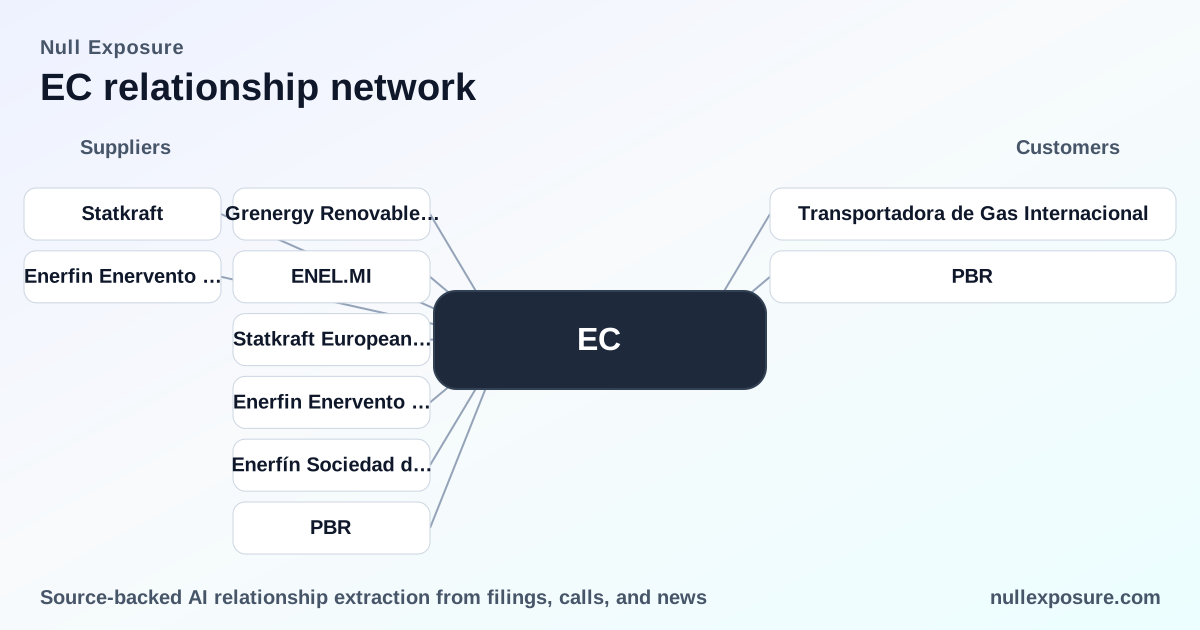
Ecopetrol (EC): Customer Relationships That Drive Revenue, Access and Midstream Control
Ecopetrol is Colombia’s integrated oil and gas champion — upstream production, refining and fuel marketing combined with midstream infrastructure — and it monetizes through commodity sales, long‑term fuel supply contracts, pipeline throughput fees and strategic field partnerships. Revenue comes from direct fuel sales to retail and industrial customers, pipeline access agreements with regional transporters, and asset-level collaborations with international producers, creating predictable cash flows while exposing the company to commodity cycles and geopolitical risk. For a focused view of the customer map and sourcing relationships, visit https://nullexposure.com/.
What the relationship set tells investors about Ecopetrol’s operating model
Ecopetrol’s public relationships reflect a commercial posture that balances long-term contracting with spot sales. The mix of downstream supply agreements (large national fuel distributors), midstream access deals (pipeline operators) and field-level partnerships (international producers) signals concentration around regional infrastructure and strategic co‑development, not diversified retail-only exposure. The information provided does not list prescriptive third‑party constraints on Ecopetrol’s contracts; in other words, no external contractual constraints were flagged in the reviewed feed.
- Contracting posture: Predominantly supply and access agreements that underpin recurring revenue.
- Concentration: Heavy exposure to Colombia’s logistics network and a small set of strategic partners.
- Criticality: Pipeline access and fuel distribution relationships are operationally critical to throughput and sales.
- Maturity: Counterparties range from established multinationals to national distributors — indicating an operationally mature, market‑integrated business model.
Direct commercial customers and midstream partners that matter
-
Organización Terpel S.A. — Ecopetrol will supply Terpel a broad portfolio of liquid fuels including diesel, blended diesel, regular and premium gasoline and biofuel blends, reflecting a large-scale downstream supply agreement that secures volume off‑take for Ecopetrol’s refined products. This arrangement was reported by Mobility Plaza on May 2, 2026 (FY2026). (Source: Mobility Plaza, 2026-05-02)
-
Transportadora de Gas Internacional (TGI) — TGI is negotiating access to two Ecopetrol subsea pipelines so regasified LNG from an FRSU can flow into TGI’s land network, evidencing midstream coordination where Ecopetrol’s pipelines enable third‑party gas commercialization. EnergyNow covered the interview with TGI’s CEO in 2025 (reported March 2026 referencing FY2025 activity). (Source: EnergyNow, Oct 2025 / reported Mar 2026)
-
PBR (Petrobras, listed as PBR) — Ecopetrol and Petrobras closed a joint sale of gas from the Sirius field, selling up to 249 GBTUD, which demonstrates cooperative upstream commercialization with a major international producer to monetize field volumes. This was referenced in a Q4 2025 earnings call transcript (FY2026). (Source: InsiderMonkey, Q4 2025 earnings call transcript, first seen Mar 2026)
-
Petrobras — A duplicate mention of the Sirius field sale with Petrobras reiterates the same operational fact: Ecopetrol executes bilateral field sales and joint commercialization with Petrobras to move gas to market, per the March 2026 earnings call transcript. (Source: InsiderMonkey, Q4 2025 earnings call transcript, first seen Mar 2026)
-
Gran Tierra Energy Inc. (GTE) — Gran Tierra announced a strategic partnership with Ecopetrol to develop fields in the Middle Magdalena Valley adjacent to Gran Tierra’s largest producing field, signaling asset‑level collaboration that expands Ecopetrol’s regional development footprint and leverages mutual infrastructure. (Source: GlobeNewswire press release, Mar 17, 2026)
Institutional holders and ETFs shaping liquidity and sentiment
These relationships are captured through ETF and fund listings that include Ecopetrol exposure; for capital markets investors, these institutions influence liquidity, passive flows and index rebalancing.
-
The Charles Schwab Corp. — Schwab is listed among ETF sponsors holding exposure to Ecopetrol via a Schwab emerging markets ETF, indicating passive investor distribution and retail channel liquidity (TradingView ETF listing, FY2026). (Source: TradingView ETF listings, first seen May 2, 2026)
-
BlackRock, Inc. — BlackRock’s iShares fund lists Ecopetrol exposure on its Latin America ETF, demonstrating significant passive institutional ownership that can amplify index‑driven flows (TradingView ETF listing, FY2026). (Source: TradingView ETF listings, first seen May 2, 2026)
-
Envestnet, Inc. — Envestnet appears via an international equity ETF holding Ecopetrol, showing wealth‑management and advisory channel exposure (TradingView ETF listing, FY2026). (Source: TradingView ETF listings, first seen May 2, 2026)
-
State Street Corp. — State Street’s SPDR series lists exposure in natural resource/region ETFs that include Ecopetrol, reinforcing passive institutional ownership and index linkage (TradingView ETF listing, FY2026). (Source: TradingView ETF listings, first seen May 2, 2026)
-
Mirae Asset Global Investments Co., Ltd. — Mirae’s regional ETF holding indicates international passive interest from Asian asset managers in Ecopetrol (TradingView ETF listing, FY2026). (Source: TradingView ETF listings, first seen May 2, 2026)
-
American Century Companies, Inc. — American Century’s Avantis Emerging Markets Equity ETF lists Ecopetrol among holdings, representing active manager interest in emerging-market energy exposure (TradingView ETF listing, FY2026). (Source: TradingView ETF listings, first seen May 2, 2026)
-
Sygnia Ltd. — Sygnia’s global ETF includes Ecopetrol exposure, reflecting EM and ESG index strategies that touch the stock (TradingView ETF listing, FY2026). (Source: TradingView ETF listings, first seen May 2, 2026)
-
CTBC Financial Holding Co., Ltd. — CTBC’s high dividend ETF shows Ecopetrol inclusion, signaling regional dividend/ income investor interest (TradingView ETF listing, FY2026). (Source: TradingView ETF listings, first seen May 2, 2026)
-
TFG Parent Holdings LLC — TFG’s Risk Parity ETF lists Ecopetrol exposure, indicating diversified multi‑asset strategies include the stock as part of broader risk allocation (TradingView ETF listing, FY2026). (Source: TradingView ETF listings, first seen May 2, 2026)
For more on structural ownership and how institutional positioning affects trading dynamics, see https://nullexposure.com/.
Investment implications: what to watch and why it matters
- Revenue stability is anchored in large downstream contracts and pipeline access. The Terpel supply agreement and TGI pipeline interactions underscore Ecopetrol’s reliance on volume off‑take and midstream throughput rather than purely spot market sales.
- Strategic field partnerships de‑risk exploration cash calls and accelerate commercialization. Deals with Petrobras and Gran Tierra convert reserves into contracted cash flows and broaden operational scale.
- Passive and active ETF ownership matters for liquidity and rebalancing risk. Exposure across BlackRock, State Street, Schwab and regional ETF sponsors creates predictable indexing flows but also subjects the stock to passive‑driven volatility on index events.
- Key risks remain commodity price cycles and Colombia‑specific political/regulatory factors. Operational criticality of pipelines and fuel distribution makes counterparty and infrastructure continuity central to valuation.
Bottom line
Ecopetrol’s customer relationships reflect a commercially integrated operator that converts upstream production into downstream sales and pipeline throughput income through a small set of strategic partnerships and wide ETF distribution. Investors should weigh the company’s established contractual channels and institutional liquidity profile against commodity cyclicality and regional geopolitical exposure.
For a deeper mapping of counterparties and how they interact with cash flow drivers, consult https://nullexposure.com/.