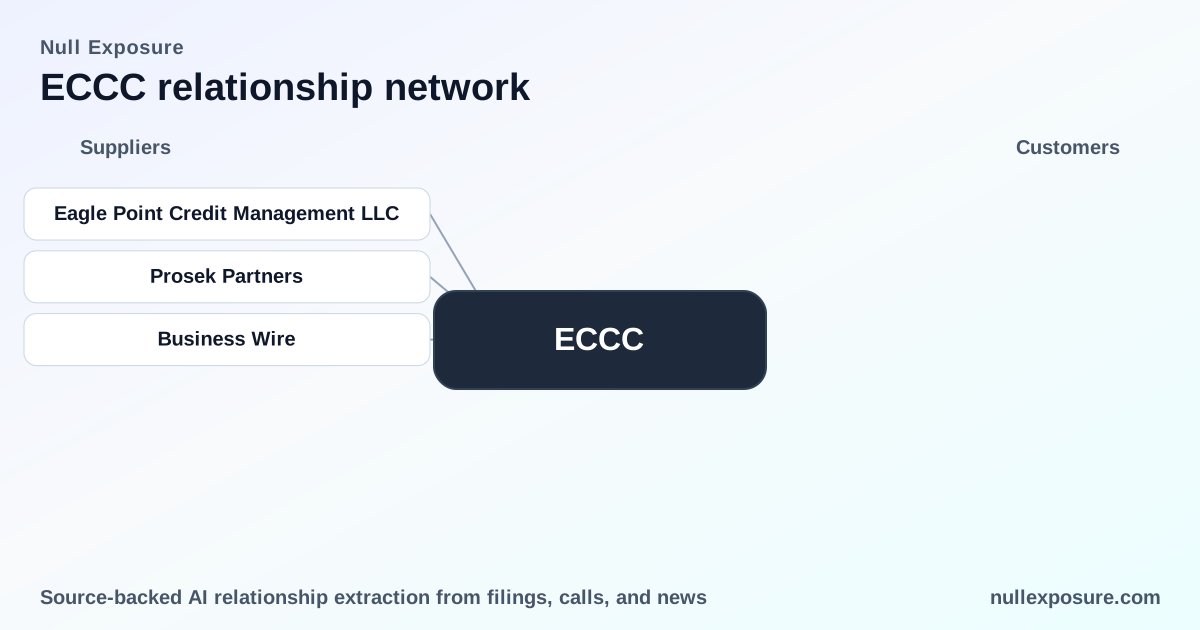
Eagle Point Credit Company (ECCC): How its advisory links shape income delivery and counterparty dynamics
Eagle Point Credit Company Inc. (ECCC) is a closed-end management investment company that monetizes through interest and fee income generated by a portfolio concentrated in collateralized loan obligations (CLOs) and distributes cash to preferred shareholders as a steady yield vehicle. The firm’s economics are driven by credit carry, structuring spreads inside CLO assets, and a management/advisory relationship that sources, monitors, and markets those positions. For practitioners evaluating ECCC’s customer and counterparty footprint, the advisory relationships and portfolio concentration are the primary operational levers to monitor. For a quick overview and further context, visit https://nullexposure.com/.
Executive snapshot — what investors should understand about the business model
ECCC is positioned as a yield-oriented preferred offering inside the asset management sector. Its income profile is driven by coupon and fee flows from CLOs, distributed to preferred shareholders, which explains the product’s appeal to income-seeking investors. Publicly reported metrics show a dividend per share of $1.68 and a dividend yield of ~6.82%, with the latest quarter ending 2025-12-31; those figures underline the company’s income-distribution focus.
Operationally, ECCC is an adviser-managed closed-end vehicle: it relies on an external management platform to source CLO exposure and execute portfolio actions, rather than running a proprietary origination business. That contracting posture concentrates operational dependency on the advisory partner — a core counterparty and de facto customer for asset sourcing, analytics, and execution services. The platform-oriented model accelerates scale advantages when the manager’s capabilities are deep, but it also creates concentration risk tied to the adviser’s performance and access.
How the numbers color the operating profile
ECCC’s recent reported metrics offer important behavioral signals for counterparties and investors:
- Profit margin: -56.4% and Return on Equity: -11.2% — these reflect a non-linear earnings pattern typical for CLO-focused investment vehicles, where mark-to-market swings, realised losses/gains, and financing costs can drive volatility.
- Revenue (TTM): $203.99 million and Diluted EPS: $1.824 — the firm generates meaningful top-line cash flows from portfolio operations even as earnings metrics fluctuate.
- Institutional ownership is modest (2.826%) while insiders are reported at 0% — an ownership profile that speaks to retail and specialist investor interest in yield products more than broad institutional accumulation.
These metrics should be read as operational context: they explain why advisory execution, portfolio selection, and CLO structural health are critical to ECCC’s ability to sustain distributions.
Customer and counterparty relationships — what’s on record
ECCC’s customer-scope relationship results in the dataset include references to a single related entity: Eagle Point Income Company (EIC). Below is the captured mention and its implication.
Eagle Point Income Company (EIC)
EIC referenced its adviser’s capacity directly in a FY2026 earnings call transcript that was captured on March 9, 2026; the call noted that “the scale and experience of our adviser, Eagle Point, remain key advantages as we seek to capitalize on opportunities in a dynamic market environment.” This remark underscores the advisory platform’s role as a shared operational backbone across affiliated closed-end vehicles and highlights the adviser’s contribution to sourcing and executing CLO strategies. Source: InsiderMonkey transcript of EIC Q4 2025 earnings call (published Mar 9, 2026) — https://www.insidermonkey.com/blog/eagle-point-income-company-inc-nyseeic-q4-2025-earnings-call-transcript-1705254/.
What the relationship data tells investors about concentrations and counterparty criticality
Although the dataset for customer relationships is limited to a single mention, the qualitative signal is clear and company-level in nature: ECCC’s operating performance is materially connected to the Eagle Point advisory platform. That manifests across several practical dimensions:
- Contracting posture: ECCC operates under an adviser-managed structure, which concentrates vendor/counterparty risk in the adviser relationship rather than diffusing it across in-house origination or multiple external managers.
- Concentration: The product focus on CLOs means asset concentration risk is high — performance depends on CLO tranche selection, underlying leveraged loan credit trajectories, and structural protections inside deals.
- Criticality: The adviser’s scale and experience are described internally as a competitive advantage; therefore, adviser execution is a critical dependency for ECCC’s ability to source attractive CLO paper and manage stress.
- Maturity: ECCC’s preferred-share structure and steady dividend profile signal a mature, income-first strategy rather than an aggressive growth posture.
Note: the provided relationship excerpt references the adviser in the context of EIC’s call; the dataset did not contain explicit contractual terms or constraint excerpts tying ECCC to specific operational limits.
Risk and monitoring checklist for investors and operators
For those evaluating ECCC across customer and counterparty dimensions, track the following items closely:
- Adviser staffing and turnover: Changes in key portfolio managers or credit teams at Eagle Point will have outsized effects on ECCC’s sourcing and risk management.
- CLO structural performance: Watch weighted-average ratings, default cadence in underlying loans, and tranche subordination levels — these determine realized losses and income persistence.
- Distribution sustainability metrics: Given the negative reported profit margin and ROE, monitor coverage ratios and realized cash flow versus accounting earnings to assess dividend durability.
- Market liquidity for preferred shares: The preferred structure depends on market acceptance; bid/ask spreads and trading depth affect financing and repricing dynamics.
Mid-article resource
For an anchored view of counterparties, the NullExposure research hub collects and normalizes relationship mentions and disclosures; practitioners evaluating ECCC’s advisory ties will find the hub useful: https://nullexposure.com/.
Bottom line for investors evaluating ECCC customer relationships
ECCC is a specialized income vehicle whose performance and distribution profile are tightly coupled to a single advisory platform and to the health of CLO markets. The recorded relationship mention from EIC explicitly highlights the adviser’s scale and experience as a strategic asset, which confirms that counterparty diligence on the adviser — not just portfolio analytics — is central to investment due diligence. Investors and operating partners should treat the advisory relationship as a primary counterparty exposure and monitor CLO structural and cash-flow metrics with the same priority given to the adviser’s staffing, execution record, and alignment with preferred-share holders.
Key takeaway: ECCC’s yield proposition is credible but concentrated — underwriting should focus on adviser execution, CLO tranche resilience, and distribution coverage rather than only headline yield numbers.