Ecolab (ECL) — Customer Relationships, Operating Signals, and Investment Implications
Ecolab monetizes a combination of product sales, recurring consumables, equipment leases and service contracts by delivering water treatment, hygiene and infection‑prevention solutions to industrial, hospitality, healthcare and public sector customers worldwide. Its business model generates high-margin recurring revenue through consumables and recurring service fees while also capturing capital‑light economics via equipment leasing and digitally enabled service offerings. For a structured view of customer exposure and relationship mappings, visit https://nullexposure.com/.
The investment thesis up front
Ecolab is a global operator with durable revenue drivers: repeatable chemical and service consumption, long service contracts and equipment leasing that create customer stickiness. Investors should value Ecolab for its combination of recurring consumables and services, regional diversification across NA/EMEA/APAC, and the optionality from portfolio rationalization—while monitoring concentration and contract terms that can affect margin and working capital.
What the filings and press reveal about direct customer links
Below are the discrete relationships captured in public sources, summarized in plain English and linked to the original references.
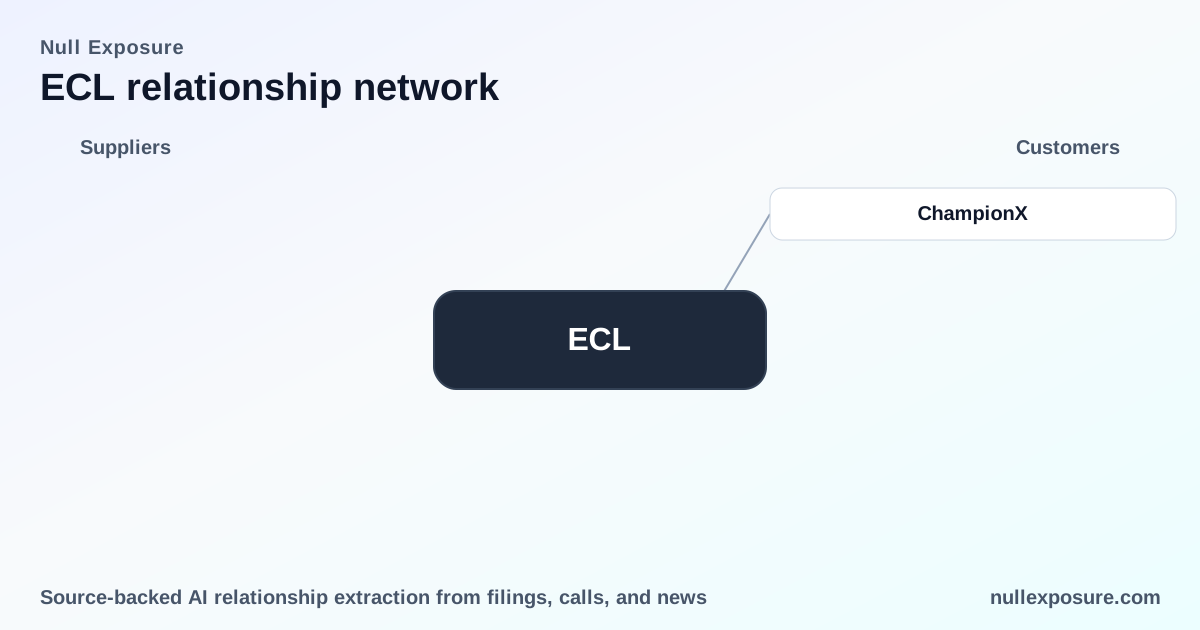
ChampionX — a legacy transition agreement
Ecolab entered a transitional commercial arrangement with ChampionX as part of the companies’ 2020 separation, under which Ecolab continued to provide, receive or transfer certain products for a defined transition period following the split. This arrangement is documented in Ecolab’s FY2024 Form 10‑K. (Source: Ecolab FY2024 10‑K filing.)
Medline (MDLN) — surgical drape business divestiture
Medline acquired Ecolab’s surgical drape business for $950 million, a transaction reported in trade press coverage in May 2026 that highlighted the strategic sale of a specialty product line. The deal transfers an operating unit to Medline and reflects Ecolab’s ongoing portfolio optimization. (Source: FierceBiotech report, May 2026.)
Company‑level operating constraints and what they mean for investors
The public evidence creates a coherent set of operating signals about how Ecolab contracts with and serves customers. These are company‑level characteristics, not attributes of any single customer relationship unless explicitly stated in the source.
-
Customer mix and counterparty types: Ecolab serves both government entities and large enterprise industrial customers, indicating contracts that span public procurement processes and long‑term commercial agreements. This mix implies a need for compliance, multi‑year procurement relationships and credit/risk management across client types. (Source: FY2024 10‑K excerpts.)
-
Global footprint with regional revenue dispersion: Ecolab operates globally across North America, EMEA, Latin America and Asia‑Pacific, selling solutions in more than 170 countries and reporting material sales by region. Investors should treat regional performance and currency exposure as primary drivers of near‑term top‑line variability. (Source: FY2024 10‑K regional disclosures.)
-
Relationship roles: seller, buyer and service provider: The company functions as a seller of products and equipment, a lessor of warewashing and water treatment equipment, and a service provider that delivers installation, monitoring and maintenance. This multi‑role posture strengthens customer lock‑in but requires operational scale to maintain service economics. (Source: FY2024 10‑K excerpts.)
-
Contracting posture and maturity signals: Evidence of operating leases for equipment and standard revenue recognition when obligations are satisfied points to a mix of immediate product revenue and longer‑duration service/lease contracts. That structure favors recurring revenue recognition and predictable aftermarket demand for consumables. (Source: FY2024 10‑K.)
-
Materiality posture: The company reports it did not participate in any material customer‑sponsored research during the relevant years, signaling that core innovation and R&D are internally driven rather than co‑funded by customers. This reduces external dependency for product development financing but concentrates R&D risk internally. (Source: FY2024 10‑K.)
-
Concentration and criticality: The operating segments target large industrial customers in manufacturing, food & beverage, energy and mining—clients for whom Ecolab’s solutions can be critical to operations. That criticality creates pricing power in some niches but also concentrates exposure to cyclical industrial demand. (Source: FY2024 10‑K.)
How these signals translate to investor risks and levers
- Revenue durability: The mix of consumables, service contracts and equipment leases creates sticky recurring revenue, a key valuation uplifter. Equipment lease economics and service attachments are structural profit drivers.
- Concentration risk: Heavy exposure to large industrial and institutional buyers means macro cyclicality in manufacturing and hospitality will materially affect growth. Monitor end‑market indicators for early signals of demand shifts.
- Geographic sensitivity: Regional revenue dispersion provides diversification, but FX and regional demand shocks will influence reported results. EMEA and APAC performance should be watched relative to NA on an ongoing basis.
- Portfolio actions: The sale of non‑core units—such as the surgical drape business—shifts Ecolab toward its higher‑margin core competencies and improves capital allocation flexibility. Transaction activity is a lever management uses to sharpen focus and free capital.
Relationship takeaways — what matters to analysts and operators
- ChampionX: Maintains transitional commercial ties from the 2020 separation that affect near‑term product flows; these are legacy arrangements that evolve as integrations and handoffs complete. (Source: Ecolab FY2024 10‑K.)
- Medline (MDLN): The $950M sale of the surgical drape business demonstrates active portfolio pruning and redeployment of capital into core water, hygiene and services businesses. This transaction reduces peripheral exposure and increases focus on higher‑return lines. (Source: FierceBiotech, May 2026.)
For additional detail on customer exposure mappings and how these relationships feed into revenue concentration and contract tenor models, visit https://nullexposure.com/ for structured reports and visualizations.
Bottom line: action checklist for investors
- Treat Ecolab as a recurring‑revenue industrial services operator with durable cash flow potential; value should reflect consumable economics plus service attachment rates.
- Monitor regional sales trends, large account renewals and equipment leasing utilization as the best leading indicators of organic momentum.
- Watch management’s use of proceeds from divestitures and how sale proceeds are redeployed—into organic growth initiatives, debt reduction, or share repurchase—as a signal of capital allocation discipline.
Bold focus areas: recurring consumables, equipment lease penetration, large enterprise exposure, and regional growth differentials. These metrics will determine whether Ecolab’s premium multiple is justified over the coming quarters.