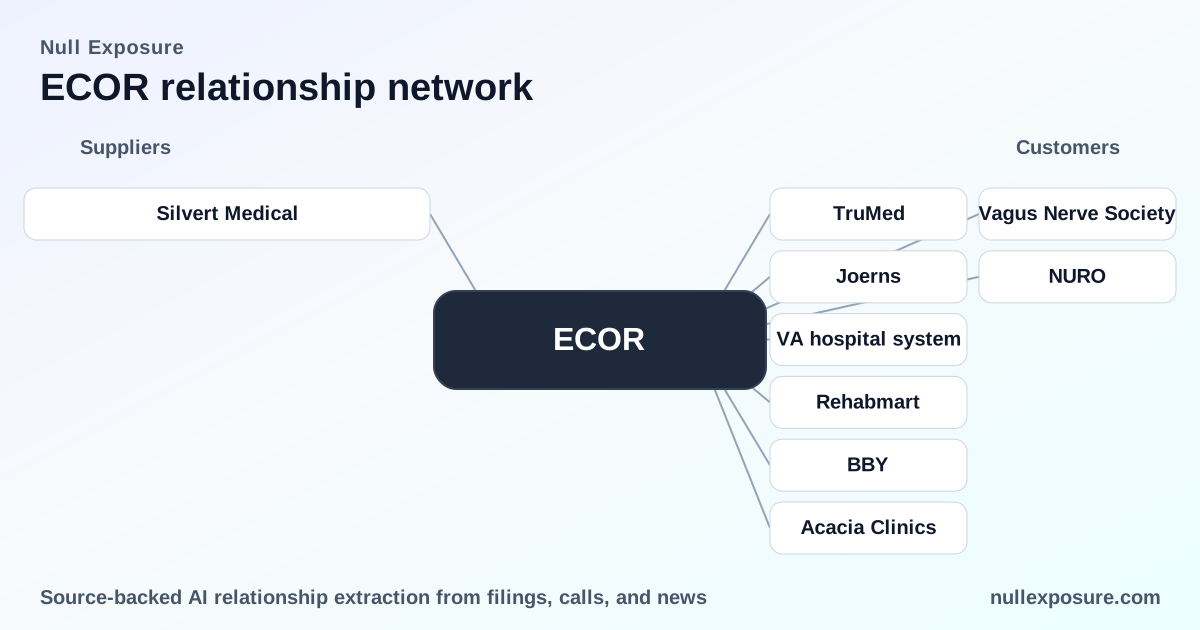
ElectroCore (ECOR) — Customer Relationships That Drive Revenue and Risk
ElectroCore commercializes gammaCore, a prescription and over‑the‑counter non‑invasive vagus nerve stimulation device, monetizing through direct device sales to healthcare systems, government channels (notably the VA), selected retail distribution, and clinical/research collaborations. Revenue is concentrated in government contracts while the firm is selectively expanding retail and clinical partnerships to diversify channels. For a concise view of vendor and customer exposures, see more at https://nullexposure.com/.
High‑level takeaways for investors
ElectroCore’s cash flow profile is defined by three dynamics: heavy dependence on the U.S. Department of Veterans Affairs for the bulk of device sales; a government contracting posture that creates both stability and concentration risk; and a parallel strategy to establish retail and research channels that could re‑weight revenue over time. The company also expanded capability through the NeuroMetrix acquisition, broadening its non‑invasive pain portfolio and strengthening its VA relationships.
Line‑by‑line: every reported customer or partner mention
TruMed
Management reported affiliates such as TruMed are promoting Truvaga, positioning it for broader retail availability. This was disclosed on the company’s 2025 Q3 earnings call. (2025 Q3 earnings call)
Joerns
ElectroCore noted Joerns, a durable medical equipment distributor, was able to add gammaCore Sapphire to a managed care contract, improving access within that channel. (2025 Q3 earnings call)
VA hospital system
The VA hospital system is described as ElectroCore’s largest and fastest‑growing customer, driving the majority of U.S. sales. (2025 Q3 earnings call)
Rehabmart
Rehabmart is cited as an online retail outlet that will carry Truvaga, expanding the company’s direct‑to‑consumer retail presence. (2025 Q3 earnings call)
Best Buy (BBY)
Management announced future availability of Truvaga through Best Buy, signaling mainstream retail distribution for consumer‑oriented products. (2025 Q3 earnings call)
BBY (duplicate reference)
Best Buy was referenced again in the same earnings commentary as a planned retail channel for Truvaga. (2025 Q3 earnings call)
Kaiser Permanente
Executive commentary and press coverage indicate the company will focus on increasing adoption at Kaiser Permanente as part of a commercial scaling strategy. (Investing.com analyst coverage, FY2026)
Department of Defense
Third‑party financial reporting attributed a material share of Rx gammaCore sales to the Department of Defense, reflecting broader federal government penetration beyond the VA. (Intellectia.ai financials summary, FY2026)
Department of Veteran Affairs
ElectroCore’s VA channel accounted for a substantial portion of sales—reported as part of federal channel totals—underscoring concentrated dependence on the Department of Veteran Affairs. (Intellectia.ai financials summary, FY2026)
Acacia Clinics (GlobeNewswire)
Acacia Clinics announced an investigator‑led study using gammaCore Sapphire for adjunctive PTSD treatment in collaboration with the Vagus Nerve Society, with ElectroCore supplying devices and an educational grant. (GlobeNewswire press release, Jan–Apr 2026)
Vagus Nerve Society (GlobeNewswire)
The Vagus Nerve Society is sponsoring investigator‑led PTSD research and the company is a device and grant contributor, signaling investment in clinical evidence generation. (GlobeNewswire press releases, FY2025–FY2026)
NeuroMetrix (NURO)
Following the May 1, 2025 close of the NeuroMetrix acquisition, management reported early traction for the Quell platform in the VA system, expanding ElectroCore’s therapeutic footprint. (2025 Q3 earnings call)
NURO (duplicate reference)
NeuroMetrix was referenced again in the earnings call commentary regarding Quell adoption in VA facilities. (2025 Q3 earnings call)
Acacia Clinics (ManilaTimes copy)
A Manila Times item amplifying the GlobeNewswire release highlighted first patient enrollments in the Acacia Clinics study and reiterated ElectroCore’s device support and grant. (ManilaTimes reprint of GlobeNewswire, Apr 2026)
Acacia Clinics (GlobeNewswire FY2025 notice)
An earlier GlobeNewswire notice referenced the Acacia Clinics and Vagus Nerve Society study in a corporate announcement context, illustrating continuity of the collaboration. (GlobeNewswire, Oct 2025)
Vagus Nerve Society (GlobeNewswire FY2025)
The earlier corporate announcement also documented the society’s sponsorship and ElectroCore’s role in the PTSD study. (GlobeNewswire, Oct 2025)
Acacia Clinics (GlobeNewswire FY2026 repeat)
Subsequent GlobeNewswire releases repeated the enrollment milestone and ElectroCore’s in‑kind support, confirming ongoing study activity into 2026. (GlobeNewswire, Apr 2026)
Acacia Clinics (additional GlobeNewswire mention)
Another corporate release reiterated the same collaboration details, underscoring the company’s sustained R&D/clinical engagement with Acacia Clinics. (GlobeNewswire, Apr 2026)
Vagus Nerve Society (additional FY2026 mentions)
Multiple notices confirm the society’s sponsorship role and ElectroCore’s provision of devices and an educational grant for the PTSD study. (GlobeNewswire, Apr 2026)
(For the primary company filings and earnings commentary cited above, see ElectroCore’s 2025 Q3 earnings call transcript and related GlobeNewswire and financial press reports referenced in company releases. A mid‑read deeper dive is available at https://nullexposure.com/.)
What the disclosed constraints say about ElectroCore’s operating model
ElectroCore runs a government‑heavy contracting posture with a legacy Federal Supply Schedule (FSS) relationship: the company documented an FSS contract secured in December 2018 that received temporary extensions into 2025 while a follow‑on offer was reviewed. This is a long‑term, framework style engagement that has produced concentration and revenue predictability. (Company filing excerpts, contract history)
Geographically, North America is the dominant revenue base, with the U.S. representing the lion’s share of sales; the company also reports meaningful EMEA exposure via the UK MedTech Funding Mandate for cluster headache (about mid‑single digits of revenue). The firm describes its role as the product seller and emphasizes active, ongoing government sales channels such as FSS/GSA/DAPA/ECAT plus open market VA facility sales. The VA channel is material and critical, accounting for roughly 70% of revenue in recent periods, which creates single‑client concentration risk and elevates contract renewal as an investment‑grade monitoring item. (Revenue breakdown and contract excerpts)
Additional constraint signals: spend bands and disclosure place VA channel revenues in the $10M–$100M band and the relationship stage is active; these are company‑level indicators of large, ongoing government purchases rather than one‑off research grants.
Investment implications: upside, execution levers, and primary risks
- Upside drivers: deep VA penetration provides predictable revenue, and retail distribution through Best Buy and Rehabmart plus managed‑care wins via Joerns can expand non‑VA channels. Clinical collaborations with Acacia Clinics and the Vagus Nerve Society improve the clinical evidence base, supporting payer uptake. NeuroMetrix/Quell adds a complementary pain device line that increases TAM inside federal systems.
- Execution levers: maintain favorable VA contracting status, scale adoption at Kaiser and other integrated health systems, and convert retail placements into sustainable unit sales.
- Primary risks: significant concentration in the VA/DoD channel creates single‑counterparty exposure; contract renewals, pricing pressure in government tenders, or changes to procurement terms would materially affect top‑line performance. Commercial expansion into retail and large payers must offset this concentration to re‑rate the business.
Bottom line
ElectroCore’s revenue profile is driven by government contracting scale with a deliberate, evidence‑oriented push into retail and clinical research that can broaden commercial channels. Monitor VA contract renewal and DoD adoption as the primary near‑term catalysts, and track retail rollouts (Best Buy, Rehabmart) and Kaiser Permanente initiatives as secondary drivers. For a structured view of customer exposures and supplier implications, visit https://nullexposure.com/ for detailed relationship analytics and alerts.