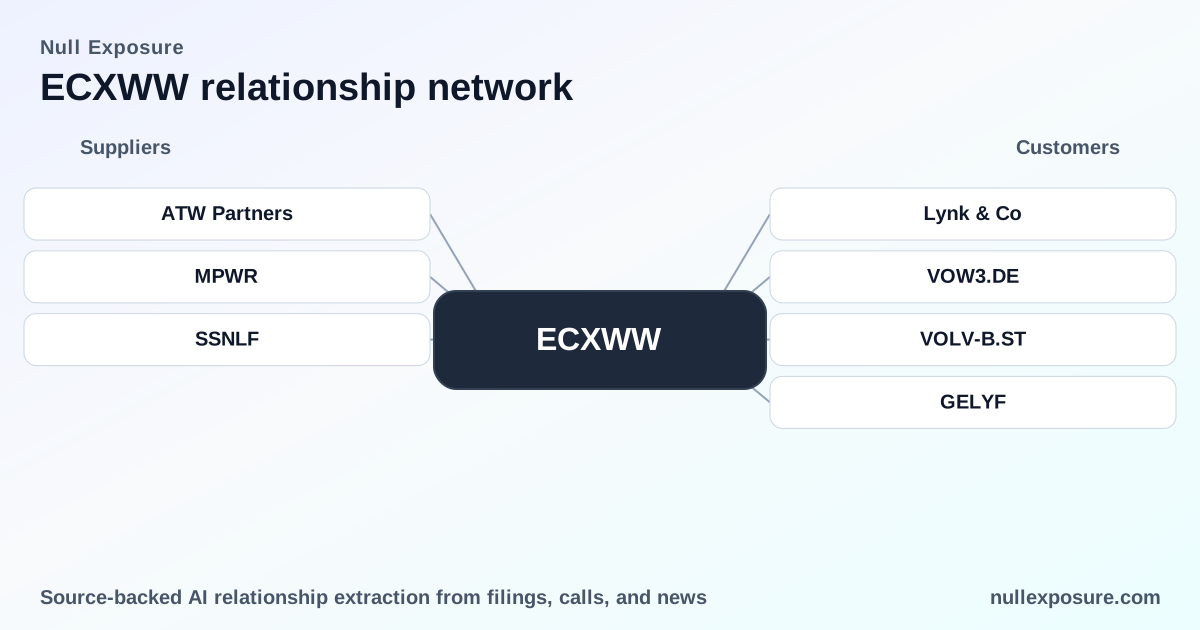
ECARX (ECXWW) — Customer Map and Commercial Implications for Investors
ECARX monetizes a software-centric automotive platform (notably the Antora intelligent cockpit) by licensing hardware-software solutions and delivering vehicle integrations to global OEMs; revenue is realized through per-vehicle contracts, platform licences and associated services tied to model launches and geographic rollouts. Investor focus should be on validation from marquee OEMs, contract scope (per-vehicle vs. platform-level), and the pace of international expansion. For a concise commercial risk/return read, see NullExposure’s homepage for more structured relationship scoring: https://nullexposure.com/.
Why customer relationships determine ECARX’s trajectory
ECARX’s financials show meaningful top-line scale (Revenue TTM: $847.9M) but compressed profitability (EBITDA negative ~$31.3M; profit margin -7.8%), which is typical for platform providers investing in customer integrations and international expansion. The company’s commercialization lever is straightforward: convert OEM validations into recurring per-vehicle revenue and incrementally monetize software features over a vehicle’s lifecycle. Customer wins therefore translate directly to revenue visibility and margin leverage, while customer concentration or limited contract scope would constrain upside.
The customers called out in the latest call — what they mean in plain English
Lynk & Co
ECARX reported that the company’s solution was replicated in the Lynk & Co 07 and 08 EM‑P models, signaling adoption across multiple vehicle programs and model refreshes. According to ECARX’s 2025 Q4 earnings call (transcript dated March 2026), this replication increases the customer’s global visibility and product continuity with the brand.
Source: ECARX 2025 Q4 earnings call (March 2026).
Volkswagen Group
ECARX described a deepened partnership with Volkswagen Group in Latin America, framing the Antora platform as a standard for intelligent cockpits and a lever for international expansion. The 2025 Q4 earnings call highlighted this as a strategic milestone for ECARX’s global footprint.
Source: ECARX 2025 Q4 earnings call (March 2026).
Volvo
ECARX pointed to evidence of scaling when citing that its core technology was “proven” in the Volvo EX30 launch, underscoring cross-brand portability of the platform. The company used the Volvo EX30 reference in the 2025 Q4 earnings call to demonstrate product maturity and multi-brand applicability.
Source: ECARX 2025 Q4 earnings call (March 2026).
VOW3.DE
In the same quarter ECARX reiterated the Volkswagen expansion story using the VOW3.DE ticker designation, emphasizing market-level recognition and the Latin America partnership as a stepping stone for broader international standards around intelligent cockpits. This remark was made during the 2025 Q4 earnings call.
Source: ECARX 2025 Q4 earnings call (March 2026).
Geely
ECARX identified the Geely Galaxy EX5 as an early commercial proof point and used that launch to show how its platform scales across brands and geographies. The 2025 Q4 earnings call cited Geely’s product launches as evidence of commercial traction and replication capability.
Source: ECARX 2025 Q4 earnings call (March 2026).
GELYF
ECARX repeated the Geely relationship by referencing the GELYF listing (ticker for Geely’s ADR presence), again linking the Galaxy EX5 success to the company’s ability to scale its core technology across models and markets. This remark was included in the 2025 Q4 earnings call.
Source: ECARX 2025 Q4 earnings call (March 2026).
What the customer set reveals about ECARX’s operating model
- Contracting posture: ECARX operates as an OEM-tier platform supplier, negotiating multi-model integrations rather than one-off software installs; the company’s language around replication and platform standards indicates multi-year, system-level commercial engagements rather than pure transactional sales.
- Concentration: The customer list demonstrates meaningful relationships with a handful of large OEMs (Geely, Volvo, Volkswagen, Lynk & Co). That concentration offers fast revenue scale when wins expand but also creates outsized revenue dependency on a limited set of partners.
- Criticality: Intelligent cockpits are core to modern vehicle differentiation; ECARX’s positioning as the provider of the cockpit platform implies high technical and contractual criticality once integrated into production lines.
- Maturity and scalability: Repeated references to replication across models (e.g., Lynk & Co 07/08, Geely Galaxy EX5, Volvo EX30) are practical signals of product-market fit and the ability to reuse engineering across programs, which supports margin improvement as software revenue scales.
- Note: There are no explicit constraint excerpts captured in the relationship payload; the above are company-level signals derived from customer disclosures, not specific contractual excerpts.
Investment risks and opportunity vectors
- Key risks: Customer concentration exposes ECARX to OEM procurement cycles and program timing; geopolitical and regulatory risks attach to a China-based technology firm selling into global OEMs; profitability is pressured until software and recurring revenue scale further. Also consider liquidity and structural differences given the instrument at hand (warrants on ECARX common stock).
- Opportunities: Validation from global OEMs—Volkswagen and Volvo in particular—accelerates international expansion and opens cross-sell pathways (maps, OTA services, subscription features). If ECARX converts platform wins into recurring software and service revenue, operating leverage will drive margin expansion.
Practical due-diligence next steps for investors
- Review the specific scope and term of platform contracts disclosed in filings and OEM press releases to determine revenue visibility and per-vehicle economics.
- Watch the cadence of model rollouts tied to these customers—production start dates and geographic coverage directly affect near-term revenue recognition.
- Monitor margin progression quarter-over-quarter as software/component mix shifts from low-margin hardware to higher-margin software services.
For a consolidated view of relationship signals and scoring logic, visit the NullExposure homepage: https://nullexposure.com/.
Bottom line
ECARX’s commercial strength rests on validated OEM integrations and the ability to scale the Antora cockpit across global models. The 2025 Q4 commentary catalogs significant OEM endorsements that materially improve revenue runway, but the path to positive EBITDA hinges on converting one-off program wins into recurring platform and services revenue while managing customer concentration and program timing. Investors should prioritize contract detail, geographic rollout schedules, and margin trajectory in their evaluation.