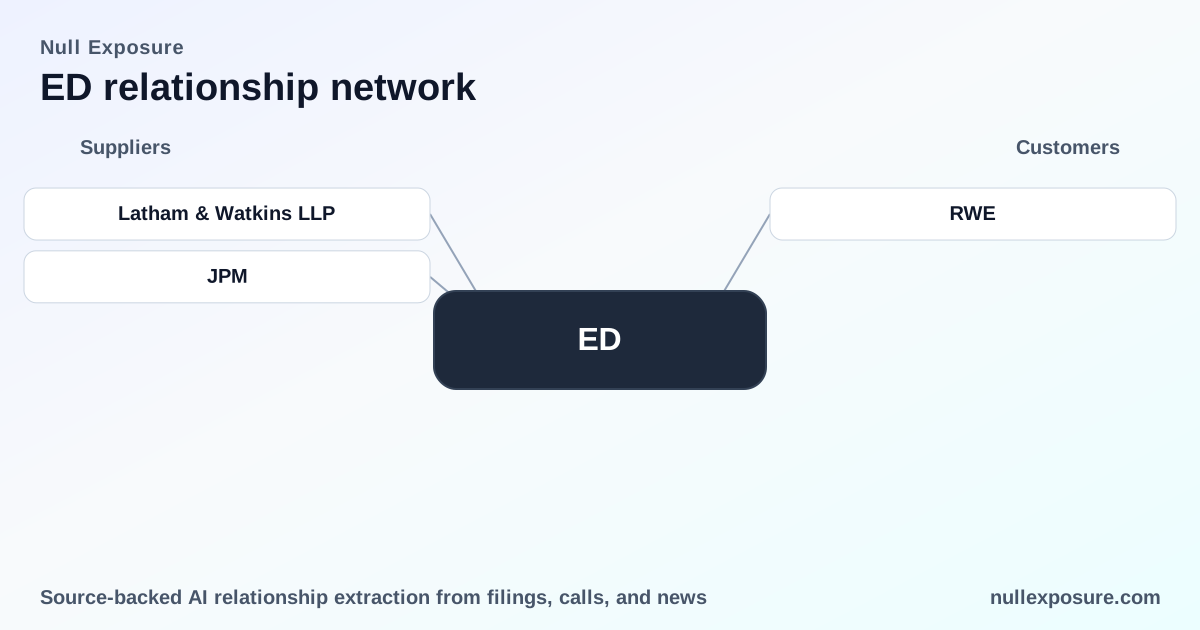
Consolidated Edison (ED): Customer relationships, constraints, and what they mean for investors
Consolidated Edison, Inc. operates as a regulated utility primarily supplying electricity, gas and steam to customers in New York City and Westchester County, monetizing through tariffed delivery rates and regulated base-rate recoveries tied to state approvals. The company's revenue model is driven by long-term, rate-regulated contracts that deliver predictable cash flow and capital return, while capital intensity and regulatory scrutiny set the cadence for growth and large periodic rate filings. For a concise market-facing view and further company signal products, visit https://nullexposure.com/.
Quick read: investment thesis in one paragraph
Con Edison is a large, geographically concentrated regulated utility with stable, tariff-backed cash flows, modest growth through infrastructure investments and a capital program that supports above-average spending bands. The core investment case rests on regulated earnings durability, predictable dividend income, and rate-case-driven upside — offset by execution risk in capital projects and regulatory timing. Key risk drivers: regulatory outcomes, large capex cadence, and exposure to NY-specific policy and weather.
How Con Edison’s operating model shapes customer relationships
Con Edison’s business is defined by a regulated contracting posture and service-focused customer base. Company disclosures show that rate plans are multi-year and continue in effect until successors are approved by regulators, establishing a long-duration revenue foundation for the utility. Tariffs and regulatory mechanisms create the effective “contracts” under which the company sells delivery service and provides outage compensations to residential and small business customers. These characteristics produce a highly predictable revenue stream but also concentrate regulatory and execution risk.
- Contracting posture: Long-term, tariff-based pricing; base-rate proceedings are periodic and govern core cost recovery.
- Concentration and geography: Revenues and assets are concentrated in the U.S., specifically New York City and Westchester County, making regulatory and local policy central to performance.
- Criticality and role: Con Edison is a primary service provider and seller of essential energy services to millions of customers — that criticality strengthens collections and regulatory protection.
- Maturity and spend: The company operates at mature scale with large, ongoing capital programs; recent filings show rate requests in excess of $1.6 billion, signaling 100M+ annual spend bands on utility operations and investment.
These are company-level signals drawn from Con Edison’s regulatory filings and public disclosures (latest quarter to 2025-12-31) and framed to explain how the business model governs customer economics.
Financial and business context investors need
Con Edison reported roughly $16.9 billion in trailing revenues and a market capitalization near $40.4 billion as of the latest public figures. Profitability metrics show a net margin around 12% and operating margin near 17.8%, with a dividend yield near 3.1% and an EPS around $5.59 (trailing). The business trades at a forward P/E in the high teens, reflecting stable regulated earnings and modest growth expectations. These numbers underpin the valuation case but also reflect investor appetite for regulated utility stability.
Relationship map — the third-party counterparties in the record
Below I cover every customer-facing relationship in the provided results. Each entry includes a one to two sentence plain-English summary and a concise source note.
RWE
Con Edison entered an agreement to sell its renewable-energy subsidiary interests — Con Edison Clean Energy Businesses, Inc. — to RWE Aktiengesellschaft’s U.S. arm, formalizing a transfer of those renewable assets out of Con Edison’s portfolio. According to a Latham & Watkins news release reporting the transaction on March 9, 2026, the deal assigns the clean-energy subsidiary to RWE Renewables Americas, LLC and reflects Con Edison’s decision to monetize certain non-utility renewable assets. Source: Latham & Watkins announcement (reported March 9, 2026).
RWE Renewables Americas, LLC
RWE Renewables Americas, LLC is the acquiring entity in the sale of Con Edison’s clean-energy subsidiaries, taking ownership of the renewable generation and development business previously held in Con Edison Clean Energy Businesses, Inc. The transaction was described in the same Latham & Watkins release documenting the sale agreement to RWE’s U.S. renewables unit. Source: Latham & Watkins announcement (reported March 9, 2026).
What the RWE transaction signals for Con Edison’s customer profile
The sale of the Clean Energy Businesses to RWE clarifies Con Edison’s strategic posture: a refocus on regulated utility delivery and infrastructure rather than merchant renewable asset ownership. That shifts counterparty exposure away from merchant power counterparties and toward regulated customers and state regulators. Investors should interpret the divestiture as a move to reduce merchant volatility and redeploy capital or reduce balance-sheet leverage against the regulated business.
Regulatory and customer-facing constraints that matter for valuation
Several company-level constraints in public filings illuminate how Con Edison runs its customer relationships:
- Long-term contracts via tariffs: Rate plans span multi-year effective periods (for example, periods covering January 2023–December 2025), meaning tariff-based revenues are durable and not transactionally renegotiated with each customer.
- Small-business customer protections: Tariffs include explicit compensation provisions for residential and small business customers that suffer prolonged outages — for instance, bill credits and food-spoilage reimbursements — signaling the company’s regulatory obligations to local end customers.
- Geographic concentration: All material operating revenues and assets are located in the United States, centered on the New York City/Westchester service territory, concentrating jurisdictional and policy risk.
- Service-provider and seller roles: Con Edison functions as the regulated service provider and seller of core energy delivery; these are active, ongoing relationships with broad customer coverage (millions of endpoints).
- Segment mix and capital intensity: The company is primarily in services (customer-facing delivery) with infrastructure-heavy operations; base rates are designed specifically to recover construction, operation and maintenance of physical delivery systems.
- High spend bands: Regulatory filings include large rate increase requests (for example, a $1,612 million electric rate increase filing in January 2025), consistent with 100M+ capital and operational spending bands that shape rate cases and cash flow timing.
These constraints are company-level signals drawn from public filings and regulatory submissions, and they explain why Con Edison’s earnings are rate-case sensitive and capital-expenditure dependent.
Key investor takeaways
- Predictable, tariff-backed revenue is the core value proposition. Regulatory frameworks create durable cash flows but also establish the primary risk vector: regulatory outcomes and capital-recovery timing.
- Geographic concentration increases policy and weather exposure. New York-specific policy choices materially affect revenue and allowed returns.
- The RWE sale is strategically dialed toward regulated utility focus. Exiting merchant renewables reduces earnings volatility and shifts capital allocation toward core infrastructure programs.
- Large capex and rate-case cadence dominate near-term catalysts. Investors should watch ongoing rate filings and regulatory rulings for upside or downside to earnings trajectories.
For a more detailed signal-level view and ongoing tracking of Con Edison’s counterparty movements, visit https://nullexposure.com/ — the homepage provides access to the full monitoring suite and related company pages.