EDAP TMS: Installed base growth through academic credibility and targeted conversions
EDAP TMS commercializes the Focal One high‑intensity focused ultrasound (HIFU) platform by selling capital systems and supporting clinical adoption through training, service, and conversions from legacy HIFU installations; revenue derives from system sales, recurring service/consumables, and the reputational halo of academic placements. Installed‑base expansion in major teaching hospitals and integrated health systems is the primary near‑term revenue lever and the clearest indicator of future recurring revenue. For a centralized view of EDAP’s evolving customer footprint, visit https://nullexposure.com/.
Why Focal One is the commercial engine
EDAP’s value proposition is straightforward: sell the Focal One unit to leading urology centers, build clinical programs around it, and extract aftermarket revenue from maintenance, consumables and training. The company reported roughly $70.5 million in trailing twelve‑month revenue and negative margins consistent with a capital‑equipment growth profile. Growth is driven by two forces: conversions of existing HIFU programs to Focal One, and first‑time deployments in underpenetrated markets (notably India and South America). Academic placements function as both a sales outcome and a marketing channel; conversion of highly respected teaching hospitals accelerates adoption across referral networks.
Commercial constraints and what they signal
- Contracting posture: EDAP operates as a capital‑equipment vendor with lifecycle economics; contracts are typically one‑off system sales followed by recurring service agreements. This produces lumpy revenue recognition and dependence on discrete procurement cycles.
- Concentration and criticality: Adoption is concentrated in specialized urology centers and SUO‑approved fellowship programs, so each placement is strategically valuable; installed systems are mission‑critical for a program’s focal therapy offering but not broadly critical to a hospital’s core operations.
- Maturity and penetration: Rapid penetration of the Society of Urologic Oncology (SUO) fellowship network—reported at 60% then 63% within successive quarters—signals substantial traction within the highest‑visibility centers, reducing commercialization risk relative to unknown adoption. These percentages derive from the company’s recent earnings commentary.
- Commercial risk: The business model depends on persuasive clinical outcomes and institutional procurement cycles; conversions of legacy HIFU programs are central to growth, creating single‑point wins that drive broader adoption.
Customer roll‑call: the placements that matter
Below are the customer relationships disclosed in EDAP’s recent earnings commentary; each is summarized in plain English with a compact source reference.
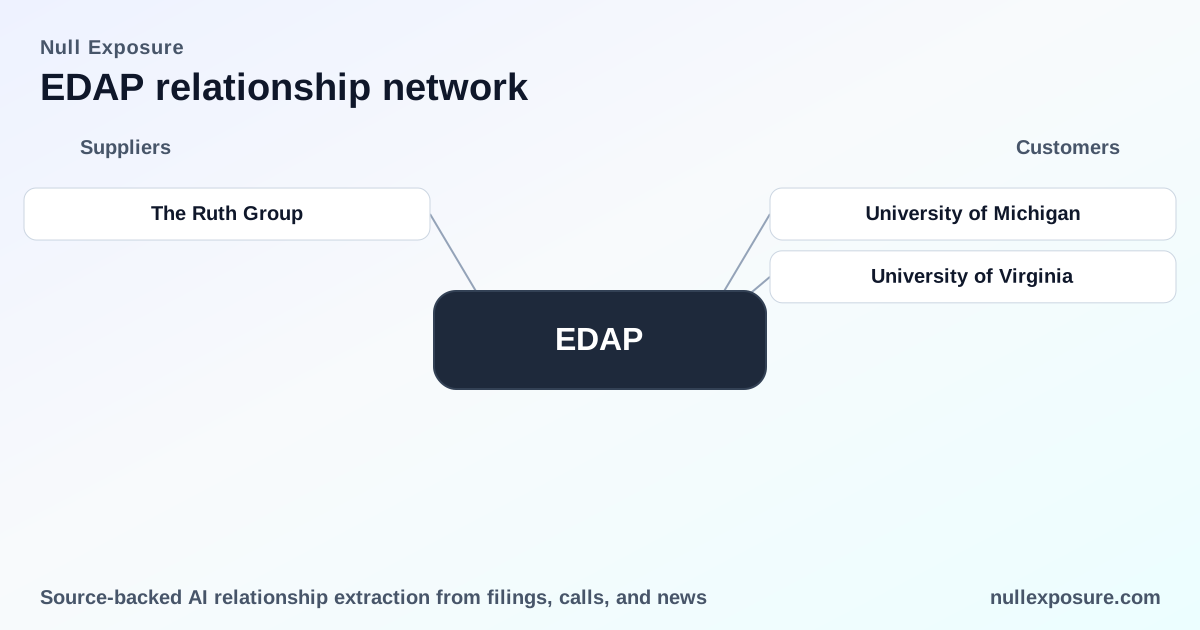
University of Virginia
- Focal One was placed at the University of Virginia as part of a batch of academic integrations that pushed EDAP into major fellowship programs nationwide. According to EDAP’s Q3 2025 earnings‑call transcript published on InsiderMonkey (March 2026), this placement contributed to reaching 60% penetration of SUO fellowship centers.
University of Michigan
- The University of Michigan received a new Focal One installation in the same quarter, reinforcing EDAP’s strategy of targeting high‑profile academic centers. This was disclosed in the Q3 2025 earnings‑call transcript on InsiderMonkey (March 2026).
Aurora St. Luke’s Medical Center (Advocate Health)
- EDAP achieved its first Wisconsin placement at Aurora St. Luke’s, which is part of Advocate Health’s integrated network spanning 18 hospitals, marking a foothold inside a multi‑hospital system. The Q4 2025 earnings‑call transcript posted on InsiderMonkey (May 2026) documents this placement.
Cleveland Clinic
- Two additional Cleveland Clinic hospitals added Focal One in Q4 2025, bringing the global Cleveland Clinic network to five systems and deepening EDAP’s presence inside a world‑class multi‑hospital provider. This expansion is noted in EDAP’s Q4 2025 earnings‑call transcript on InsiderMonkey (May 2026).
Lakewood Ranch Medical Center (Florida)
- Lakewood Ranch Medical Center converted from legacy HIFU technology to Focal One during the quarter, one of three major program conversions that quarter and an example of EDAP winning share from incumbent technology. Details appear in the Q4 2025 earnings‑call transcript on InsiderMonkey (May 2026).
University of Pittsburgh Medical Center (UPMC)
- UPMC, an SUO‑approved fellowship program, was added to EDAP’s installed base in Q4 2025, lifting SUO penetration to 63% and strengthening EDAP’s academic network. This addition is cited in the Q4 2025 earnings‑call transcript on InsiderMonkey (May 2026).
Argentinian Institute of Diagnostics and Treatment (Buenos Aires)
- A sale to the Argentinian Institute of Diagnostics and Treatment expands EDAP’s South American footprint and complements existing sites in Brazil and Chile. The Q4 2025 earnings‑call transcript on InsiderMonkey (May 2026) reports this international deployment.
Ruby Hall Clinic (Pune, India)
- Ruby Hall Clinic in Pune secured a Focal One system, representing an important commercial milestone in India—a large underpenetrated market for focal therapy. This was disclosed in the Q4 2025 earnings‑call transcript on InsiderMonkey (May 2026).
University of Pennsylvania
- The University of Pennsylvania converted its existing HIFU program to Focal One, signaling EDAP’s ability to displace legacy suppliers within elite cancer centers. EDAP referenced this conversion in the Q4 2025 earnings‑call transcript on InsiderMonkey (May 2026).
Penn State Health
- Penn State Health completed a conversion from legacy HIFU technology to Focal One, another example of EDAP capturing share through product upgrades in established focal therapy programs. See the Q4 2025 earnings‑call transcript on InsiderMonkey (May 2026).
Advocate Health (integrated network)
- The Aurora St. Luke’s placement is within Advocate Health’s network; EDAP’s entry into Advocate Health represents a broader commercial opening into an 18‑hospital system spanning Wisconsin and Illinois. This is described in the Q4 2025 earnings‑call transcript on InsiderMonkey (May 2026).
What these relationships mean for investors
Collectively, these placements tell a clear commercial story: EDAP is converting legacy HIFU programs and landing Focal One in elite academic centers and select integrated health systems, which drives both near‑term unit revenue and higher‑value recurring service streams over time. Academic endorsements increase clinical credibility and shorten sales cycles to peer institutions.
Key risks to watch: concentration of sales cycles, dependence on a surgical subspecialty market, and the lumpy nature of capital purchases. Monitor sequential installed‑base disclosures and aftermarket revenue growth as the truest signals of durable progress.
If you want a consolidated view of EDAP’s relationship map and trendline analysis, explore more at https://nullexposure.com/ for the company coverage and continuous updates.
Bottom line
EDAP’s recent quarter demonstrates a predictable, repeatable growth path: convert legacy HIFU programs in marquee centers, use those wins to penetrate affiliated networks, and monetize through service and aftermarket contracts. For investors focused on medical‑device adoption curves, EDAP’s academic placements and system conversions are the primary indicators of sustainable commercial momentum.