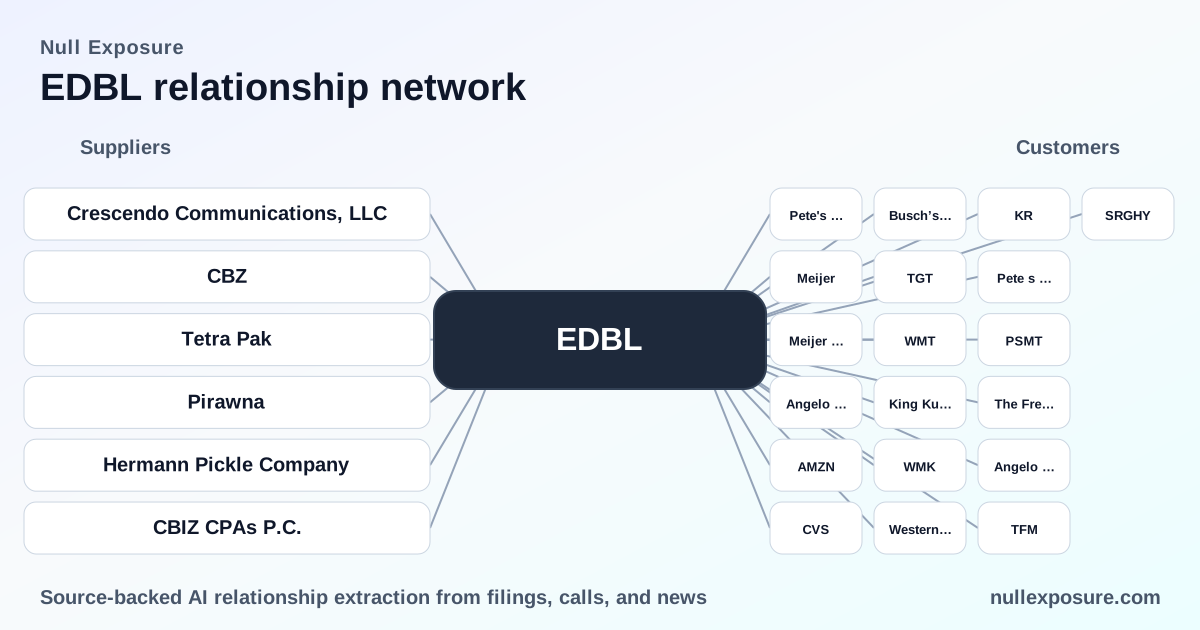
Edible Garden AG (EDBL): retail distribution is the growth engine — but concentration is the risk
Edible Garden AG operates controlled-environment agriculture (CEA) facilities and sells fresh herbs, value-added produce and CPG extensions (ferments, sauces, nutraceuticals) to large retail chains, regional grocers and e-commerce channels. The company monetizes through direct supply contracts and purchase-order sales to national and regional retailers, with branded and private-label programs that drive recurring shelf placements and seasonal volume. Revenue is driven by expanded national rollouts (Target, Walmart, Kroger) and regional partner penetration (Weis, Meijer, The Fresh Market), while profitability is constrained by customer concentration and working capital tied to a handful of large buyers. Learn more at https://nullexposure.com/.
How the business actually makes money — a concise operating thesis
Edible Garden sells over 100 SKUs spanning cut herbs, potted herbs, fermented products and ancillary CPG items into supermarkets and mass channels; it derives revenue from (1) long-term supply agreements with key buyers, (2) spot purchase-order sales to broader retail partners, and (3) expanding e-commerce and international channels for new CPG brands. Management emphasizes retail distribution expansion as the primary lever for scaling branded and private-label volume, while funding in-store fixture installs and trade support to secure buy-in from large grocers.
Key relationship map — who is buying EDBL products (complete list)
Below are every counterpart named in public disclosures and media hits collected in the period cited. Each entry is a plain-English summary with source context.
-
Meijer Distribution, Inc. / Meijer — Edible Garden executed supply agreements effective January 1, 2024 under which the company will supply and sell products to Meijer; Meijer also features in public comments as a major private-label customer and an important distribution rollout partner (Q3 2025 earnings call; FY2024 10‑K).
Source: Company 10‑K (FY2024) and Q3 2025 earnings call transcript. -
Walmart / WMT / Walmart.com — Walmart is a major distribution partner driving seasonal sales growth (the Poultry Mix grew 27.5% in a key Thanksgiving period) and is referenced in sustainability reporting through Walmart’s Project Gigaton; management also cited Walmart’s private-label ingredient mandates as a retailer dynamic (FY2025 press releases and Q3 2025 earnings call).
Source: FY2025 press releases distributed via Sahm Capital and GlobeNewswire; Q3 2025 earnings call. -
Target / TGT / Target.com / Target Stores — Management reports meaningful brand traction through rollouts at Target, and the company announced a major fresh‑cut herb program at Target stores and Target.com distribution for CPG lines (Q3 2025 call, FY2026 press release).
Source: Q3 2025 earnings call transcript and GlobeNewswire/BusinessInsider (FY2026). -
Amazon / AMZN — Edible Garden expanded e‑commerce placements domestically and internationally, including Amazon and Target.com, and cites Amazon as a channel for product launches and broader digital distribution (Q3 2025 call; FY2026 corporate update).
Source: Q3 2025 earnings call and Sahm Capital FY2026 distribution note. -
PriceSmart / PSMT — PriceSmart is named as an international partner for the company’s CPG rollouts, representing early export placements into warehouse club channels in Latin America and the Caribbean (Q3 2025 call; FY2026 update).
Source: Q3 2025 earnings call; Sahm Capital FY2026 release. -
Kroger / KR — Edible Garden launched its USDA Organic fresh herb line at Kroger, supporting both branded and private‑label volume across Kroger’s store network (Q3 2025 call; FY2026 reporting).
Source: Q3 2025 earnings call and Sahm Capital FY2026 report. -
The Fresh Market / TFM — The company announced chainwide distribution of USDA Organic herbs at The Fresh Market after a strong Q4 2025 launch, expanding specialty retail placement nationwide (FY2026 press release).
Source: GlobeNewswire / BusinessInsider FY2026 press coverage. -
Weis Markets / WMK — Edible Garden began shipping integrated herb programs to Weis Markets, including potted herbs and cut herb varieties, as part of regional expansion efforts (FY2025–FY2026 announcements).
Source: GlobeNewswire and Perishable News press releases (FY2025–FY2026). -
Busch’s Fresh Food Market / Busch’s — A new distribution agreement introduced Edible Garden’s fresh potted herbs across Busch’s store network to extend regional reach (FY2026 press release).
Source: Sahm Capital / GlobeNewswire FY2026 announcement. -
Safeway — Safeway added Pickle Party™ and Pulp® to its assortment, accelerating national reach for the company’s fermented product lines (FY2026 release).
Source: Sahm Capital FY2026 press note. -
Woodman’s Markets — Woodman’s began carrying the Pickle Party™ fermented pickles and krauts line as part of product rollout into regional fresh-focused grocers (FY2026 announcement).
Source: Sahm Capital press release (Jan 2026). -
King Kullen supermarkets — Pickle Party™ shipments commenced to King Kullen, expanding access for the fermented CPG range on Long Island and nearby markets (FY2025 release).
Source: Sahm Capital / company press release (Dec 2025). -
Western Beef — Western Beef added the company’s Pulp and Pickle Party lines, supporting regional specialty distribution for fermented sauces and pickles (FY2025–FY2026 media).
Source: Perishable News (Dec 2025) and related press coverage. -
Weis / WMK (duplicate entries noted in filings) — Multiple FY2025–FY2026 notices confirm Weis relationships and integrated herb program shipments (company press).
Source: GlobeNewswire and Perishable News FY2025–FY2026. -
Pete’s Fresh Market — Management stated partnerships with Pete’s Fresh Market as part of Midwest expansion initiatives (Q3 2025 earnings call).
Source: Q3 2025 earnings call transcript. -
Angelo Caputo’s Fresh Markets — The company cited Angelo Caputo’s Fresh Markets as part of its Midwest retail expansion (Q3 2025 earnings call).
Source: Q3 2025 earnings call transcript. -
ShopRite — ShopRite was listed as a recent retail rollout, contributing to broader supermarket penetration (Q3 2025 earnings call and FY2025 coverage).
Source: Q3 2025 earnings call and InsiderMonkey FY2025 summary. -
Western Beef / Western Beef (duplicate press entries) — Confirmed shipping of Pulp and Pickle Party product lines (Perishable News).
Source: Perishable News (Dec 2025).
(NB: several relationships appear in multiple filings and channel variants — e.g., Walmart.com vs Walmart — and are combined above as channel-specific manifestations of the same retailer where relevant.)
Operating constraints and what they mean for investors
-
Contract mix: Edible Garden has a two‑tier procurement posture — long‑term supply agreements (e.g., Meijer Distribution, Inc.) running through Dec 31, 2026 alongside routine purchase‑order ("spot") sales for the broader retail base. The company funds in‑store fixture installs under some supply agreements (an aggregate installation funding example totaled $806,947), signaling selective upstream investment to secure shelf presence (10‑K, FY2024).
Source: Company 10‑K (FY2024). -
Customer concentration and criticality: Four customers accounted for ~82% of 2024 revenue, with one customer at ~44%, and about 87.5% of trade receivables tied to five customers—this is a high concentration profile that makes revenue and working capital sensitive to a small number of large buyers.
Source: Company disclosures (FY2024). -
Geography and scale: Sales are concentrated in the Northeast, Midwest and Mid‑Atlantic with targeted international club placements via PriceSmart; distribution expansion to nearly 6,000 store locations is management’s stated objective (Q3 2025 call; FY2026 update).
Source: Q3 2025 earnings call and FY2026 press materials. -
Commercial maturity: Mix of contract types plus aggressive retail rollouts indicates an operating model that is scaling through distribution wins but still in a phase where a few large accounts disproportionately influence top-line and cash flow.
Investment implications — what matters going forward
- Upside driver: Continued rollout into national big‑box retailers and e‑commerce (Target, Walmart, Amazon) scales volume and cross‑sell potential for higher‑margin CPG items. Securing chainwide programs (Target, The Fresh Market) materially increases shelf count and consumer visibility.
- Principal risk: Severe customer concentration and receivables exposure; loss or repricing from any top-four buyer would significantly affect revenue and liquidity.
- Operational watchlist: Execution on fixture installs, in‑store merchandising, and cost control across CEA operations will determine whether distribution gains translate to sustainable margins.
If you want a structured view of counterparties, contract types and concentration for modeling or due diligence, visit https://nullexposure.com/ for a detailed breakdown and sourcing.