Edesa Biotech (EDSA): How partnerships underwrite a clinical-stage commercialization path
Edesa Biotech is a clinical-stage biopharma focused on inflammatory and immune-related diseases, monetizing through drug development, selective licensing, and partner-driven commercialization rather than direct sales today. The company advances clinical assets (notably EB05), secures non-dilutive funding and government-supported manufacturing scale-up, and relies on licensing arrangements to access distribution channels — a model that reduces near-term cash burn but concentrates value on a small number of pivotal trials and partner relationships. For a concise data-first briefing on partner links and their implications, see NullExposure’s coverage: https://nullexposure.com/.
The BARDA relationship: why a government-backed trial changes the cash equation
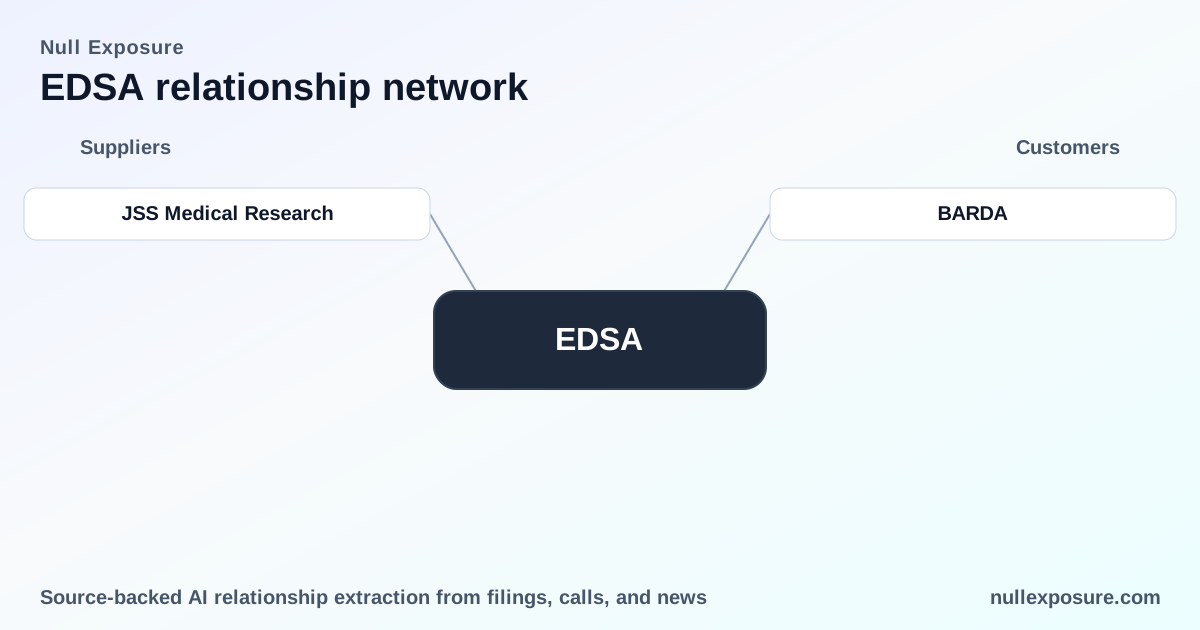
EB05 is enrolled in a platform study funded by BARDA that totals roughly $117 million and evaluates novel therapeutics for ARDS without requiring a SARS‑CoV‑2 positive test. According to a Zacks report covering FY2025, Edesa is supplying EB05 through manufacturing scale-up supported by the Government of Canada’s Strategic Innovation Fund, so the company is not deploying its own cash for that study — a material operational and financing relief for a small clinical-stage company. (Zacks, March 2026).
This relationship has three practical implications for investors and operators:
- Near-term cash preservation: Government and BARDA funding plus Canadian scale-up support absorb manufacturing costs that would otherwise pressure liquidity.
- Clinical readout concentration: Value creation is concentrated on the outcome of BARDA‑funded trials. Positive readouts create outsized upside; negative results have outsized downside.
- Regulatory and contracting complexity: BARDA-funded platform studies change contracting terms and commercialization timelines relative to standard investigator‑led trials.
Other named partners: the Pendopharm license and what it signals
Edesa’s corporate disclosures show an exclusive Canadian license granted to Pendopharm (a division of Pharmascience Inc.) in August 2017 to distribute, market, and sell certain licensed products for human therapeutic use in specified gastrointestinal conditions. This historic deal demonstrates a willingness to pursue regional licensing rather than build in-house commercialization, and it establishes a playbook for future market access through third-party distributors. (Company filing, August 2017).
Company-level signals from disclosed constraints: what the operating model looks like
Beyond individual partner actions, the company’s own disclosures and contract language reveal a consistent operating posture:
- Contracting posture: Edesa structures commercialization through licenses and partner distribution rather than direct go-to-market execution; the Pendopharm agreement is explicit evidence of that strategy.
- Concentration of critical assets: The firm is clinically focused with very limited current revenue (Revenue TTM: $500) and negative EBITDA, which concentrates enterprise value on a handful of assets and trial outcomes (Company financials).
- Criticality of external funding: Use of the Government of Canada’s Strategic Innovation Fund and BARDA support indicates a reliance on non-dilutive, public-sector financing to carry manufacturing and late‑stage development costs.
- Maturity and capability gaps: Internal disclosures state Edesa “does not have any marketing or distribution capabilities,” classifying the company as a prospect-stage developer that will need partners for commercialization.
Two constraints that come through in company material are especially actionable for partnership strategy: the firm provides drug product and technical support at its own expense for trial cohorts (a short-term cash commitment to ensure trial integrity), while simultaneously delegating distribution rights in key geographies to licensees such as Pendopharm. Presenting both obligations and delegations together defines a hybrid model: Edesa funds certain trial inputs to preserve control of development quality, then outsources commercialization to regional partners.
(For broader operational context and proprietary partner screening, visit NullExposure: https://nullexposure.com/.)
Relationship-by-relationship run-down (plain English, sourced)
-
BARDA — Edesa supplies EB05 into a $117M BARDA‑funded ARDS platform trial, with manufacturing scale-up financed by the Canadian government so company cash is not consumed by that study; this arrangement materially reduces near-term development costs while leaving clinical outcomes as the primary value driver. (Zacks news report, March 2026).
-
Pendopharm — An exclusive Canadian license agreement (Aug 2017) grants Pendopharm rights to regulatory approval, distribution, marketing and sale of specified products in Canada, illustrating Edesa’s strategy of licensing regional commercialization rather than building internal sales infrastructure. (Company filing, August 2017).
What investors and operators should watch next
- Clinical readouts from the BARDA platform are the immediate value catalysts; timing and endpoints will drive both the stock and commercial interest.
- Cash and dilution risk remain real given the company’s tiny reported revenue (Revenue TTM: $500) and negative operating metrics; partnerships and government funding are the primary mitigants. (Company financials, latest quarter 2025-12-31).
- Commercial execution depends on licensees: the Pendopharm precedent shows Edesa will likely rely on regional partners to convert approvals into revenue, so the depth and terms of future licensing deals will determine realized sales and margin capture.
- Regulatory and contracting nuance in BARDA platform trials can accelerate or delay market pathways; operators should map IP, supply, and reimbursement steps now to anticipate time-to-market scenarios.
Key metrics to keep top of mind: market cap ~$162M, shares outstanding ~8.9M, and an analyst target price of $11 (company summary data). These figures frame market expectations versus clinical and partnership execution timelines.
Bottom line for the institutional audience
Edesa’s model is partner-first and capital-efficient at the development stage: it mitigates manufacturing expense through government support and licenses commercialization regionally, while shouldering targeted trial obligations to protect data quality. That structure reduces immediate cash burn but concentrates firm valuation on a small number of pivotal clinical events and partner negotiations. Investors evaluating EDSA should treat BARDA trial progress and the cadence of licensing deals as the two principal value levers.
For an ongoing, partner‑centric monitor of small-cap biotechs and their commercial relationships, see our research portal: https://nullexposure.com/.