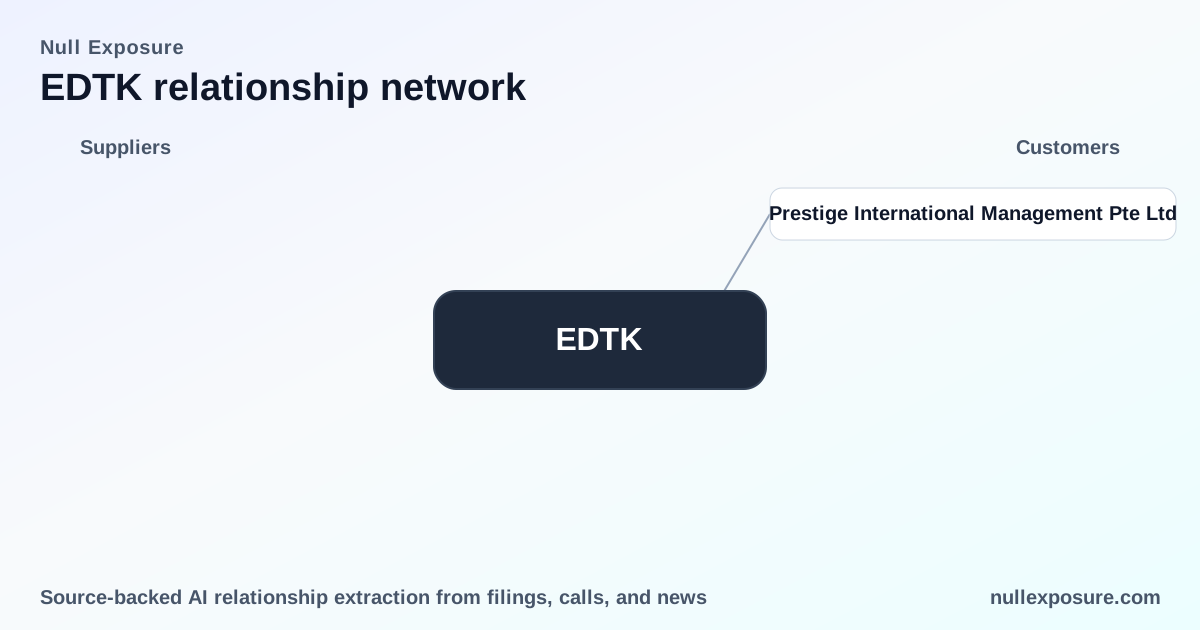
EDTK Customer Relationships: Talent export, training fees, and a headline loan repayment
Skillful Craftsman Education Technology (EDTK) monetizes by recruiting and training vocational and healthcare personnel in China and placing them with institutional customers abroad, while generating course and placement fees from educational services and staffing contracts. Its customer relationships today signal a dual strategy: export vocational talent into higher-margin international placements and shore up balance sheet flexibility through related-party repayments and operational restructuring. For a concise investor review of counterparties and operational constraints, see more at Null Exposure.
How these relationships map to revenue and risk
EDTK operates as a training-to-placement platform: it recruits students, provides vocational training, and converts select trainees into fee-generating placements for international employers and partners. Revenue is concentrated on services tied to placement outcomes and contractual training programs rather than recurring subscription revenue, which makes counterparty execution and contract terms critical to near-term cash flow. The customer relationships below provide direct evidence of that monetization path and one notable balance-sheet remediation step.
Prestige International Management Pte Ltd — healthcare placements (GlobeNewswire, FY2023 entry 1)
Skillful Craftsman entered a collaboration with Prestige to recruit and train Chinese healthcare professionals—primarily nurses fluent in English—and place them into Singaporean hospitals via Prestige’s network, generating placement and training revenue tied to successful placements. According to a GlobeNewswire press release dated October 26, 2023, the agreement aims to alleviate staffing shortages in Singapore by channeling qualified Chinese healthcare workers through Prestige’s placement network.
Prestige International Management Pte Ltd — same program documented again (GlobeNewswire, FY2023 entry 2)
A second capture of the same announcement reiterates that Prestige will place the sourced healthcare professionals with Singapore hospitals, confirming the company’s operational focus on cross-border staffing and the practical execution of its training-to-placement model. The GlobeNewswire item (October 26, 2023) is cited again as the source for this partnership and its FY2023 reporting context.
Wuxi Kingway Technology Co., Ltd. — loan repayment and structural change (TipRanks, FY2025)
EDTK’s operational restructuring included a loan repayment agreement where Wuxi Kingway agreed to repay RMB10.7 million to Craftsman Network by June 2026, reflecting a deliberate effort to clean up intercompany liabilities and reduce legacy VIE exposures. This development was reported in a TipRanks company announcement covering FY2025 and signals a near-term liquidity improvement tied to related-party settlement.
What these counterparties imply about EDTK’s operating model
- Contracting posture: The Prestige arrangement indicates EDTK contracts on a service-and-placement basis, where payment and recognition of revenue depend on successful placements rather than fixed recurring fees. That structure ties cash flow to operational execution and partner networks.
- Concentration and counterparty importance: Prestige is a strategic channel partner for international placements; losing that channel would materially affect the company’s ability to convert trained talent into fee-paying placements. The Wuxi Kingway repayment is a single-event counterparty action that materially affects the balance sheet by reducing related-party liabilities.
- Criticality of execution: The business model is critically dependent on recruitment quality, regulatory clearance for cross-border placements, and partner relationships that handle placement logistics and employer matching. These are operational rather than purely commercial risks.
- Maturity and financial posture: The FY2025 restructuring and loan repayment arrangement show a company in transition from VIE-era complexity toward cleaner governance and cash recovery; combined with negative EBITDA and compressed operating margins, near-term profitability depends on converting these partnerships into dependable cash receipts.
Relationship-level takeaways for investors and operators
- Prestige International Management Pte Ltd (GlobeNewswire, Oct 26, 2023): The Prestige tie provides a direct commercial channel into Singaporean hospital hiring markets and monetizes EDTK’s training pipeline through placement fees and service contracts, strengthening international revenue potential. (Source: GlobeNewswire press release, Oct 26, 2023.)
- Prestige capture (duplicate entry, GlobeNewswire): The repeated documentation of the Prestige collaboration in FY2023 confirms the company’s strategic emphasis on healthcare staffing exports as a distinct revenue stream. (Source: GlobeNewswire press release, Oct 26, 2023.)
- Wuxi Kingway Technology Co., Ltd. (TipRanks, FY2025): A loan repayment of RMB10.7 million from Wuxi Kingway to Craftsman Network due by June 2026 materially reduces related-party exposure and provides a scheduled cash inflow that supports near-term liquidity rebuilding. (Source: TipRanks company announcement, FY2025.)
Practical investment implications — what to watch next
- Monitor cash receipts tied to the Wuxi Kingway repayment schedule through June 2026; successful collection is a direct balance-sheet improvement and reduces credit overhang from VIE-era liabilities.
- Track operational metrics around placement conversion rates and revenues per placement from the Prestige relationship; placement throughput will determine whether the international channel becomes a dependable margin driver.
- Watch regulatory and visa/licensing developments relevant to cross-border healthcare placements, as these are near-term operational constraints that directly affect monetization.
- Given the company’s negative EBITDA, thin revenue base (RevenueTTM listed at 893,690) and high Price-to-Sales multiple, investors should demand quarterly evidence of placement cash flows and visible collections on related-party repayments before repricing the equity.
Final read and action
EDTK’s customer relationships show a coherent strategic play: turn China-based vocational training into international placement revenue while cleaning up historical related-party obligations. The Prestige partnership is revenue-oriented and operationally critical; the Wuxi Kingway repayment is balance-sheet-oriented and time-sensitive. Both dynamics are essential to assess before taking a position.
For a deeper operational and counterparty diligence pack, visit Null Exposure for linked documents and timeline tracking.