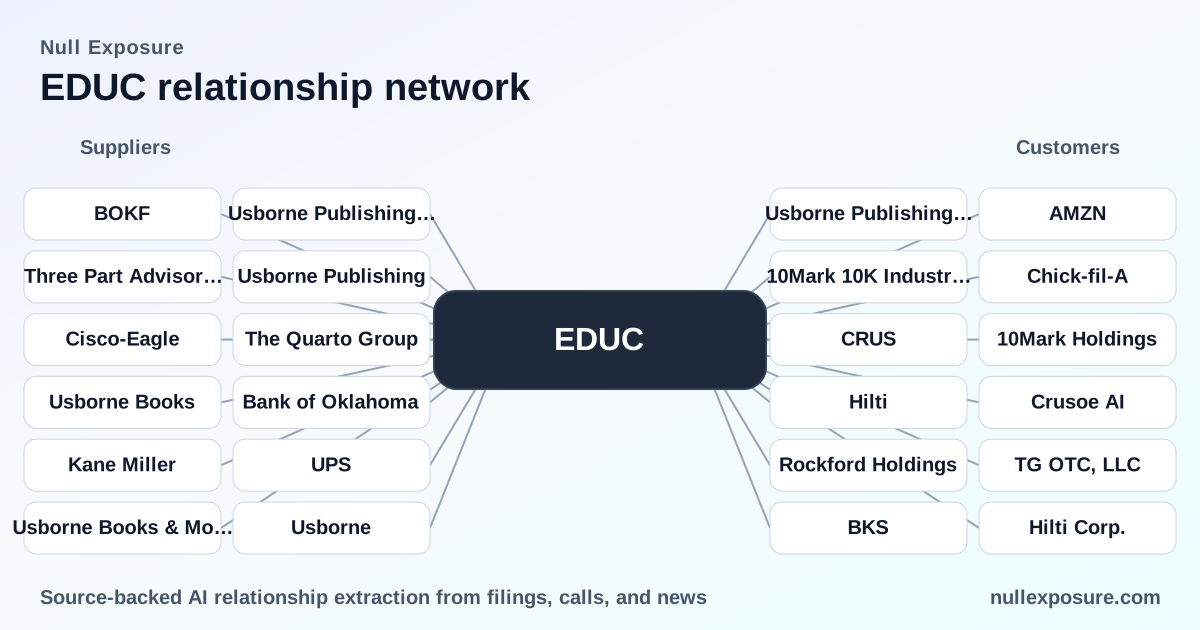
Educational Development Corporation (EDUC): Customer map and what the deals tell investors
Educational Development Corporation is a small-cap publisher and distributor of children’s books that earns revenue through three channels: wholesale sales to retail partners, direct sales via independent Brand Partners (PaperPie), and licensing/co‑publishing relationships, with recent balance-sheet optimization through real‑estate sale‑and‑leaseback activity. The company reported roughly $25.4M of trailing revenue and has used asset dispositions and leaseback structures to convert illiquid real estate into operating liquidity while retaining distribution capacity. For deeper firm-level signals, see Null Exposure’s research hub: https://nullexposure.com/
What investors need to know up front
EDC’s operating profile is distribution‑centric and relationship driven: book titles and catalog relationships (co‑publishing with international houses), a reseller network of Brand Partners, and a handful of large, long‑dated real‑estate lease relationships that materially affect cashflow and covenant flexibility. Recent activity — the sale and leaseback of the “Hilti Complex” — shifts the company from owner-operator of its HQ and warehouse to a tenant, reducing capital intensity but introducing long‑term landlord and tenant counterparty risk.
How EDC monetizes and where revenue concentration lives
EDC sells books via wholesale channels (retailers such as Barnes & Noble), direct channel through Brand Partners (PaperPie), and through co‑publishing relationships (notably with Usborne). The company’s decision in prior years to pull back from Amazon reshaped distribution mix toward direct and wholesale channels and underpins its sales strategy today. For investors, the monetization mix implies revenue sensitivity to partner distribution decisions and to the health of direct Brand Partner recruitment.
Explore comprehensive relationship signals on the platform: https://nullexposure.com/
Operating constraints and what they imply for risk and runway
- Contracting posture — long‑term occupancy commitments. Public filings and press releases describe multi‑year leases with 10‑year initial terms and extension options and annual escalation clauses, indicating mature, long‑tenor landlord/tenant contracts that lock in occupancy costs and provide predictable cash rent but reduce flexibility to shrink physical footprint quickly.
- Counterparty mix — retail, institutional, and individual buyers. EDC’s PaperPie channel serves individual customers as well as schools and public libraries, meaning demand volatility is a mix of consumer and budget‑cycle risk (schools/libraries).
- Distribution/reseller orientation. The company actively uses independent sales representatives (“Brand Partners”) as resellers, creating a commission‑based, decentralized sales engine that is highly scalable but concentration‑sensitive if Brand Partner counts decline.
- Balance‑sheet tradeoffs. Sale‑and‑leaseback proceeds reduce fixed‑asset exposure and increase liquidity, but introduce counterparty and lease escalation risk that becomes earnings‑critical if occupancy costs rise or tenants vacate.
Relationship roster — every partner referenced in public sources
Below I cover each relationship mentioned in EDC filings and press coverage; each entry includes a concise plain‑English summary and the associated source.
Usborne Publishing Limited
Usborne is an England‑based co‑publisher that accounts for a significant portion of EDC’s inventory purchases, indicating supplier concentration in the company’s front‑of‑catalog sourcing. According to EDC’s FY2025 Form 10‑K, inventory purchases are concentrated with Usborne Publishing Limited (FY2025 10‑K).
10Mark 10K Industrial, LLC
10Mark 10K Industrial, LLC is the named buyer in EDC’s sale of the Hilti Complex; EDC completed the sale and immediate leaseback of its headquarters and distribution warehouse to this entity as part of portfolio optimization. The completion of the sale was announced in a company press release (Newsfile; Oct 27, 2025 / Yahoo Finance coverage).
CRUS (ticker reference)
Multiple releases reference Crusoe as an anchor tenant: approximately 110,000 sq ft of the Hilti Complex is occupied under a long‑term lease. Financial news coverage and company releases identify Crusoe/CRUS as a multi‑year lessee in the facility (Yahoo Finance / company press releases, FY2025).
Crusoe Energy / Crusoe Energy Systems / Crusoe AI
Crusoe Energy (variously referenced as Crusoe Energy Systems and Crusoe AI in press material) occupies a substantial portion of the Hilti Complex under a 10‑year lease, providing predictable rental income for the property portion of EDC’s transaction history. This is noted in press releases announcing the sale‑and‑leaseback and related marketing updates (Newsfile releases, FY2024–FY2025).
Hilti / Hilti Corp.
Hilti originally sold the campus to EDC and subsequently leased back a large portion of the property; today Hilti is a long‑dated tenant covering roughly half of the complex under a 15‑year lease, making Hilti a foundational occupant in the property’s cashflow model (local press and company disclosures, FY2016 and FY2025 filings/releases).
Rockford Holdings
Rockford Holdings was the buyer named in an earlier sale agreement that EDC later terminated after Rockford failed to meet purchase terms. The termination of the sale agreement was disclosed in company press material explaining the contract cancellation (Newsfile release, FY2024).
10Mark Holdings
10Mark Holdings is the broader buyer group related to the 10Mark 10K Industrial purchaser; EDC’s management confirmed the buyer group is associated with 10Mark Holdings, which has regional real‑estate holdings in Oklahoma and Texas, underscoring a local institutional buyer relationship (earnings call transcript and press summaries, FY2025).
TG OTC, LLC
TG OTC, LLC appears as a named purchaser in a Purchase Sale Agreement disclosed by the company; management announced execution of an agreement with this buyer in a fiscal‑results release, representing another counterparty in EDC’s real‑estate transactions (Newsfile release, FY2025).
Amazon / AMZN
EDC historically cut direct sales through Amazon (a decision dating to 2012) to protect its Brand Partner network; the move reduced a previously material sales channel and reshaped distribution to focus on wholesale and direct channels (industry reporting and Publishers Weekly/MMH historical coverage, FY2018 and retrospective articles).
Barnes & Noble / BKS
Barnes & Noble is cited as a representative wholesale retail customer in EDC’s distribution strategy; management has prioritized wholesale relationships with large retailers like Barnes & Noble over certain online channels (MMH industry coverage, FY2018).
Chick‑fil‑A
Chick‑fil‑A was used as an example of partnership tie‑ins, where condensed versions of EDC titles were included in promotions, illustrating non‑retail promotional distribution that expands reach beyond traditional bookselling channels (local business reporting, FY2016).
PaperPie
PaperPie is EDC’s direct sales/Brand Partner channel; management reported a significant decline in active PaperPie brand partners (from ~13,900 to ~5,800 in a recent period), a critical demand signal for the direct channel and a firm‑level risk to near‑term revenue stability (investor commentary and earnings call notes, FY2025 coverage).
Investment implications and final takeaways
- Concentration and supplier risk: Heavy inventory reliance on Usborne creates procurement concentration that investors should monitor for pricing or supply disruptions.
- Operational leverage to property cashflows: Sale‑and‑leaseback proceeds materially altered the balance sheet and convert fixed assets to liquidity, but introduce landlord/tenant counterparty and escalation exposure through long‑term leases.
- Distribution fragility: The PaperPie channel is a growth lever but also a source of volatility; the recent shrinkage in active Brand Partners is a red flag for top‑line resilience.
- Retail relationships matter: Relationships with large retailers and strategic promotional partners remain revenue anchors and help diversify channels outside of online marketplaces.
For ongoing monitoring of EDC’s partner exposures and covenant implications, Null Exposure publishes rolling updates and source‑level linkages: https://nullexposure.com/