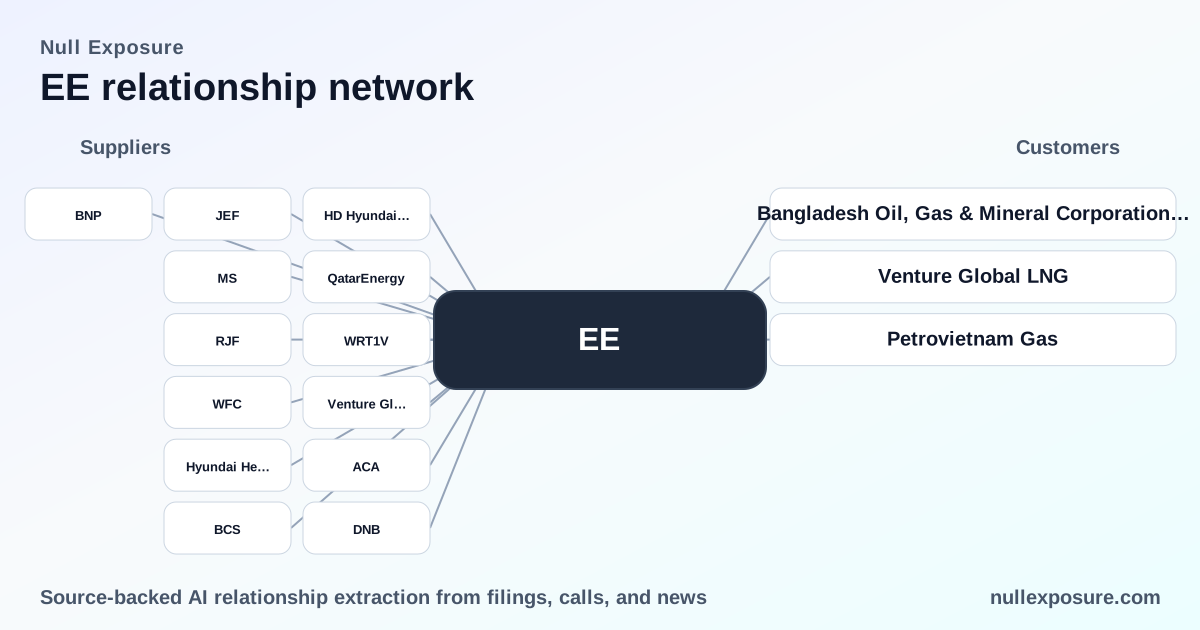
Excelerate Energy (EE): Customer Relationships Underpinning an FSRU-Centered Growth Story
Excelerate Energy operates a global fleet of floating storage and regasification units (FSRUs) and associated LNG terminal infrastructure, and it monetizes those assets through a mix of long-term time charters and terminal use contracts (take‑or‑pay economics), plus physical LNG and natural gas sales. For investors, the revenue profile is driven by contracted regasification capacity and anchored governmental and utility counterparties in EMEA, APAC and LATAM, with a measurable backlog of performance obligations that supports predictable cash flow. Learn more about how these customer ties shape credit and growth dynamics on the homepage: https://nullexposure.com/
Why customer contracts matter for valuation
Excelerate’s business model is infrastructure-heavy and contract-driven: FSRU and terminal services are the company’s strategic core and deliver the bulk of operating cash flow, while cargo sales and short-term contracts provide incremental margin. The company reports a large fixed-price backlog for remaining performance obligations and describes many contracts as effectively long-term leases, which creates visibility for debt service and capital allocation. Investors should treat Excelerate as an asset operator whose credit and cash-generation profile is tightly coupled to contract length, counterparty credit, and regional demand for regasification.
Customer relationships that drive the business
Below I cover every named customer relationship disclosed in the public reporting and recent press cited in the company records and trade press. Each relationship summary is concise and sourced to the filing or news item cited.
Bangladesh Oil, Gas & Mineral Corporation (Petrobangla)
Excelerate signed a 15‑year LNG sale and purchase agreement (SPA) with Petrobangla in November 2023, establishing a long-dated supply arrangement that begins in 2026. Under the agreement Excelerate will deliver 0.85 MTPA in 2026–27 and 1.0 MTPA from 2028–2040, a volume schedule disclosed in the company’s FY2024 10‑K filing. (Source: FY2024 Form 10‑K, filed 2026).
Venture Global LNG
Excelerate executed a 20‑year LNG sale and purchase agreement with Venture Global LNG in February 2023, signaling a long-term supplier relationship that supports Excelerate’s cargo supply and commercial flexibility tied to its regasification projects. (Source: FY2024 Form 10‑K, referenced in FY2024 disclosures).
Iraq’s Ministry of Electricity
Excelerate secured a commercial agreement with Iraq’s Ministry of Electricity to build the country’s first LNG import terminal at Khor Al Zubair, with a minimum contracted offtake of 250 million cubic feet per day—a strategic, large-volume offtake that positions Excelerate as the primary regasification provider for the project. (Source: market coverage and trade reporting, Investing.com, May 2026).
Deutsche Energy Terminal (DET) / Wilhelmshaven FSRU
Excelerate’s 277‑meter FSRU, Excelsior, was moored off Wilhelmshaven as part of the second terminal at that site, with commissioning activities beginning and Deutsche Energy Terminal (state-backed) operating the hub—an operational deployment that underlines Excelerate’s role as an FSRU provider in strategically important European supply hubs. (Source: Offshore‑Energy.biz, May 2026).
PV Gas (Vietnam)
Excelerate signed a cooperation agreement to source LNG from the United States with Vietnam’s PV Gas, establishing a commercial linkage for U.S. LNG supply into Vietnam and reflecting Excelerate’s active trade relationships in APAC. (Source: Offshore‑Energy.biz reporting, May 2026).
Petrovietnam Gas
Excelerate and Petrovietnam Gas signed a memorandum of understanding on U.S. LNG supplies earlier in 2026, formalizing intent to coordinate LNG deliveries and commercial terms that support near‑term Asian demand growth. (Source: Offshore‑Technology.com, March 2026).
What the contract terms and disclosed constraints imply for investors
-
Long-term contracting is the default posture. Excelerate’s disclosures emphasize that the business is substantially supported by time charters and terminal use contracts that are effectively long‑term, take‑or‑pay arrangements and often qualify as leases under accounting rules. That contract structure creates high revenue visibility and supports asset-level financing. (Company filing language in FY2024 10‑K.)
-
Material backlog and revenue certainty. Management reports an estimated fixed transaction price allocated to remaining performance obligations of roughly $8.1 billion, which functions as a measurable backlog that underpins near‑ to medium‑term cash flows and debt capacity assumptions.
-
Government and state‑owned counterparties feature prominently. The company states its customer mix includes state‑owned oil and gas companies, transmission operators and industrial users of gas, implying credit exposure concentrated in sovereign‑influenced entities and utilities rather than purely merchant counterparties.
-
Global, regionally diversified footprint. Excelerate operates across EMEA, APAC and LATAM with active projects and contracts reported in Germany, Bangladesh, Pakistan, Brazil, Argentina and the UAE; that regional diversity reduces single‑market demand risk but introduces execution and political risk across multiple jurisdictions.
-
High criticality of service. Management characterizes FSRU and terminal services as critical in markets that lack gas supply optionality—a commercial characteristic that supports pricing power and contract resilience in stressed supply scenarios.
-
Contract mix includes short‑term activity. While the core is long-term, the company acknowledges some short-term contracts (<1 year) that contribute incremental revenues and operational flexibility, which benefits merchant commercialization of cargoes and spot arbitrage.
-
Segment and role clarity. Excelerate positions itself across infrastructure (FSRU and terminal development) and services (regasification and operation) and also acts as a seller of LNG cargos; the company is therefore both an operator and a commercial counterparty.
-
All operational FSRUs contracted. As of the FY2024 reporting period, management reports all operational FSRUs are contracted, a signal of fleet utilization and near-term revenue stability.
Investment implications and risk map
-
Positive: Predictable cash flow and financing optionality. The long‑term, take‑or‑pay nature of many contracts and an $8.1bn remaining transaction price provide clear cash‑flow support for leverage and reinvestment decisions. Excelerate’s model is asset-backed and contract-driven, which investors can model with higher conviction than a merchant gas trader.
-
Watch: Counterparty and country execution risk. A meaningful share of receipts comes from sovereign or state‑influenced counterparties and from projects in jurisdictions with complex permitting, security, or policy regimes; investors should price political and offtake enforcement risk into credit spreads.
-
Watch: Cargo supply and market risk. While the company secures long-term charter revenues, cargo sales and sourcing arrangements (e.g., ventures with Venture Global and PV Gas) expose Excelerate to LNG market price dynamics and shipping availability.
If you want a concise investor-facing matrix that maps each counterparty to contract length, counterparty type, and estimated revenue impact, see the more detailed relationship dashboards at https://nullexposure.com/ — they are designed for portfolio and credit analysts conducting diligence.
Bottom line
Excelerate’s customer relationships combine multi‑decade contracts with sovereign and utility buyers, strategic FSRU deployments in Europe and the Middle East, and commercial teaming for cargo supply in Asia. That structure delivers predictable base cash flow and a platform for selective growth, while concentrated country exposures and cargo‑market linkages remain the principal risks to monitor.