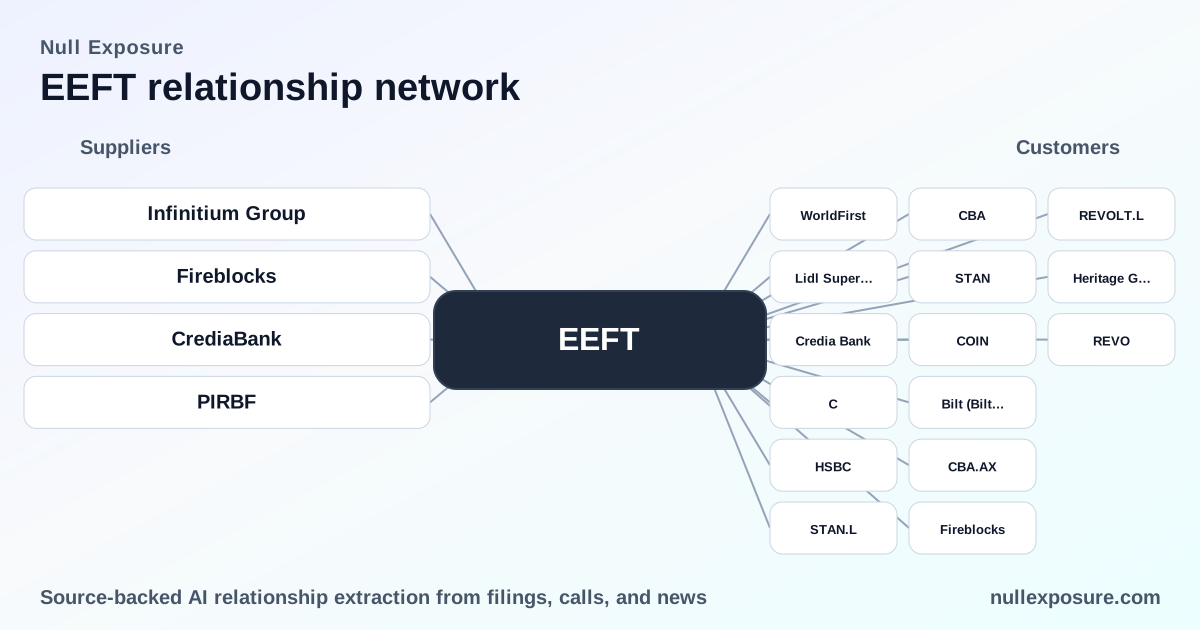
Euronet (EEFT): Customer momentum validates a platform-first payments strategy
Euronet Worldwide monetizes a diversified payments stack—ATM/POS processing, epay digital content distribution, cross-border money transfer, and card issuing/processing platforms (REN and Dandelion)—through transaction fees, recurring platform contracts, and FX/currency margins. Recent announcements show management converting product investments into commercial wins across banks, fintechs, retailers and platform partners, driving both recurring revenue and scalable software optionality. Learn more at https://nullexposure.com/.
Customer wins tell a coherent commercial story
Euronet’s customer activity in FY2025–FY2026 is concentrated in three execution themes: bank infrastructure/issuing (REN and CoreCard migrations), cross-border rail expansion (Dandelion network), and digital content/gift-card distribution (epay + partnerships). These relationships demonstrate a deliberate move up the value chain from commoditized ATM/POS services toward higher-margin software and issuing services, and they underline Euronet’s global reach from Latin America to Europe and APAC.
- A strategic partnership with DXC for REN integration extends Euronet into enterprise core banking distribution channels; DXC will integrate its Hogan core banking platform with Euronet’s REN issuing and processing stack (DXC press release, Jan 21, 2026).
- Dandelion network wins (Citi, Standard Chartered, HSBC and others) expand Euronet’s cross-border real-time rails and institutional counterparty base (Euronet Q4 2025 earnings call, Mar 2026).
- epay distribution and branded payments deals with Revolut, Lidl and ZEPTO broaden digital content reach and loyalty integrations across multiple countries (Euronet Q4 2025 earnings call and Q1 2026 transcripts, Mar–May 2026).
Consider a mid-deal read on these partnerships below; each relationship from Euronet’s disclosures is summarized with source context.
Detailed customer roll‑call and one‑line takeaways
- Lidl Supermarkets — Euronet broadened its branded digital payments arrangement with Lidl into Italy and France, expanding epay/merchant integrations (Euronet Q4 2025 earnings call, Mar 2026).
- Credia Bank — Euronet signed a banking infrastructure and acquiring relationship that will add roughly 20,000 merchants and expand issuing (InsiderMonkey transcript, FY2026 commentary).
- WorldFirst — Euronet’s Dandelion signed a network agreement with WorldFirst to support real‑time cross‑border payments for SMEs, leveraging Ant Group ownership (GlobeNewswire and earnings call excerpts, Q4 2025/FY2026).
- DXC — DXC announced a strategic partnership to bring REN issuing and processing to Hogan clients, giving Euronet access to 300M+ deposit accounts via DXC’s core banking footprint (DXC press release and Zawya, Jan 21, 2026).
- Standard Chartered — Listed among banks leveraging Dandelion for real‑time cross‑border flows, validating Euronet’s institutional rail strategy (Euronet Q4 2025 earnings call, Mar 2026).
- Citi — Citi was added to Dandelion’s portfolio, positioning Euronet to route customer cross‑border flows through a major global bank (Euronet Q4 2025 earnings call, Mar 2026).
- UniCredit Bank — Euronet signed to deploy cash recyclers across UniCredit’s Polish branch network, reflecting continued ATM/branch automation demand (Q1 2026 earnings transcript, May 2026).
- Banco Guayaquil — Euronet extended its Ecuador relationship with a 3‑D secure agreement, strengthening merchant authentication services (Q1 2026 earnings transcript, May 2026).
- Banco Itau (Paraguay) — REN landed its first banking infrastructure agreement in Latin America with Banco Itau in Paraguay, marking REN’s regional debut (Q1 2026 earnings transcript, May 2026).
- Bank ninety nine — Implemented an ATM-as-a-Service banking infrastructure agreement in Austria, evidencing Euronet’s productization of ATM operations (Q1 2026 earnings transcript, May 2026).
- HSBC — Cited as Euronet’s original large bank client and now a Dandelion participant, reinforcing an ongoing institutional banking footprint (Q1 2026 earnings transcript, May 2026).
- Commonwealth Bank of Australia (CBA) — Added to the Dandelion portfolio alongside Citi, supporting Australasian cross‑border flows (Q4 2025 earnings call and InsiderMonkey coverage, Mar 2026).
- U Transfer — Dandelion launched with U Transfer (South Korea) as a new partner, extending remittance corridors into APAC (Q1 2026 transcript, May 2026).
- Master Remit — Euronet added Master Remit (Australia/New Zealand) to Dandelion, strengthening outbound‑to‑APAC corridors (Q1 2026 transcript, May 2026).
- Coinbase / COIN — Post‑acquisition processing relationships expanded to include high‑profile programs such as the Coinbase OneCard, increasing card‑processing volume (InsiderMonkey Q4 2025 transcript, FY2026).
- Bilt (Bilt 2.0 / Bilt) — Migrated Bilt’s 628,000‑card portfolio to Euronet’s CoreCard processing platform in partnership with Cardless, demonstrating issuer migration capability (GlobeNewswire and GuruFocus, Q1 2026).
- ZEPTO — In India, Euronet launched Google Play and Apple gift card codes on ZEPTO, expanding epay distribution on quick‑commerce platforms (Q1 2026 transcript, May 2026).
- Revolut / REVOLT.L / REVO — epay expanded digital gift card and prepaid product distribution with Revolut to 20–22 countries, enhancing global retail distribution and loyalty reach (Q4 2025 results release and Q1 2026 transcript, Mar–May 2026).
- Heritage Grocers — Highlighted as a strategic win illustrating merchant and grocery channel adoption of Euronet services (Finviz bull case summary, FY2026 commentary).
- Fireblocks — Named among strategic partners that reinforce Euronet’s role as a global payments infrastructure provider and software optionality (Finviz summary, FY2026 commentary).
Sources for the above include Euronet’s Q4 2025 earnings call and Q1 2026 transcripts (March–May 2026), DXC and PRNewswire press releases (Jan 21, 2026), GlobeNewswire earnings release (Feb–Apr 2026), and contemporary trade summaries (InsiderMonkey, Investing.com, Finviz).
What the constraints say about Euronet’s operating model
Euronet’s public disclosures present company‑level operating signals that matter for investors evaluating these customer relationships:
- Contracting posture: Contracts are a mix of long‑term (3–7 year) platform agreements and shorter 1–3 year retail POS/merchant deals, signaling both sticky recurring revenue and tactical retail churn. (Euronet MD&A excerpts on contract terms.)
- Counterparty breadth: Customer types span individual consumers, small/medium businesses, mid‑market and large banks, indicating revenue diversification across client sophistication tiers. (Descriptions of Ria, xe and EFT customers.)
- Geographic footprint: Relationships and product deployments are global, with active programs across EMEA, APAC, Latin America and North America, which both amplifies growth runway and exposes Euronet to regional regulatory complexity.
- Materiality and concentration: No single customer accounts for >10% of consolidated revenue, supporting low single‑counterparty concentration risk while requiring broad execution to sustain growth.
- Role and maturity: Euronet predominantly operates as a service provider and platform operator with active deployments across ATM, issuing, and distribution products—some product lines (epay, REN) show clear path to higher margin maturity.
Investment implications and next steps
Investor takeaway: Euronet is executing a deliberate shift toward higher‑margin, software‑centric products while retaining steady cash flow from legacy transaction processing. The DXC REN partnership and the Dandelion bank roster materially increase addressable markets for REN and real‑time cross‑border services. Risks include integration execution on migrations (Cardless/CoreCard/Bilt) and regional regulatory complexity as REN and Dandelion scale.
For a deeper diligence brief and to track new client disclosures, visit https://nullexposure.com/.