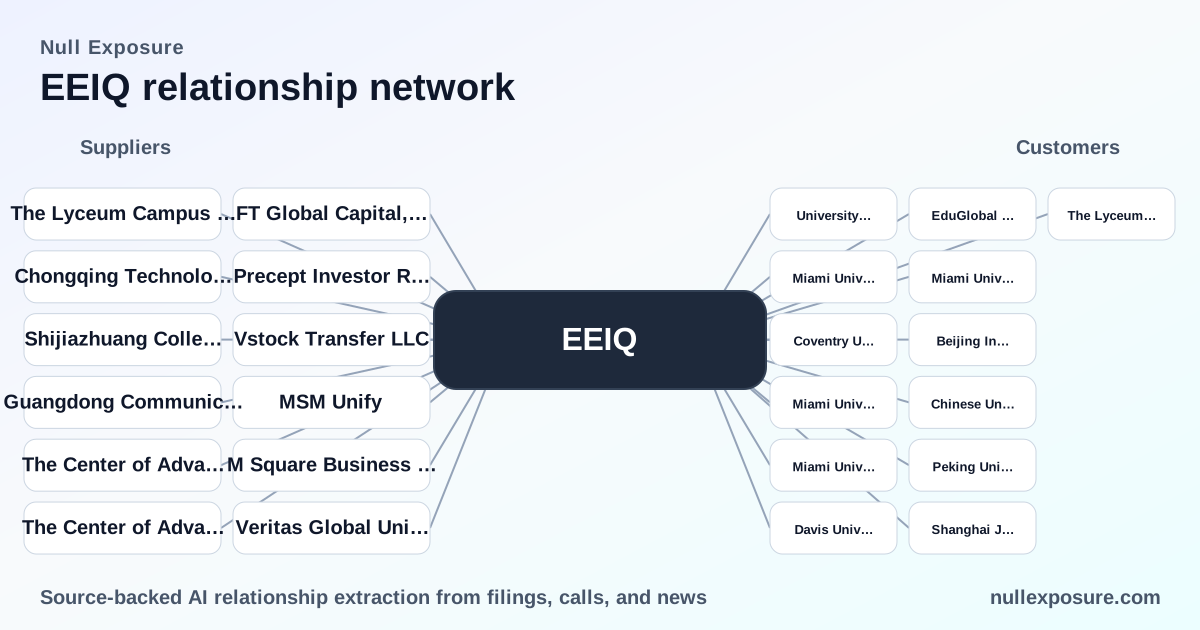
EEIQ: Partner Map and Counterparty Risk for Investors
Elite Education Group International Ltd (EEIQ) operates as a recruiting-and-services platform for international students—principally Chinese nationals—monetizing through recruiting agreements with universities, on-campus and near-campus student housing and dining services, and delivery of foundational and pathway academic programs. Revenue is driven by institutional partnerships (recruiting contracts and program delivery) and campus services (housing, dining, transportation), with material concentration in a small set of education partners. Learn more at https://nullexposure.com/.
How EEIQ actually makes money — the business model in plain English
EEIQ sells three discrete services to institutions and families: student recruitment and enrollment services (acting as an agent for overseas universities), on-the-ground campus support (student housing, cafeterias, shuttles, supervision), and delivery of academic foundation/pathway programs in partnership with universities. Company disclosures and press releases for FY2025–FY2026 show those service lines combined into bundled contracts with partners and through EEIQ’s affiliated schools such as Davis University and EduGlobal College (GlobeNewswire, Jan 28, 2026; QuiverQuant, FY2026).
The partner roster — where revenues and operational exposure come from
Below are the company relationships shown in public releases and media coverage. Each entry is a concise, plain-English summary with the cited source.
Miami University Regional campuses (also shown as Miami University Regionals / Miami University (Regional Campuses) / Miami University of Ohio)
EEIQ has operated a recruiting and student-services relationship with Miami University’s regional campuses since 2013, providing student housing, dining, shuttle transport and supervision while explicitly stating those facilities are not owned or operated by Miami University; the relationship accounted for roughly 25% of FY2025 revenue via the English Language Center. (GlobeNewswire, Jan 28, 2026; QuiverQuant FY2026).
Coventry University
EEIQ functions as a recruiting agent for Coventry University in the UK, using third‑party arrangements to enroll international students into Coventry programs and pathways. This partnership is repeatedly described across company press releases and media summaries in FY2025–FY2026. (PR Newswire FY2025; GlobeNewswire Feb–Mar 2026).
University of the West of Scotland
EEIQ acts as a recruiting agent for the University of the West of Scotland (via The Education Group (London) Ltd), enabling UK-sourced program recruitment for Chinese and other international students as disclosed in multiple announcements. (PR Newswire FY2025; GlobeNewswire FY2026).
Davis University
Davis University is a principal affiliated academic operator for EEIQ and is cited as the dominant revenue generator in FY2025, contributing approximately 71% of revenue through academic coursework and professional training programs. Davis also appears central to recent program expansions and revenue growth announcements. (QuiverQuant FY2026; GlobeNewswire Jan 28, 2026).
EduGlobal College
EduGlobal College is an affiliated provider of foreign language and college-level education and accounted for approximately 4% of FY2025 revenue, per company reporting; it supplements EEIQ’s foundational program portfolio. (QuiverQuant FY2026; SahmCapital FY2025).
Peking University
EEIQ’s foundational programs are offered on the main campus of Peking University as part of the company’s China‑based program network, giving EEIQ access to elite Chinese academic brands for student recruitment. (GlobeNewswire Jan 28, 2026).
Shanghai Jiao Tong University
Foundational programs are also offered at Shanghai Jiao Tong University’s main campus, expanding EEIQ’s presence among leading Chinese universities used for pipeline generation. (GlobeNewswire Jan 28, 2026).
Beijing Institute of Technology
EEIQ lists foundational program delivery on the main campus of the Beijing Institute of Technology as part of its China-based partners for program rollout and student sourcing. (GlobeNewswire Jan 28, 2026).
Chinese University of Hong Kong (Shenzhen campus)
The Shenzhen campus of the Chinese University of Hong Kong is a location where EEIQ offers foundational programs, reinforcing the company’s strategy of partnering with high-profile Chinese institutions. (GlobeNewswire Jan 28, 2026).
The Lyceum Campus (Sri Lanka)
Davis University entered a non-binding MOU with The Lyceum Campus in Sri Lanka in December 2025 to offer a Masters in Management program, signaling intent to expand program distribution into South Asia via local campus partnerships. (GlobeNewswire Jan 28, 2026).
(Where multiple press outlets repeat the same partnership language, the company’s press releases and aggregated news coverage provide the primary public record — PR Newswire and GlobeNewswire items in FY2025–FY2026 contain the core statements above. See company filings and press releases cited across March–May 2026 coverage.)
You can review EEIQ partner announcements and coverage on the company’s news feed or at https://nullexposure.com/ for a centralized view.
What the partner map implies about EEIQ’s operating model and constraints
EEIQ’s partner list and public commentary create a clear set of company-level operational signals:
- Contracting posture: mostly agency and service contracts. The company consistently describes itself as a recruiting agent and service operator rather than as the degree-granting institution — it does not claim ownership of university facilities where it provides housing and dining (PR Newswire; GlobeNewswire).
- Revenue concentration and counterparty importance. For FY2025, Davis University accounted for ~71% of revenue and Miami University regionals ~25%, leaving a thin margin for other partners (QuiverQuant FY2026). That concentration produces single-counterparty sensitivity at scale.
- Criticality of services to partner delivery. Student housing, dining and supervision are operationally critical — losing a single campus contract would create immediate logistical and top-line disruption given the small absolute revenue base (GlobeNewswire Jan 28, 2026).
- Maturity and durability signals. The Miami regional relationship dates from 2013, indicating a long-standing operational relationship that underpins recurring revenue, while newer MOUs (e.g., Lyceum Campus) show expansion ambitions (GlobeNewswire Jan 28, 2026).
Investment implications — what investors should weigh
- Concentration risk is material. With two partners responsible for the majority of revenue, EEIQ’s growth and downside are tightly linked to partner renewals and enrollment flows.
- Service-led revenue is operationally intensive. Housing, dining and transportation require on-the-ground management and create margin pressure; the FY2025 operating margin and EPS show the company is not yet profitable at scale (company FY2025 results; GlobeNewswire Jan 28, 2026).
- Brand leverage in China and the UK is a growth vector. Partnerships with top Chinese universities and UK institutions position EEIQ to scale recruiting for pathway programs if enrollment trends hold.
- Balance-sheet and market-size context. EEIQ’s market capitalization and recent financials signal a micro-cap profile with outsized execution risk relative to peers (company financial disclosures FY2025–FY2026).
Bottom line: concentrated, operationally intensive, but strategically positioned
EEIQ operates an asset-light recruiting and services model that is dependent on a small number of institutional partners and on operational execution at the campus level. That structure gives the company a clear route to monetize international student flows, but investors must price in concentration risk and execution sensitivity before allocating capital.
For a consolidated view of partner press releases, filings and coverage used in this note, visit https://nullexposure.com/.