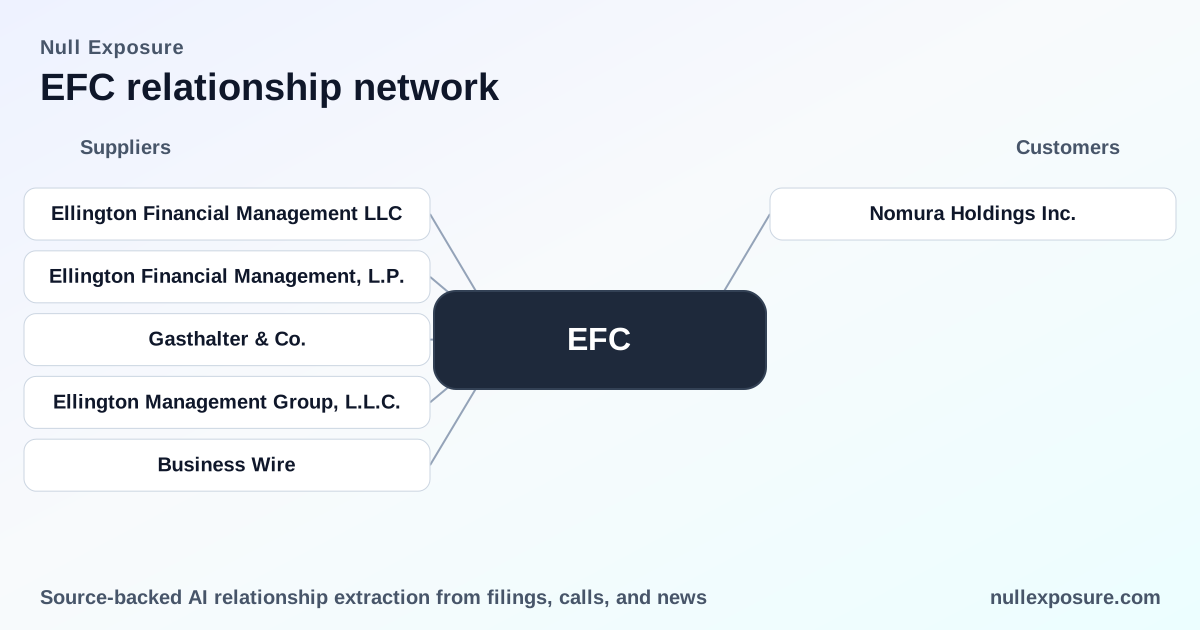
Ellington Financial (EFC): Customer Relationships that Drive Funding and Concentration Risk
Ellington Financial operates as a mortgage REIT that acquires and manages mortgage‑related and other credit assets and monetizes through yield generation on its portfolio, financing spreads from repurchase and secured funding lines, and fee income tied to securitizations and servicing. The company’s capital model depends on counterparty funding, shelf/ATM equity issuance, and ongoing securitization activity — each relationship therefore has direct implications for liquidity, concentration and execution risk. For a concise look at counterparties and sales‑agent relationships investors should focus on two documented ties: a material repo counterparty exposure and a recent expansion of sales agents for an ATM offering. For more contextual coverage, visit https://nullexposure.com/.
Why relationships matter for a mortgage REIT: funding, concentration, and speed
Ellington’s economics are straightforward: buy or originate yield assets, finance them through short‑to‑medium term secured funding and capital markets, and harvest the spread after operating and hedging costs. Counterparties that supply repo or financing lines drive day‑to‑day liquidity; sales agents and underwriters determine the speed and cost of equity access; and servicers/securitizers influence credit realization and fee capture. Changes in any of these relationships alter EFC’s cost of capital and its ability to manage balance‑sheet duration.
Counterparty exposure — Nomura Holdings Inc.
Nomura is documented in Ellington’s FY2024 filings as a material repo/financing counterparty. According to Ellington Financial’s FY2024 Form 10‑K, Nomura Holdings Inc. had $185.7 million of amount at risk to EFC with a weighted average remaining maturity of 230 days, representing 11.7% of EFC’s equity at year‑end. This is a direct measure of counterparty concentration on the firm’s funding side and highlights meaningful single‑counterparty exposure in secured financing relationships (EFC FY2024 10‑K).
Equity distribution and sales agents — EFC‑P‑C and the ATM expansion
Ellington expanded an at‑the‑market (ATM) equity program and updated its sales‑agent arrangements late in 2025. A news report summarizing the company’s SEC filing noted that Ellington and its manager amended agreements with Citizens JMP Securities, B. Riley Securities, BTIG, and Armstrong Securities and added Citadel Securities Institutional LLC and Moelis & Company LLC as sales agents on December 23, 2025, as part of a program increase to $500 million (Investing.com, May 2, 2026). The item is filed under the equity tranche label EFC‑P‑C in market reporting and signals expanded distribution capacity for ATM issuance and a broadened sales network.
What the filings collectively reveal about EFC’s operating model
Filings and evidence in the relationship set produce consistent, actionable company‑level signals:
- Contracting posture — seller in repo transactions: Filing language about repo mechanics shows Ellington regularly sells assets and agrees to repurchase them, a standard secured funding posture that creates recurring counterparty dependency and short‑term refinancing needs (company filings, FY2024).
- Securitization and servicing links: Excerpts related to issuer behavior and HMBS treatment indicate involvement in pooling/securitization activity and retained servicing economics as part of originations and secondary market activity (company disclosures).
- Geographic footprint — North America and EMEA exposure: The company lists geographic concentration members tied to the U.S. and the U.K./EMEA in its financing receivables disclosures for 2024, signaling cross‑regional asset or counterparty exposure that can influence funding counterparties and hedging arrangements (FY2024 filings).
- Portfolio quality stage — performing financing receivables: Balance‑sheet schedules classify relevant receivables as performing at 2024 year‑end, indicating current cash flow generation rather than distressed inventory (FY2024 reporting).
Together these signals describe a company with mature funding mechanics, active securitization and servicing linkages, and concentrated counterparty dependencies that investors must monitor.
Risk implications and what investors should watch
- Concentration risk is elevated. Nomura’s ~11.7% of equity exposure as a single counterparty is material for a financing‑dependent REIT; single‑counterparty disruption could force rapid funding translation or pricing shocks. (EFC FY2024 10‑K.)
- Execution risk on equity is lower but evolving. The addition of Citadel and Moelis to the ATM syndicate and the expansion to $500 million increases distribution optionality and execution capacity for equity raises, reducing—but not eliminating—liquidity risk when markets dislocate (SEC filing summarized by Investing.com, Dec. 23, 2025 / May 2, 2026).
- Regional and product mix matters. EFC’s exposure documents include both U.S. and U.K./EMEA concentration tags; currency, legal and market shocks in either jurisdiction will affect financing availability and asset valuation asymmetrically.
- Operational complexity from securitization and servicing. Retained servicing and HMBS pools create fee and operational linkages that are durable cashflow drivers but also sources of counterparty and performance risk if underlying originators or servicers change behavior.
If you track this company’s funding profile and counterparty lists as part of your risk model, the two relationships above ought to be prioritized for monitoring: Nomura for immediate funding concentration and the expanded ATM sales‑agent roster for equity issuance capacity.
Relationship roll‑call (concise investor references)
- Nomura Holdings Inc.: Ellington reported $185.7 million of counterparty amount at risk with a 230‑day weighted average remaining maturity, equal to 11.7% of EFC’s equity at December 31, 2024, underscoring material single‑counterparty financing exposure (Ellington Financial FY2024 10‑K).
- EFC‑P‑C / Sales‑agent network: A company SEC filing summarized in a May 2, 2026 news report shows Ellington amended agreements with Citizens JMP, B. Riley, BTIG, and Armstrong Securities and added Citadel Securities Institutional LLC and Moelis & Company LLC as sales agents, tied to an ATM expansion to $500 million (Investing.com, referencing the Dec. 23, 2025 filing).
Bottom line — how relationships translate to investment decisions
Ellington’s business model relies on a tight set of counterparty and capital‑markets relationships. The Nomura exposure is a clear concentration flag that directly affects short‑term liquidity risk, while the ATM sales‑agent changes materially improve equity issuance capacity. Investors should treat counterparty lists and sales‑agent arrangements as leading indicators of funding stress or relief, and incorporate both into scenario analyses for liquidity, cost of capital and dividend sustainability.
For a structured view of counterparties and to integrate these relationship signals into portfolio monitoring tools, visit https://nullexposure.com/.