Equifax (EFX) — Customer Relationships and Commercial Signals for Investors
Equifax monetizes a global suite of identity, credit and fraud products through a mix of subscription contracts and transaction-based services, selling both directly to consumers and to large enterprise customers and resellers. The company’s revenue profile blends predictable recurring streams (annual subscriptions and employer services) with high-margin, per‑transaction verification and analytics, while product integration partnerships extend distribution into fintech, automotive and platform ecosystems. This combination produces diversified revenue, low single‑customer concentration and strategic embeds into critical risk workflows. Explore the broader platform context at https://nullexposure.com/.
What to watch: strategic partners turning into distribution channels
Equifax continues to push its fraud and identity products into channels that scale—cybersecurity brands, automotive dealer platforms, commerce platforms and mortgage industry infrastructure. These commercial relationships are not isolated pilots: they represent productized integrations (Kount, identity orchestration, scoring) that generate both recurring fees and per‑transaction volumes. Investors should value both the revenue uplift and the stickiness that comes from embedding fraud and identity checks into daily operational flows for customers.
Customer relationships: what the public record shows
Below I cover every customer relationship surfaced in recent reporting and press flow. Each item includes a short, plain-English takeaway and the public source.
CMS
Equifax management told investors that there remains a significant runway to expand services with CMS, indicating continued engagement and upsell potential within that account. This comment was made during the Q1 2026 earnings call transcript (InsiderMonkey, May 2026) (https://www.insidermonkey.com/blog/equifax-inc-nyseefx-q1-2026-earnings-call-transcript-1743834/).
Gen Digital (GEN)
Gen Digital expanded its partnership with Equifax to embed Equifax’s financial health and fraud data into Gen’s AI-driven consumer security and financial-wellness products, covering brands like Norton and LifeLock and extending data into AI alerts and insights. Multiple press reports and Gen’s statements in FY2026 describe the broader integration (Finviz, CrowdfundInsider, InsiderMonkey, Feb–Mar 2026) (https://finviz.com/news/307806/gen-digital-gen-accelerates-with-ai-security-and-financial-wellness-solutions).
Dealertrack / Cox Automotive (TRAK)
Dealertrack has integrated Equifax’s machine‑learning based synthetic ID fraud detection into its Dealertrack platform, adding identity orchestration and synthetic fraud alerts to dealer workflows and compliance solutions—including a Canada-focused identity verification integration with Interac. Press releases from Cox Automotive and Dealertrack describe these product integrations (PR Newswire, AutoRemarketing, Yahoo Finance, Mar 2026) (https://www.prnewswire.com/news-releases/cox-automotive-dealertrack-adds-synthetic-id-fraud-alert-as-part-of-compliance-solution-302051587.html).
VTEX
VTEX announced a collaboration to allow VTEX customers to integrate Equifax’s Kount payment fraud solution, offering anti‑fraud services to merchants across VTEX’s global customer base and broadening Kount’s distribution footprint. The announcement positions Kount as a merchant-facing tool used across thousands of businesses (MarketScreener, Mar 2026) (https://www.marketscreener.com/news/vtex-equifax-and-vtex-join-forces-to-enhance-fraud-protection-for-customers-worldwide-ce7e5adddf8cf124).
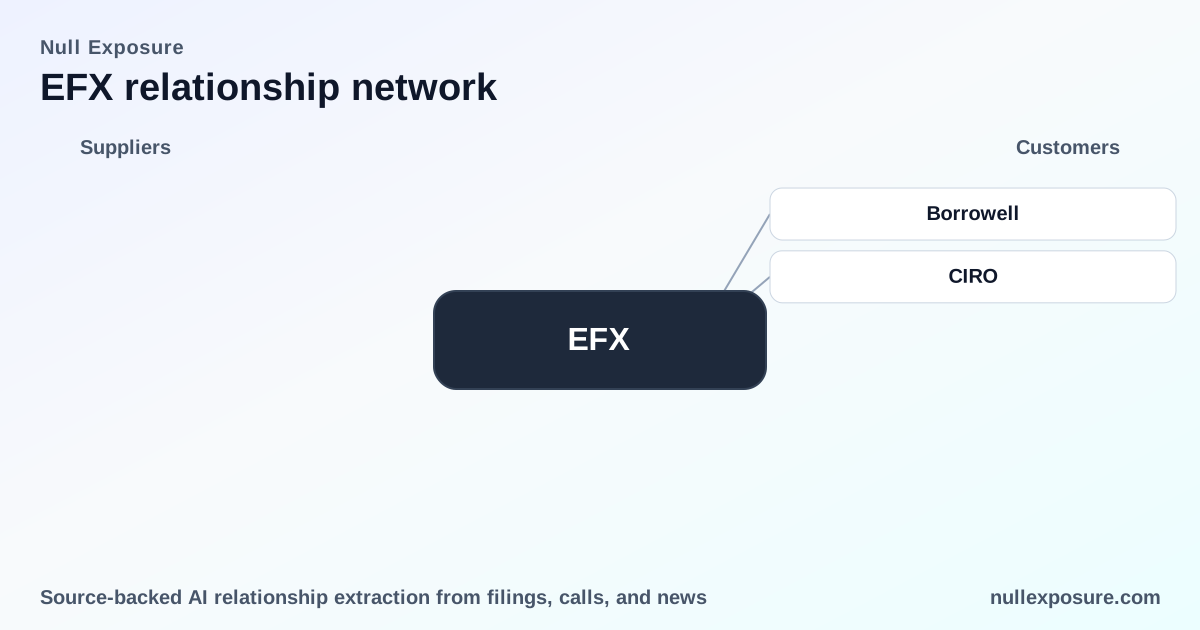
CIRO
CIRO is offering impacted consumers two years of credit monitoring through Equifax and TransUnion as part of remediation after a regulator-detected breach, demonstrating Equifax’s role as a marketplace provider of consumer monitoring services to third-party remediation programs. This was reported in an industry news piece in FY2026 (InvestmentExecutive, Mar 2026) (https://www.investmentexecutive.com/news/ex-equifax-employee-alleges-firm-allowed-fraudulent-access-to-credit-file/).
Fannie Mae and Freddie Mac (VantageScore context)
Fannie Mae and Freddie Mac accepted mortgage underwriting using VantageScore 4.0, a scoring model co‑owned by Equifax, which widens the addressable market for non‑FICO scores and implicitly supports Equifax’s analytics franchise in mortgage channels. Coverage of the policy change and VantageScore ownership appeared in Benzinga in April 2026 (Benzinga, Apr 2026) (https://www.benzinga.com/real-estate/26/04/51990212/fannie-mae-freddie-mac-move-beyond-fico-with-new-credit-scoring-model-to-boost-competition).
Borrowell
Canadian fintech Borrowell is listed among third‑party platforms authorized to submit credit file disclosure requests to Equifax, illustrating Equifax’s role as the back‑end credit data provider for embedded fintech experiences. This was reported alongside regulatory and access commentary in FY2026 (InvestmentExecutive, Mar 2026) (https://www.investmentexecutive.com/news/ex-equifax-employee-alleges-firm-allowed-fraudulent-access-to-credit-file/).
Kount 360 Platform (Equifax product)
Equifax launched an identity proofing solution within its Kount 360 platform, extending Kount’s fraud and identity orchestration capabilities to new enterprise and merchant customers and reinforcing Kount as a strategic product line for transaction-level revenue. Product launch coverage appeared in FY2026 product roundups (Simply Wall St, Sep 2025/ FY2026 references) (https://simplywall.st/stocks/us/commercial-services/nyse-efx/equifax/future).
SSA
Equifax referenced a “big win” with SSA in a recent earnings call, signaling a meaningful contract or renewal with that entity (full context disclosed in the transcript), which underscores Equifax’s continued traction in large institutional verification or identity engagements. The comment came out in the Q1 2026 earnings call transcript (InsiderMonkey, May 2026) (https://www.insidermonkey.com/blog/equifax-inc-nyseefx-q1-2026-earnings-call-transcript-1743834/).
Commercial and operational constraints that matter to investors
- Contracting posture: Equifax operates a hybrid model: annual subscriptions for platform access and employer services, and per‑transaction pricing for verification, credit reporting and scoring. This mix supports steady recurring revenue while capturing volume upside during demand spikes.
- Revenue concentration: Company disclosures indicate low concentration risk—the largest client accounted for roughly 3% of revenue, which supports resilience against single‑customer losses and simplifies downside scenarios.
- Counterparty mix and distribution: Equifax sells to individuals, financial institutions, government agencies and resellers, while also operating resell channels that increase scale but require partner management and revenue-sharing.
- Geographic footprint and scale: Operations are global (North America, LATAM, EMEA, APAC), which diversifies regulatory and market risk but increases compliance complexity across jurisdictions.
- Criticality and stickiness: Equifax products are embedded into mortgage underwriting, dealer compliance, merchant fraud workflows and consumer monitoring—functions that are operationally critical to customers and create high switching friction.
- Maturity and product segmentation: The business sits in a mature but expanding market, with legacy credit reporting complemented by growth in fraud prevention, AI‑enhanced analytics and identity orchestration.
Investment implications and action points
- Upside: Partnerships with Gen Digital, VTEX and Dealertrack convert Equifax data into recurring and transaction-based revenue while widening end-user reach—this supports mid‑cycle growth and margin expansion through scale.
- Risk: Regulatory, privacy and remediation programs (e.g., monitoring arrangements like CIRO’s) continue to be operational overhead; investors should monitor remediation costs and adjudication timelines.
- What to monitor next: contract renewals with large institutional customers (SSA/CMS references), Kount adoption metrics within merchant platforms, and productized data usage in Gen Digital’s AI offerings for evidence of increasing per‑user ARPU.
For a consolidated view of partner-level signals and ongoing monitoring, visit https://nullexposure.com/ to track the evolving customer map and the public evidence that drives valuation models.