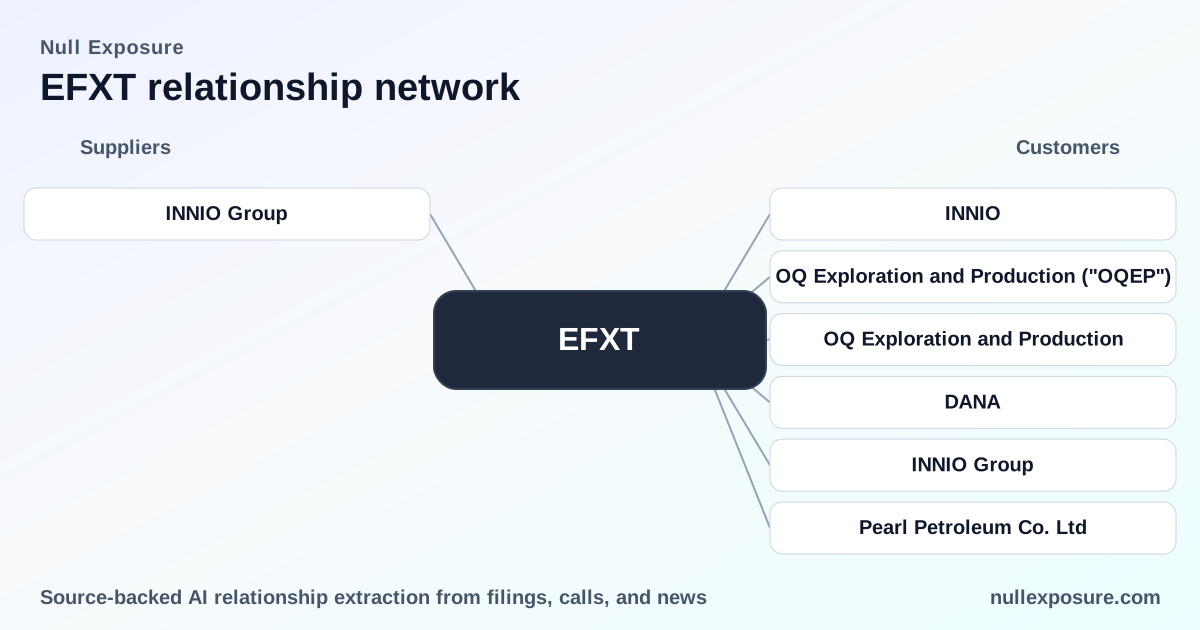
Enerflex Ltd. (EFXT): customer relationships that drive revenue and risk
Enerflex supplies natural gas compression, oil & gas processing, refrigeration systems, energy-transition hardware and electrical power generation gear, monetizing through large EPC contracts, equipment sales and recurring aftermarket services and rentals. Revenue combines project-based engineering and construction work with higher-margin service and parts streams, and recent activity shows the company is actively reshaping its portfolio to concentrate on core aftermarket and selected geographies. For deeper situational analysis, visit https://nullexposure.com/.
Why customer relationships matter for Enerflex investors
Enerflex’s commercial model is dual: project economics (lumpy, contract-driven revenue) and recurring aftermarket revenue (service, parts, rentals). That duality creates a trade-off: projects deliver the bulk of near‑term cash flows but expose the company to execution and counterparty risk, while aftermarket contracts support margin stability and long-term customer lock-in. Recent press releases and market reports suggest Enerflex is actively managing that mix through divestitures and large international projects, which will materially affect revenue concentration and operational risk over the coming quarters.
Deal-by-deal: customers and counterparty activity that matter today
INNIO / INNIO Group — APAC aftermarket carve‑out (FY2026)
Enerflex has signed a definitive agreement to divest the majority of its APAC aftermarket operations to INNIO, with closing expected in the second half of 2026, a move that reduces Enerflex’s direct exposure in Australia, Thailand and Indonesia while crystallizing cash and shrinking aftermarket scale in APAC. This action was reported in The Globe and Mail and confirmed in Enerflex’s corporate disclosure in February 2026. (Source: The Globe and Mail, Mar 9, 2026; Enerflex press release reported on GlobeNewswire, Feb 26, 2026; additional coverage on Intellectia.ai, FY2026.)
OQ Exploration and Production (OQEP) — Bisat‑C Expansion delivery (FY2025)
Enerflex completed the construction and start‑up of the Block 60 Bisat‑C Expansion for OQEP in Oman, demonstrating the company’s continued execution capability on large Middle East EPC projects and generating significant project revenue in 2025. The project completion was disclosed in Enerflex’s Q3 2025 results and echoed in an earnings‑call transcript from Q3 2025. (Source: Enerflex press release on GlobeNewswire, Nov 6, 2025; Q3 2025 transcript coverage on InsiderMonkey.)
Dana Gas (DANA) — contract termination on KM250 (FY2026)
Dana Gas publicly terminated its contract with Enerflex for the KM250 expansion project, citing persistent performance issues that substantially disrupted an $806 million expansion at Khor Mor; this represents a material operational and reputation risk given the size and profile of the contract. Rudaw reported the termination and noted Dana Gas’s disclosure on the Abu Dhabi Securities Exchange. (Source: Rudaw reporting, Sept 10, 2024, as referenced in market summaries.)
Pearl Petroleum Co. Ltd — arbitration related to KM250 (FY2026)
Following the KM250 disruption, Pearl Petroleum has commenced arbitration proceedings against Enerflex, with the dispute linked to Enerflex’s role as the EPC contractor on the project; arbitration elevates the potential for contingent liabilities and extended legal exposure. Rudaw’s reporting summarized Pearl Petroleum’s initiation of arbitration in connection with KM250. (Source: Rudaw reporting, Sept 10, 2024.)
What the pattern of relationships reveals about Enerflex’s operating model
No explicit constraint excerpts were provided in the dataset used for this review; however, the relationship activity itself signals clear company‑level characteristics:
- Contracting posture: Enerflex operates as an EPC contractor on major projects while simultaneously maintaining an aftermarket service business — a hybrid posture that requires capabilities in project execution, spare‑parts logistics and field maintenance.
- Concentration: The divestiture of APAC aftermarket assets to INNIO reduces geographic aftermarket concentration but also shrinks Enerflex’s recurring-service footprint in those markets.
- Criticality: Large projects like KM250 (an $806 million expansion) are systemically critical to fiscal outcomes for the year in which they occur and to reputation in the region; termination and arbitration around such projects create outsized downside risk.
- Maturity and portfolio management: Enerflex is actively managing portfolio maturity — moving from owning broad APAC aftermarket operations toward a narrower, potentially higher‑margin set of operations — which suggests a strategic pivot to improve margins and reduce administrative scale.
Investment implications: upside, execution risk, and how to watch next
Enerflex is positioned between cyclical project revenue and steady aftermarket income. The announced APAC aftermarket divestiture should generate near‑term cash and simplify operations, but it reduces recurring revenue exposure that historically cushions project volatility. Meanwhile, the completion of the Bisat‑C facility for OQEP validates execution capability in Oman, but the KM250 termination and ensuing arbitration underscore an execution risk premium investors must price into the stock.
Key items for investors to monitor:
- Progress and closing terms of the INNIO APAC transaction and the use of proceeds (cash build, debt paydown, or shareholder return).
- Arbitration developments with Pearl Petroleum and any settlements or damage awards tied to KM250; these outcomes will materially affect contingent liabilities.
- New aftermarket contract wins outside APAC to replace divested revenue and preserve sticky service margins.
- Quarterly project backlog and cash‑collection timing, which reveal whether Enerflex is stabilizing free cash flow after these portfolio changes.
Bottom line: Enerflex is reshaping its revenue base — reducing APAC aftermarket exposure while retaining project execution in the Middle East — and investors should balance the upside from portfolio simplification against the near‑term execution and legal risks embedded in large EPC projects. For ongoing monitoring and deeper customer‑relationship analysis, visit https://nullexposure.com/.
Actionable takeaway
- If you own EFXT, prioritize updates on the INNIO divestiture closing and any arbitration disclosures tied to KM250; both will be the primary catalysts for re‑rating the business.
- If you are evaluating a position, treat the company as a hybrid project‑service operator with heightened short‑term execution risk but a clear strategic push to consolidate and de‑risk its aftermarket footprint.