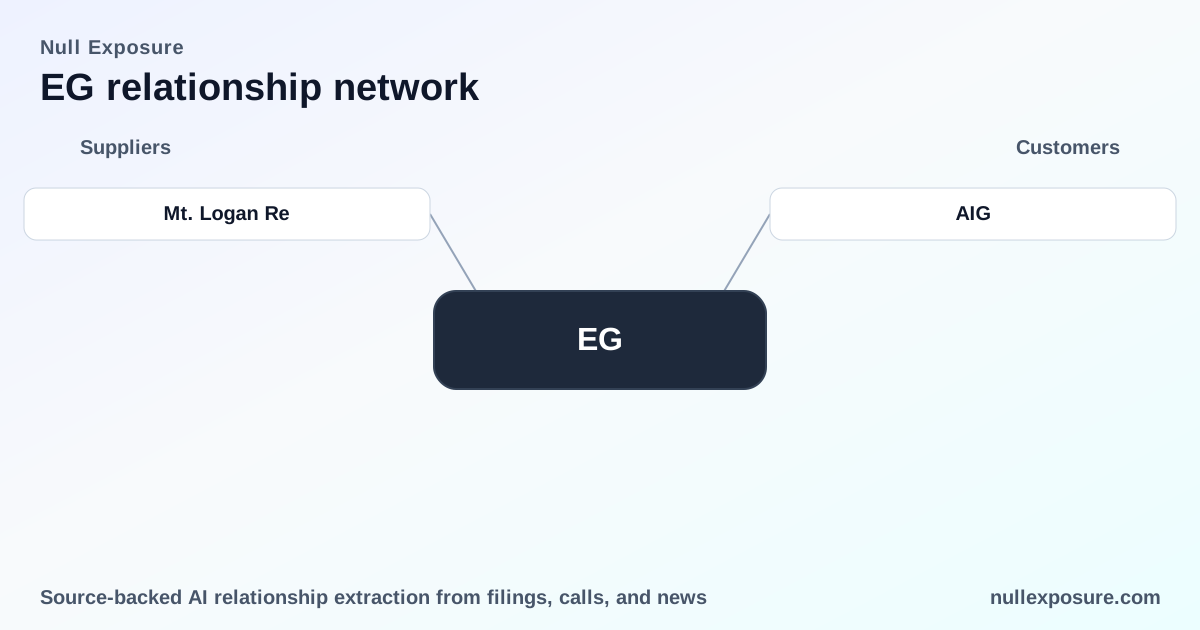
Everest Group Ltd (EG) — Customer Relationships and Strategic Implications
Everest Group Ltd underwrites and reinsures commercial and specialty risks globally and monetizes through insurance premiums, reinsurance contracts and portfolio management of underwriting exposures; the company also executes selective asset and business sales to optimize capital and underwriting mix. Recent transactions that transfer renewal rights and retail lines materially reshape Everest’s premium base, expense profile and near-term underwriting cadence, while sponsorships and third‑party agreements clarify its market positioning as both an insurer/reinsurer and a services buyer/seller.
If you want a concise dossier linking these relationship signals to commercial risk, visit https://nullexposure.com/ for our full coverage and source links.
AIG: Transfer of renewal rights that reduce premium base and change operational profile
Everest sold renewal rights to its European, U.S. and Asian commercial retail insurance businesses to AIG for total consideration of $426 million, including a transition services agreement, and the transaction covers roughly $2 billion of gross written premiums. According to Everest’s Q4 2025 earnings call, management disclosed the $426 million consideration in March 2026, and subsequent news coverage detailed the scope as approximately $2 billion in GWP (Insurance Business, March–May 2026).
IndexBox and TradingKey reporting links this transfer to a significant reduction in premiums and a temporary increase in group expense ratios, and also highlighted potential operational and underwriting challenges for AIG as it absorbs 30–40% of those lines (IndexBox and TradingKey, March 2026).
Wawanesa Mutual Insurance: Canadian retail business exits Everest’s portfolio
Everest agreed to sell its Canadian retail insurance business to Wawanesa Mutual Insurance for an undisclosed sum, a move that further trims Everest’s retail footprint in North America. RTTNews reported the transaction as part of Everest’s broader repositioning of retail lines in FY2026 (RTTNews, May 2026).
XBP Global Holdings: Sponsorship and research support signals vendor relationships
XBP Global supported an Everest Group report on intelligent document processing and public‑sector service modernization, indicating a commercial relationship around research sponsorship and workflow automation collaboration. The joint report was publicized in February 2026 via GlobeNewswire/ManilaTimes coverage (ManilaTimes/GlobeNewswire, Feb 2026).
How these customer relationships change Everest’s operating model
The AIG and Wawanesa transactions are part of an active portfolio management strategy: Everest is selling renewal rights and entire retail businesses rather than closing them, which preserves some value via consideration and transition services while offloading underwriting volatility. That posture signals a contracting strategy that prioritizes capital efficiency and underwriting discipline over scale in particular retail commercial lines.
- Contracting posture and maturity: Everest’s use of renewal‑rights transfers and TSAs shows a mature approach to de‑risking lines with an emphasis on contractual transfers and managed transitions rather than abrupt run‑offs.
- Concentration and client mix: Company disclosures indicate a broad counterparty base—no single client accounted for more than 3.9% of gross written premiums in 2024—so these transactions reduce exposure without creating single‑counterparty concentration risk at the group level.
- Criticality and operational impact: The reserve for losses and loss adjustment expenses is a critical audit matter ($29.9 billion at year‑end 2024), so balance‑sheet sensitivity to underwriting mix changes is material even as individual customer concentration remains low.
These are company‑level signals drawn from Everest’s disclosures and transaction announcements, not an attribution of constraints to any single counterparty.
Geography, segment mix and what that implies for customers
Everest’s business is global but North America‑heavy (United States 57%, Europe 25%, rest 18% in 2024), and it distributes insurance and reinsurance through brokers and agents worldwide. That geographic footprint explains why Everest can contract renewal rights regionally (AIG covering US/UK/Europe/APAC) and still retain diversified business elsewhere. Everest’s public filings emphasize both a diversified client base across large enterprises and mid‑market companies and a services‑oriented insurance segment that distributes products globally.
Constraints and what they tell investors about the business model
Everest’s disclosures generate several company‑level signals important to underwriting counterparties and investors:
- Counterparty mix: Public statements describe service to both multinational corporations and mid‑size commercial clients, indicating product and distribution breadth across client tiers.
- Geographic scale: Documented operations “in the U.S., Bermuda and international markets” and a network spanning more than 100 countries confirm a global operating footprint that supports regional reinsurance and retail transactions.
- Materiality posture: While no single customer exceeded 3.9% of GWP (2024)—a signal of low customer concentration—Everest’s reserve estimates are a critical audit matter, which makes underwriting and reserving changes consequential to capital and reported results.
- Segment focus: The company emphasizes an insurance segment that distributes products through brokers and agents, a structure that creates predictable distribution channels but can limit direct customer stickiness.
Together these signals describe a company that contracts strategically, leverages global distribution, and treats capital and reserve management as top governance priorities.
What investors should watch next
- Profitability vs. scale trade‑off: The sale of renewal rights reduces GWP and can temporarily raise expense ratios while improving long‑term underwriting returns; monitor combined ratio and expense ratio in subsequent quarters.
- Reserve sensitivity: Given the $29.9 billion reserve ledger and its status as a critical audit matter, any change in loss emergence or reinsurance recoverables after portfolio transfers will materially affect solvency metrics.
- Counterparty execution risk: AIG’s absorption of renewal rights creates transitional underwriting and operational risk; follow AIG disclosures and related TSAs for indicators of retained contingent liabilities or seam issues.
- Strategic use of partnerships: Sponsorship and research engagements (e.g., XBP) signal active vendor relationships that can accelerate process modernization but are operationally non‑core relative to underwriting.
Key investor takeaways: Everest is deliberately reshaping its retail footprint through contractual transfers that prioritize capital efficiency, while maintaining a global, diversified client base and a material reserve portfolio that keeps underwriting risk central to valuation.
For a compact view tying these relationship signals to public filings and market commentary, visit our research hub at https://nullexposure.com/.
Bold positioning, explicit transaction terms and reserve transparency will drive near‑term earnings volatility and medium‑term improvement in underwriting margins; investors should prioritize reserve development, combined ratios and post‑transaction expense trends as the next set of catalytic data points.