EGH Acquisition Corp. Rights (EGHAR): SPAC funding concentrated behind a single announced business combination
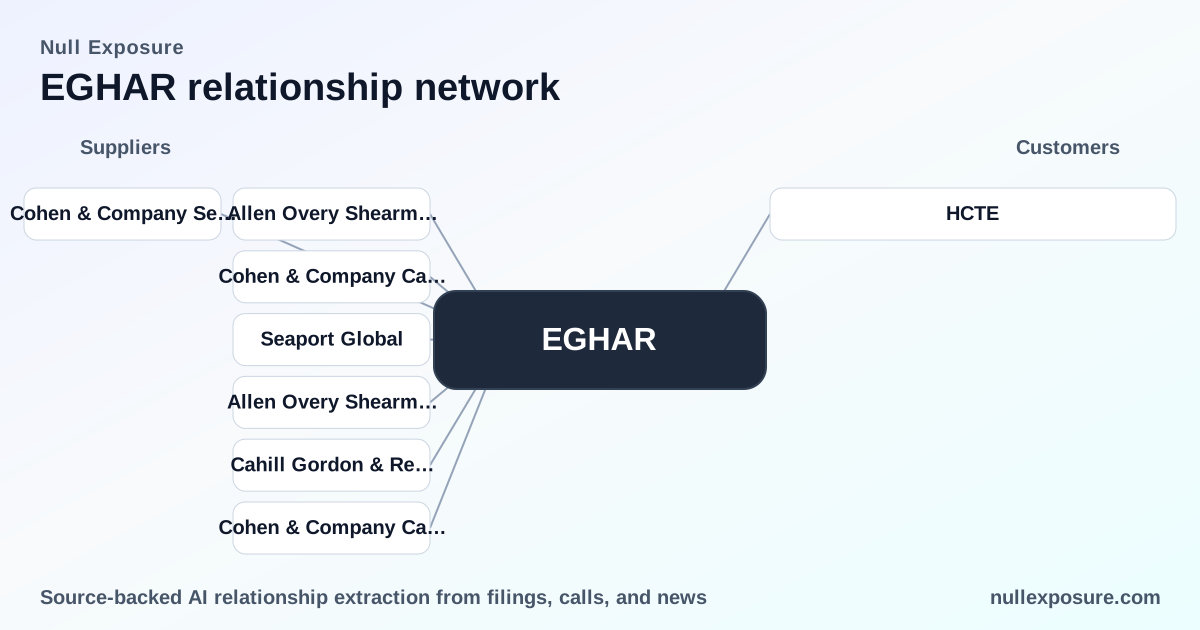
EGH Acquisition Corp. functions as a special purpose acquisition company (SPAC); EGHAR represents the warrant/right instrument that captures upside for investors linked to EGH’s merger outcomes. The sponsor’s core monetization path is through completing a business combination that converts trust-account cash into equity for a target and creates market value for the combined company — warrant holders profit if post-merger equity appreciates. For investors evaluating customer relationships, the material commercial exposure for EGH’s trust account is currently concentrated on a single announced partner: Hecate Energy (HCTE).
Visit our research hub for more corporate relationship intelligence: https://nullexposure.com/
A compact deal: EGH’s trust account committed to Hecate’s development finance
EGH’s announced business combination values Hecate at a pre-money enterprise value of $1.2 billion, and EGH has committed up to $155 million from its trust account to support the target’s utility-scale energy park development, cover EGH shareholder redemptions, and pay transaction expenses. This financing commitment is the principal commercial link between EGH and Hecate and defines the immediate capital deployment profile for the SPAC vehicle. (Quiver Quant, March 9, 2026; Taiyang News, March 9, 2026.)
The public record: each relationship entry explained
Below are the source-level relationship entries surfaced in the public record. Each item is summarized in plain English with its source.
Taiyang News — HCTE (entry 1)
A Taiyang News business report dated March 9, 2026 states that EGH’s trust account will provide the company with up to $155 million to develop its utility-scale energy park portfolio, linking EGH’s financing to the execution of Hecate’s project pipeline. (Taiyang News, March 9, 2026)
Taiyang News — Hecate Energy (entry 2)
The same Taiyang News article (March 9, 2026) repeats that EGH’s trust account is earmarked to support Hecate Energy’s utility-scale projects, underscoring the transaction’s use of SPAC cash for operational capital and post-close project development. (Taiyang News, March 9, 2026)
Quiver Quant — HCTE (entry 3)
A Quiver Quant press release on March 9, 2026 reports the business combination and explicitly notes the $1.2 billion pre-money enterprise valuation for Hecate and the up-to-$155 million commitment from EGH’s trust account to fund development, redemptions, and transaction expenses. (Quiver Quant, March 9, 2026)
Quiver Quant — Hecate Energy Group LLC (entry 4)
Quiver Quant’s release (March 9, 2026) identifies the counterparty as Hecate Energy Group LLC and reiterates that EGH’s trust funds are allocated to the development of Hecate’s energy park portfolio as part of the combination financing package. (Quiver Quant, March 9, 2026)
What these relationships imply about EGH’s operating model and business characteristics
Based on the recorded customer relationships and company status, the following operating-model signals are relevant for investors:
-
Contracting posture — deal-centric and front-loaded. EGH operates as a SPAC whose primary contracting posture is event-driven: the trust account is a committed pool of cash meant to be deployed at close. The up-front commitment of up to $155 million to a single target is characteristic of a transaction-focused financing vehicle rather than a diversified operating business.
-
Concentration — high single-counterparty exposure. The public record documents a concentrated exposure to Hecate Energy as the principal announced counterparty. That concentration increases deal-specific execution risk: the commercial and financing success of EGH’s program is tightly coupled to one transaction.
-
Criticality — funding is central to combination success. The trust contribution is critical to Hecate’s near-term development plans and to EGH’s ability to consummate the merger while satisfying shareholder redemptions and transaction fees. The funding allocation therefore represents both a primary use of SPAC proceeds and a gating item for closing.
-
Maturity — pre-close SPAC lifecycle. EGH is in the SPAC lifecycle phase: public listing with a trust account, announced business combination, and public communications describing financial commitments. Warrant instruments such as EGHAR deliver optionality that only realizes value after close and subsequent market performance.
These characteristics translate to practical investor considerations: redemption risk, sponsor execution, and the timing of capital deployment are the key operational levers that determine whether EGHAR captures meaningful upside.
Key risk factors and value drivers for warrant holders
-
Redemption pressure reduces deal equity. Because trust funds are also allocated to satisfy shareholder redemptions, large redemptions will reduce the net capital available for Hecate’s development, increasing dilution or requiring alternative financing.
-
Single-deal concentration amplifies idiosyncratic risk. With the trust commitment focused on Hecate, any execution delays, regulatory hurdles, or project cost overruns materially affect EGH’s prospects and EGHAR’s implied optionality.
-
Market sensitivity of warrant value. EGHAR’s value tracks expected post-combination equity performance; the instrument is sensitive to market sentiment around renewable energy project development and the combined company’s delivery of near-term milestones.
-
Sponsor alignment and timeline. The sponsor’s capacity to close the transaction, secure any bridge financing, and manage post-close integrations will determine the path to realizing warrant value.
If you are tracking SPAC-sponsored financing risk or preparing a position thesis around warrant instruments, our platform provides curated relationship maps and deal summaries: https://nullexposure.com/
Investor takeaway: concise conclusions
- EGH’s commercial footprint today is a single-material relationship: Hecate Energy, backed by an up-to-$155 million trust commitment that supports project development, redemptions, and transaction costs. (Quiver Quant; Taiyang News, March 9, 2026.)
- This concentration creates a binary investment profile for EGHAR: positive warrant returns require a successful close, disciplined redemption outcomes, and favorable post-combination equity performance.
- Active monitoring of redemption levels, sponsor disclosures, and Hecate project milestones is the priority for investors evaluating EGHAR exposure.
Bold, deal-level commitments define EGH’s current market position. Warrant investors must treat EGHAR as a deal-dependent instrument and maintain event-driven monitoring until the post-combination capital structure and operational plan are clear.