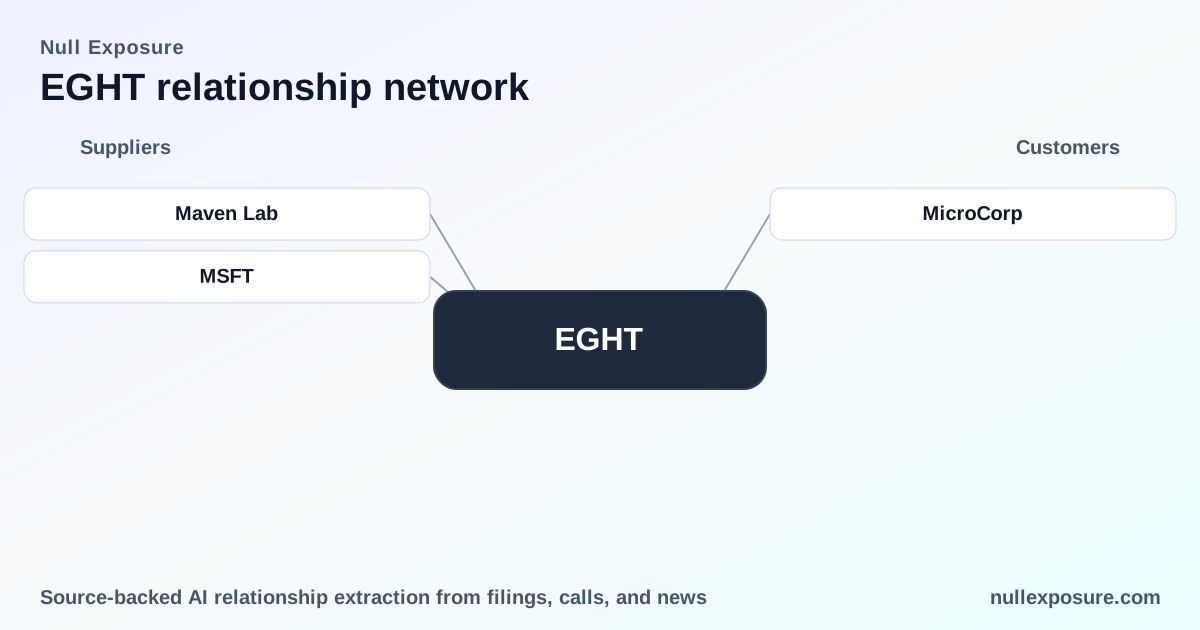
8x8 (EGHT) — Customer Relationships, Contracts and Commercial Signals
8x8 operates a global, cloud-native communications platform that monetizes primarily through per-user subscription plans augmented by usage-based fees for communications and contact center services; revenue is realized via direct sales and channel partners, while renewals and net-new annual subscription revenue are explicit executive performance targets. Investors should value 8x8 as a SaaS-oriented communications operator with a mixed subscription/usage revenue model, broad customer segmentation, and channel-led distribution that amplifies growth but leaves usage volatility and renewal economics as the primary operational levers. Learn more at https://nullexposure.com/.
How 8x8 actually sells value to customers
8x8 packages unified communications, contact center, voice, video and API services into a single cloud platform and sells those capabilities as subscription tiers, per-user plans and add-on usage. The company targets a spectrum of buyers — from small businesses to large enterprises and public sector organizations in more than 160 countries — and routes revenue through both direct sales and partners. Management ties executive compensation to service revenue, non-GAAP operating income, and net new annual subscription revenue, signaling that recurring subscription economics are the primary KPI for the business.
What the relationship data shows — two active customer/partner items
Below are the customer-facing relationships surfaced in our dataset and how they matter for EGHT’s commercial footprint.
-
PHI — 8x8 Silent Mobile Authentication integration with SmartSafe SilentAccess. According to a technology Inquirer report dated March 10, 2026, SmartSafe’s SilentAccess will be integrated with 8x8 Silent Mobile Authentication to reduce fraud and remove one-time passwords from customer journeys, positioning 8x8 as a fraud-reduction enabler in digital authentication flows. (technology.inquirer.net, March 2026)
-
MicroCorp — channel distribution agreement for cloud UC and contact center services. TelecomReseller reported on January 23, 2026 that MicroCorp will distribute 8x8’s Cloud Unified Communications, Contact Center and Enterprise Telephony services nationwide, reflecting continued emphasis on channel expansion to scale sales and distribution. (telecomreseller.com, January 2026)
Why these relationships matter to investors
Both items are commercial multipliers rather than single large buyers. The PHI integration strengthens 8x8’s product stickiness in authentication-sensitive verticals and enhances contact center security functionality — a product-led move that supports higher retention and potential upsell. The MicroCorp distribution tie is a classic scale play that converts channel reach into incremental seats and contact-center deployments without expanding direct sales expense proportionally. Together, they illustrate 8x8’s twin go-to-market approach: product integrations that deepen enterprise value and channel alliances that broaden market access.
Contracting posture, concentration and criticality — company-level signals
The consolidated constraints in public disclosures establish a clear operating profile:
-
Contracting posture: Contracts are predominantly annual to multi-year subscription agreements with payment terms commonly net 30; usage-based offerings exist alongside subscriptions, adding revenue variability. This means the revenue base is largely predictable on a recurring basis, but usage volatility can introduce quarter-to-quarter variance.
-
Revenue mix and go-to-market: The company emphasizes subscription service revenue as the primary metric and sells both directly and through indirect channels. Executive incentives tied to service revenue and net new annual subscription revenue indicate management’s focus on recurring ARR growth rather than one-off transactions.
-
Customer composition and concentration: 8x8 serves small business, mid-market, large enterprise and public sector customers globally, and no single customer contributed 10% or more of revenue in fiscal 2023–2025, which signals low customer concentration and a diversified risk profile.
-
Counterparty types and criticality: With an explicit strategic shift toward mid-market and public sector customers (500–10,000 employees) and continued engagement with SMBs and large enterprises, 8x8’s platform is mission-relevant across multiple buyer types; renewals are essential to maintain ARR and service economics.
-
Maturity and operating focus: Repeated references to service revenue targets and non-GAAP operating income goals indicate a company operating in scale-with-efficiency mode — balancing growth (seat expansion, channel reach) against margin discipline.
Operational risks and value drivers derived from constraints
- Value drivers: Recurring subscription revenue, channel-led seat growth, product integrations (like authentication) that increase stickiness, and global footprint are primary drivers of future cash flow stability.
- Risks: Usage-based revenue introduces revenue unpredictability; success depends on retention/renewal rates and the ability to convert channel reach into profitable net-new ARR. Contract terms that are annual to multi-year favor predictability, but the mixed model requires active management of usage trends and pricing.
- Concentration risk mitigation: Revenue diversification across many customers and geographies reduces single-counterparty risk, but retention of mid-market and public sector accounts is strategically critical.
Relationship-by-relationship detail (concise investor view)
-
PHI — The integration of SmartSafe SilentAccess with 8x8 Silent Mobile Authentication positions 8x8 to capture spend tied to secure customer authentication and fraud reduction in contact center flows, enhancing product differentiation in regulated or fraud-sensitive verticals. Source: technology.inquirer.net, March 10, 2026.
-
MicroCorp — A national distributor agreement to resell 8x8’s Cloud UC, Contact Center and Enterprise Telephony expands indirect sales capacity and accelerates seat acquisition without proportionally increasing direct sales overhead. Source: TelecomReseller, January 23, 2026.
Key takeaways for investors
- 8x8 is a subscription-first SaaS communications company with complementary usage fees; management measures success via service revenue and net-new subscription metrics.
- Channel partnerships like MicroCorp support scalable distribution; product integrations such as the PHI authentication tie strengthen platform stickiness.
- Revenue concentration is low, but the business depends on renewals and controlling usage volatility to protect margins.
- Investors should focus on ARR growth, renewal rates, usage trends, and channel conversion efficiency as the primary indicators of commercial health.
If you want deeper counterparty-level analysis or ongoing tracking of EGHT customer signals, visit https://nullexposure.com/ for workflow-ready insights and monitoring.