VAALCO Energy (EGY): Customer Relationships That Drive Cash — And Concentration Risk
VAALCO Energy is an independent oil & gas E&P that monetizes hydrocarbons through cargo liftings and direct sales, predominantly in Africa and with producing properties in Canada. The company generates cash by selling crude oil, natural gas and NGLs under short-duration commercial liftings and contract terms that settle quickly after a tanker lifting; revenues are therefore a function of production volumes, lift timing and counterparty credit. Improved collections from Egyptian sales in 2025 materially reduced receivables and reshaped near-term cash flow visibility. For a compact institutional view of counterparty exposures and event-level signals, see NullExposure’s coverage: https://nullexposure.com/.
Why customers matter more than reserves right now
VAALCO’s economics are simple: production converts to barrels, barrels are sold either to trading houses or directly to national oil companies, and cash collection is timed to liftings and invoicing. That operational cadence creates four investor-relevant characteristics:
- Short-term contracting posture. Customer sales commonly occur on a monthly tanker-lifting cadence and payments are made 30 days after the bill of lading, which concentrates credit risk into short payment cycles but also makes working capital dynamics predictable when counterparties are current.
- Concentration and criticality to revenue. VAALCO reports highly concentrated revenue by country and counterparty across the portfolio; a small set of producing regions and counterparties account for a very large share of receipts, and interruptions in these corridors would have outsized P&L and cash effects.
- Government exposure where present increases settlement profile complexity. Sales either go to third-party buyers or directly to national oil companies, which alters counterparty risk characteristics versus commercial trading houses.
- Core-product, commodity-driven cash flow. Revenue derives from crude, gas and NGL sales, so pricing and lift scheduling dominate short-term earnings volatility more than contract lifetime.
These are not abstract traits — they are visible in VAALCO’s filings and in recent operational commentary. If you are assessing credit or partnership risk, treat collections history and customer mix as primary inputs. For detailed monitoring of counterparties and events, visit https://nullexposure.com/.
Relationship-by-relationship: who pays VAALCO and how reliably
Egyptian General Petroleum Corporation (EGPC)
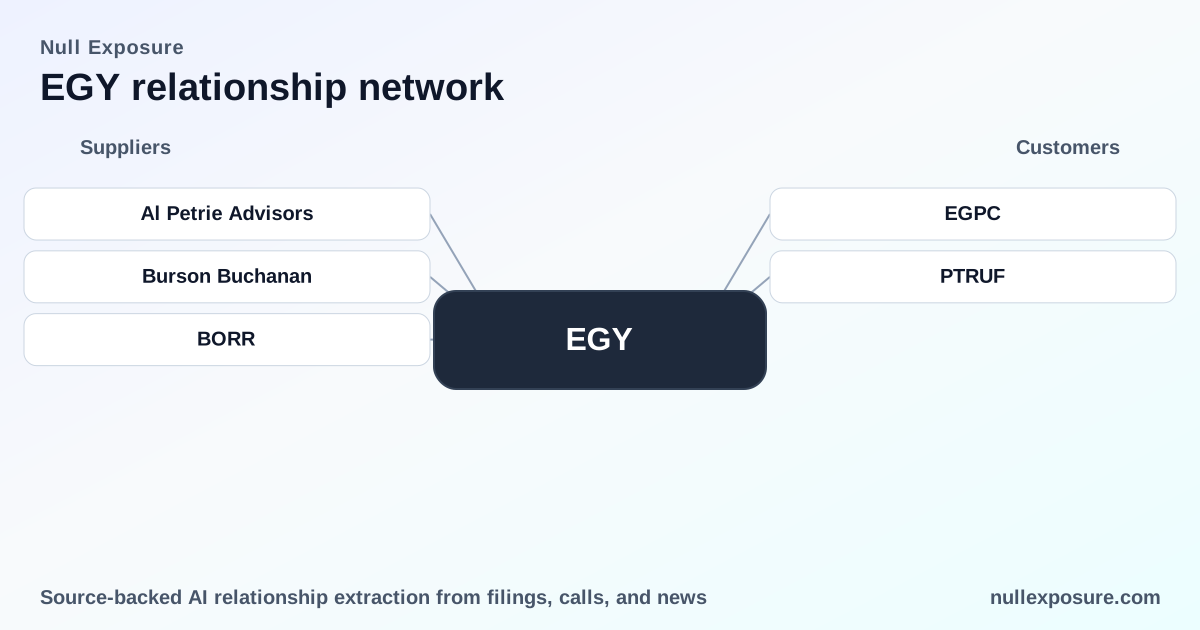
EGPC is VAALCO’s Egyptian counterparty for crude sales and is explicitly referenced in company commentary as the government purchaser in Egypt. VAALCO reported that outstanding accounts receivable from EGPC fell from $113 million at the start of 2025 to $31 million at year-end 2025 despite invoicing over $129 million during the year, a clear signal of accelerated collections and cash realization from Egyptian liftings. This disclosure was made in a company operational update published on GlobeNewswire in January 2026 and reiterated in the Q4 2025 earnings discussion reported in the earnings transcript coverage (InsiderMonkey). According to GlobeNewswire (Jan 15, 2026) and the Q4 2025 call transcript, EGPC is a government counterparty in-country and collections dynamics in Egypt directly affected VAALCO’s 2025 cash position.
Petrus Resources (PTRUF)
VAALCO signed an Asset Purchase and Sale Agreement to divest substantially all of its Canadian land assets and related liabilities to Petrus Resources (traded as PTRUF in some reporting). The transaction is a non-core asset sale that reduces VAALCO’s Canadian footprint and transfers associated liabilities to Petrus Resources, per reporting on TradingView in March 2026. This relationship is transactional (asset buyer/seller) rather than a recurring crude purchaser role, but it materially changes the company’s geography exposure and removes a line of operating cost and complexity from VAALCO’s balance sheet. TradingView reported the deal details in March 2026.
What the relationship map implies for investors
- Cash-flow sensitivity is front-loaded. The short-term payment cadence (monthly liftings, 30-day settlement post bill of lading) means operating cash is closely tied to timely collections; the reported reduction in EGPC receivables is therefore a positive inflection for liquidity in FY2026.
- Concentration is a structural risk. Company disclosures and revenue tables indicate concentrated revenue by operating segment and country — notably Gabon and Egypt figure prominently — which creates high dependence on a few counterparties and jurisdictions for cash. That concentration is a company-level signal and must be considered when modeling downside scenarios.
- Government counterparties change settlement dynamics. Where government entities like EGPC are a counterparty, payment risk is different than with commercial traders; the improved collections in 2025 reduce near-term settlement risk but do not eliminate policy or sovereign-linked operational exposures.
- Core-product exposure keeps the business cyclically correlated to oil prices. As an E&P, earnings and free cash flow are primarily driven by crude and gas prices and lift timing, not long-term contracted revenue streams.
Key takeaway: improved receivables collection from EGPC materially de-risks 2025 cash flow, but revenue concentration across a few countries and the presence of government counterparties sustain structural counterparty and geopolitical risk.
Operational constraints and how they shape counterparty risk
VAALCO’s operating model features several constraints that investors must fold into assessments of customer relationships:
- Contracting posture: short-term payment and lifting cycles concentrate collection risk into monthly settlement periods, which makes working capital predictable when counterparties perform but vulnerable to episodic payment delays.
- Counterparty type: where the company sells directly to national companies, government counterparties are in the mix (EGPC for Egypt), changing collection mechanics and potentially introducing in‑kind settlement clauses in other jurisdictions.
- Geography: the asset base is African-focused (Gabon, Egypt, Côte d’Ivoire, Equatorial Guinea) with residual North American exposure in Canada; this geography mix drives country risk and logistical complexity.
- Role and go-to-market: VAALCO operates as a seller of hydrocarbons, and in some regions relies on marketing agreements where an international trading house acts as a reseller—a structure that can diversify buyer credit but also concentrate marketing channel risk.
- Product focus: revenues derive from the company’s core product — crude oil, natural gas and NGLs — so commodity price and lift scheduling are primary drivers of revenue volatility.
These constraints are not hypothetical; they are embedded in VAALCO’s commercial terms and public disclosures and should be reflected in any credit model or partnership due diligence.
Bottom line for investors and operators
VAALCO is running a lean, commodity-exposed E&P business with short payment cycles and high customer concentration. The company’s January 2026 disclosure that EGPC collections improved substantially is a material positive for near-term liquidity, while the sale of Canadian assets to Petrus Resources simplifies the operating footprint and eliminates a source of capital and operating draw. Investors should weigh the improved collections against persistent country and concentration risks when forecasting free cash flow or sizing credit facilities.
For a consolidated, event-driven view of VAALCO’s counterparties and receivables movements, visit NullExposure for evolving counterparty signal tracking: https://nullexposure.com/.
Sources and selected references
- VAALCO Energy press release and operational update, GlobeNewswire (Jan 15, 2026) — collections and receivables disclosure on EGPC.
- Q4 2025 earnings call transcript coverage, InsiderMonkey (May 2026) — commentary on EGPC collections and receivables becoming current.
- TradingView news report (Mar 2026) on VAALCO signing an Asset Purchase and Sale Agreement with Petrus Resources (PTRUF).