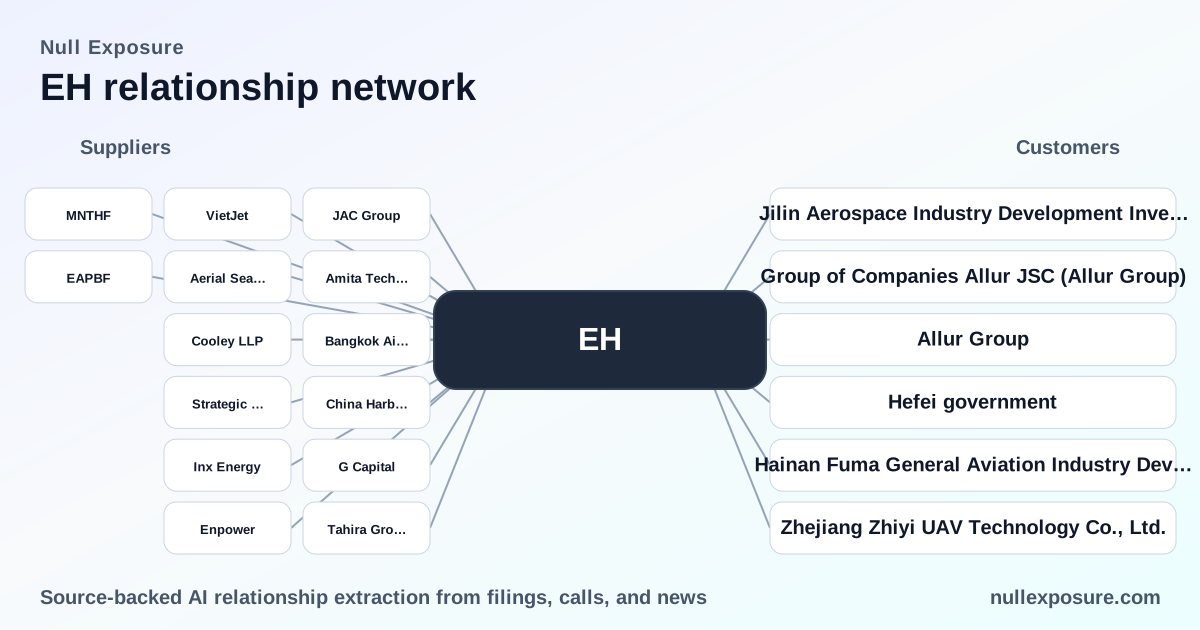
EHang’s customer map: commercial orders, government support, and the path to recurring revenue
EHang operates and monetizes an autonomous aerial vehicle (AAV) platform by selling EH216-series eVTOL aircraft and securing phased purchase commitments, MOUs and local operating partnerships that convert hardware sales into service revenue through certified operators. The company’s near-term monetization mixes unit sales, local assembly and joint ventures, and operational service fees as EHang transitions from trials to commercial sightseeing and ticketed flights. For investors focused on revenue durability, the customer set shows a deliberate shift from one-off OEM receipts to operator-driven recurring service revenue. For deeper coverage of EHang’s customer exposures and signals visit https://nullexposure.com/.
Why the customer roster matters for valuation and execution
EHang’s valuation is sensitive to two dynamics in the customer list: (1) order concentration and convertibility—large MOUs and government-backed commitments can be converted into multi-year deliveries or stall if regulatory or funding conditions change; and (2) operational criticality—the company’s shift to commercial ticketing through certified operators creates recurring service prospects that materially improve gross margin profile versus pure aircraft sales. The relationships below each carry execution and regional-risk considerations that will determine revenue timing and margin conversion.
Key high-level takeaways
- Government and regional tourism groups are anchor customers that de-risk early commercial rollouts through volume orders and local support.
- MOUs and cooperation agreements dominate the pipeline; not all are firm purchase orders but several include immediate deliverables and local investment commitments.
- Certified operators create the route to recurring service revenue—EHang’s own operator unit and partner operators are central to monetization.
Explore more analysis and relationship-level intelligence at https://nullexposure.com/.
Customer relationships and what they mean for cash flow and scale
Below I cover each relationship listed in the results. Each entry is a concise, plain-English synthesis with its source.
Jilin Aerospace Industry Development Investment Co., Ltd.
EHang disclosed that Jilin Aerospace’s platform company agreed to place an order for 41 EH216-S pilotless eVTOLs under a cooperation agreement, representing a material near-term supply commitment for the EH216-S model. (EHang press release, March 9, 2026: https://www.ehang.com/news/1233.html)
Guizhou Tourism Group
EHang reported delivery of 30 EH216-S units in Q4 and a cumulative 50 units to Guizhou Tourism Group, signaling a tourism-driven deployment with meaningful fleet scale at a single regional customer. (Earnings call transcript coverage, Q4 2025 / FY2026: Globe and Mail / Motley Fool transcript, May 2026)
Group of Companies Allur JSC (Allur Group) — MOU
Under a Memorandum of Understanding, Allur Group signaled intent to purchase 50 EH216-series units in phases, beginning with an initial combined order for passenger and cargo variants and plans for a local UAM operation center and assembly facility. This represents strategic distribution and localization in Central Asia. (EHang press release, March 2026: https://www.ehang.com/news/1278.html)
Allur Group — company announcement
EHang’s corporate filing reiterated the Allur MOU and emphasized joint development of UAM in Central Asia, including phased purchases and local assembly—a commercial expansion play into new regional markets. (GlobeNewswire release, November 26, 2025: https://www.globenewswire.com/news-release/2025/11/26/3194903/0/en/EHang-Reports-Third-Quarter-2025-Unaudited-Financial-Results.html)
EHang General Aviation
EHang General Aviation, the company’s operator arm, started commercial operations and ticket sales in March and will generate operational service revenue, marking the company’s shift from test flights to ticketed services run by an affiliated operator. (Earnings call transcript coverage, Q4 2025 / FY2026: InsiderMonkey transcript, May 2026)
Hefei government
The Hefei municipal government committed approximately RMB 500 million in comprehensive support, which includes potential orders for aircraft, investments and other cooperation across EHang’s industry chain—an explicit government-level backstop for regional rollouts. (EHang press release, March 2026: https://www.ehang.com/news/1272.html)
China Media Group (CMG)
EHang assets and 3D content were featured at the 2026 CMG Spring Festival Gala Hefei sub-venue, exposing EHang’s technology to a global audience and supporting broader public acceptance of urban air mobility. (EHang news, Spring 2026 coverage: https://www.ehang.com/news/1346.html)
Heyi Aviation
Heyi Aviation is one of two OC-certified operators expected to begin ticketed EH216-S sightseeing services in company venues, creating another operating counterparty that will generate recurring service streams. (Earnings call transcript / press coverage Q4 2025 — May 2026: InsiderMonkey / CompositesWorld)
Hainan Fuma General Aviation Industry Development Co., Ltd
EHang signed a cooperation agreement with Hainan Fuma at the VT35 global debut event, indicating additional local partners for distribution or service deployment in Hainan province. (Event coverage, Vertical Magazine, March 2026)
Zhejiang Zhiyi UAV Technology Co., Ltd.
EHang signed cooperation with Zhejiang Zhiyi UAV Technology of Wencheng County at the VT35 launch, reflecting a pattern of regional partnerships to expand manufacturing, service or training capabilities. (Event coverage, Vertical Magazine, March 2026)
Hefei HeYi Aviation
Hefei HeYi Aviation received one of China’s first Air Operator Certificates for pilotless human-carrying eVTOLs and supported regular trial operations at Hefei Luogang Park starting March 2025, underlining Hefei’s role as a testbed transitioning to commercial service. (Community and analyst narratives, SimplyWallSt update / FY2026 coverage)
EHang General Aviation (duplicate reporting)
Additional outlets confirm EHang General Aviation and Heyi Aviation as the two OC-certified operators launching ticketed services at EHang Future City and Luogang Park, reinforcing the operational deployment narrative. (CompositesWorld coverage, Q4 2025 disclosure)
Heyi Aviation (duplicate reporting)
Industry press reiterated Heyi Aviation’s role as a certified operator readying for public ticketed services at EHang facilities, supporting near-term service revenue. (CompositesWorld coverage, Q4 2025)
How these relationships shape EHang’s operating model and commercial constraints
The dataset did not include formal constraint metadata; however, the relationship mix provides clear company-level signals about EHang’s operating model:
- Contracting posture: EHang pursues a mix of firm orders and MOUs, combining immediate deliveries (e.g., Jilin, Guizhou) with phased, conditional agreements (e.g., Allur), balancing revenue recognition with market expansion.
- Concentration: Early revenue will be concentrated regionally, anchored by Chinese municipal governments and tourism groups but expanding through targeted international MOUs—concentration risk exists but is mitigated by geographic rollout plans.
- Criticality: Certified operators (EHang General Aviation, Heyi/Hefei HeYi) are critical to the company’s transition from unit sales to recurring service income; successful operator launches directly determine revenue convertibility and margin improvement.
- Maturity: The business is in early commercial maturity—trial operations have moved to commercial ticketing in select venues, but many partnerships remain in MOU or phased-purchase status, meaning revenue is staged rather than uniform.
Investment implications and closing verdict
EHang is executing a clear two-track commercial strategy: sell aircraft and enable operator-driven services. The presence of government-backed commitments and regional tourism deployments materially reduces first-mover adoption risk while MOUs in Central Asia and local cooperation agreements create upside optionality for scale and localization. The immediate investor question is execution speed—how quickly MOUs convert to firm orders and how reliably certified operators ramp to sustained ticket volumes. If EHang converts these relationships into recurring service revenue at scale, the company’s margin profile and valuation multiple can expand materially.
For a focused dataset of relationship intelligence and to monitor conversion milestones that drive revenue recognition, visit https://nullexposure.com/.