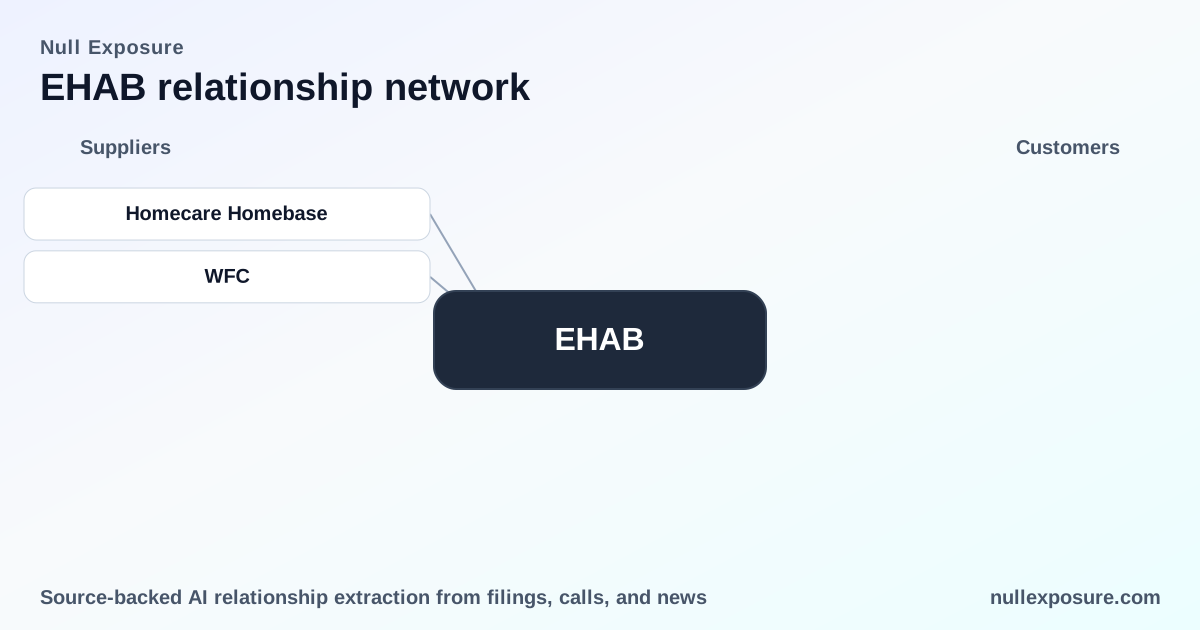
Enhabit (EHAB): Transaction-driven reset for a Medicare-heavy home health operator
Enhabit operates and monetizes a network of Medicare-certified home health and hospice agencies, generating the vast majority of revenue from government payers under episode-based Medicare reimbursements and negotiated managed-care arrangements. The company’s cash flow profile is driven by high Medicare concentration, short-term episode payments, and a distributed footprint across 34 states; its announced sale to private buyer Kinderhook Industries crystallizes a valuation near $1.1 billion and realigns the capital structure and strategic timeline for operators and vendors that depend on Enhabit’s volumes. For investors and counterparties, the deal converts recurring payer exposure into a defined exit price and shifts counterparty risk from public markets to a private-equity sponsor. For further context on our coverage approach, visit https://nullexposure.com/.
H2: What the announced deal is: Kinderhook buys Enhabit for $13.80 per share Enhabit disclosed an all-cash sale agreement that sets the purchase price at $13.80 per share, implying an enterprise value of approximately $1.1 billion. That price equaled public analyst targets and represented a liquidity event for shareholders while transferring operating control to Kinderhook Industries, a private-equity buyer that will drive next-stage integration and capital allocation decisions. According to a Sahm Capital article (March 2026), the sale price to Kinderhook was reported at $13.80 per share; a shareholder notice published via NewsfileCorp (FY2026/May 2026) confirms the all-cash transaction and the total enterprise value near $1.1 billion.
H2: All customer-facing relationships in the record — the facts you need Below are the relationships recorded in the search results. Each entry is summarized in plain English with the cited source.
-
Kinderhook Industries, LLC — The company agreed to acquire Enhabit in an all-cash transaction at $13.80 per share, valuing the business at roughly $1.1 billion and taking the company private. (Sahm Capital coverage, March 2026; NewsfileCorp shareholder notice, FY2026.)
-
Kinderhook Industries, LLC — A shareholder investigation notice referenced the Kinderhook sale terms, restating the purchase price and enterprise value and signaling active shareholder engagement around deal fairness. (NewsfileCorp press release/Shareholder Notice, FY2026.)
H3: How to read the two entries Both items reference the same counterparty and transaction; one is press commentary on price and fairness, the other is a shareholder notice that frames the deal as the definitive corporate action. Together they show both market reporting and shareholder scrutiny around the transaction (March–May 2026).
H2: Operating model signals that matter to counterparties and investors Enhabit’s commercial characteristics are defined by the way it contracts, the payer mix, and the tempo of cash flows:
-
Short-term contracting posture: Payment under Medicare’s home health prospective payment system is episodic (up to 60-day episodes), and managed-care agreements are typically one-to-three year contracts with frequent renewals. This results in recurring but discrete revenue events rather than long-term locked-in pricing. That short-term cadence compresses renegotiation windows for large payers and increases sensitivity to reimbursement swings.
-
Government-centric counterparty mix and material concentration: Medicare and Medicare Advantage represented about 89.8% of net service revenue in 2024, with hospice revenues even more concentrated (Medicare >98% in the hospice segment). This drives predictability from a payor stability perspective but introduces single-payer policy risk and makes reimbursement changes immediately material.
-
Large-enterprise counterparties matter for rate negotiation: Enhabit actively negotiates with Medicare Advantage plans, managed care entities, and private insurers; those contracts are economically significant and can influence realized reimbursement per episode.
-
Geographic footprint and scale: The company runs 255 home health and 115 hospice locations across 34 states, concentrated in the southern U.S., which delivers scale benefits in staffing, referral networks, and administrative overhead but also regional exposure to labor and regulatory dynamics.
-
Service-provider role and segment maturity: Enhabit is a national provider of mature services—home health and hospice—where reimbursement rules are established, clinical protocols are standardized, and margin expansion depends on operational efficiency rather than product innovation.
These are company-level operating realities derived from public filings and segment disclosures; they apply to Enhabit broadly rather than to any one buyer or vendor relationship unless explicitly stated in the evidence.
H2: Financial and deal context for investors and suppliers Enhabit reported roughly $1.06 billion in trailing revenue and $86.3 million in EBITDA, with market capitalization around $704 million before the deal. The sale price implies a premium to market valuation and shifts value realization from public equityholders to a private buyer. For vendors and payers, the buyer transition to Kinderhook is a discrete inflection point: contract novations, re-pricing conversations, and integration-driven procurement decisions will dominate the next 12–24 months.
-
For managed-care partners: Short-term contract cycles and high Medicare penetration mean managed-care negotiations will determine margin capture; Kinderhook’s playbook will influence whether Enhabit pursues rate renegotiation or cost-out programs.
-
For referral and operations partners: Local network continuity matters; while ownership changes, provider relationships and referral flows typically persist unless Kinderhook elects consolidation.
H2: Key investor takeaways and risk checklist
- Deal crystallizes value: $13.80 per share and ~ $1.1 billion EV establish a near-term exit multiple and reset expectations for valuation comparables among home-health peers.
- Concentration risk is real: Nearly 90% Medicare revenue makes regulatory or reimbursement shifts an immediate earnings lever; investors must stress-test scenarios where Medicare rates change.
- Cash flow cadence is episodic: Short-term episode payments and frequently renewing managed-care contracts increase sensitivity to utilization and case-mix trends.
- Sponsor sponsorship changes incentives: Kinderhook ownership will reorient priorities toward EBITDA growth, margin improvement, and possibly bolt-on M&A—outcomes that benefit suppliers who can scale with the platform but challenge vendors reliant on legacy procurement cycles.
H2: Final read and action items Enhabit’s sale to Kinderhook converts public market ambiguity into private-ownership certainty, but it does not change the company’s underlying operating constraints: heavy Medicare dependence, short-term reimbursement cycles, and a multi-state footprint. Investors should view the transaction as a valuation reset that preserves operating risks while providing new operational levers under PE ownership. Service providers and managed-care partners should prepare for renewed focus on cost and contract terms.
For a concise monitor of post-deal developments and to track counterparty signals in similar sectors, see our home page at https://nullexposure.com/.