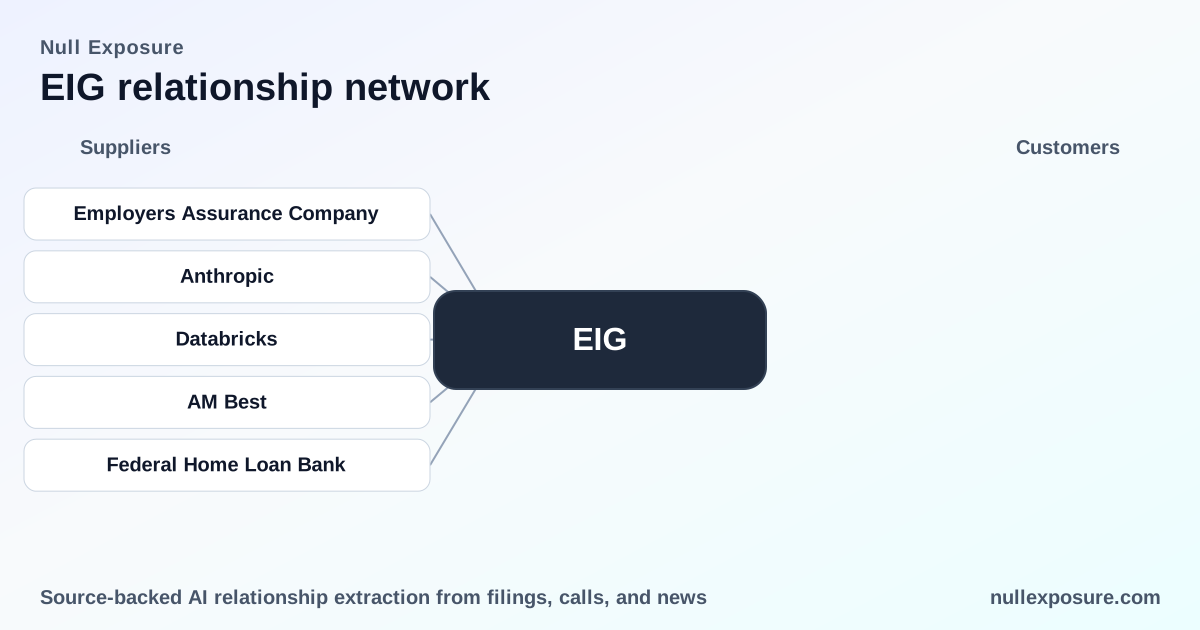
Employers Holdings (EIG): Customer Relationships and Commercial Signals for Investors
Employers Holdings, Inc. (EIG) is a focused commercial property & casualty insurer that underwrites workers’ compensation risk for small and mid-sized businesses and monetizes through premium revenue, underwriting services, and ancillary policy administration. The company’s business model is narrow and predictable: collect premiums, manage claims and loss adjustment, and distribute through a mix of direct channels and alternative partners to optimize acquisition cost and retention. For investors, the question is whether concentration, distribution strategy, and partner exposure support steady underwriting economics or raise tail risks tied to a few states and channel partners. Learn more at NullExposure.
The ADP mentions — what investors should know
ADP’s recent Marketplace announcement included a curated set of partners and referenced “Employ,” placing EIG within a payroll/HR ecosystem that routes solutions to employers. These mentions are transactional marketing placements rather than large vendor contracts, but they signal distribution relevance within HR-tech channels, which is strategically useful for a specialty insurer focused on small and mid-market customers.
ADP — Finviz summary (reported March 9, 2026)
Finviz captured ADP’s Marketplace update noting a curated set of AI agents that included partners like “Employ,” positioning those partners as potential HR-facing solution providers within ADP’s ecosystem. According to the Finviz summary, Employers is listed among partners whose solutions help address HR challenges (Finviz news, March 9, 2026).
Source: Finviz report on ADP Marketplace, March 9, 2026 — https://finviz.com/news/327268/adp-marketplace-launches-ai-agents-to-help-make-work-easier-smarter
ADP — ADP press release (March 2, 2026)
ADP’s own press release for March 2, 2026 describes a curated set of AI agents and explicitly lists partners including “Employ,” framing them as solutions for HR problems and potential distribution collaborators inside ADP’s Marketplace. This is a promotional inclusion in ADP’s partner roster rather than a disclosed commercial, financial contract (ADP press release, March 2, 2026).
Source: ADP Media Center press release, March 2, 2026 — https://mediacenter.adp.com/2026-03-02-ADP-Marketplace-Launches-AI-Agents-to-Help-Make-Work-Easier,-Smarter
How these relationship entries affect EIG’s commercial posture
Both items are marketing-level placements inside a large HR/payroll vendor’s partner catalog. For EIG the key commercial implication is distribution breadth: being included in ADP’s Marketplace increases visibility to small and mid-market employers and complements traditional broker channels. This supports EIG’s stated strategy of developing alternative distribution channels and selling directly to customers where economically viable.
Company-level constraints and what they reveal about operating risk
The extracted constraints describe EIG’s counterparty and geographic profile in clear terms that matter for investors evaluating customer relationships and concentration risk:
- Customer focus is small-to-mid-market and service-driven. Company disclosures designate EIG as a specialty provider of workers’ compensation insurance to small and mid-sized businesses in low- to medium-hazard industries. This implies a high-volume, low-ticket contracting posture where underwriting scale matters more than single large accounts.
- U.S.-centric operations with material state concentration. The company operates solely within the United States and reports a 45% concentration of in-force premiums in California, which creates state-level regulatory and loss-cost sensitivity that is central to underwriting risk.
- Limited single-policy exposure. Filings state no single policyholder accounts for 10% or more of revenue, signaling low counterparty concentration at the customer level even as state concentration remains material.
- Relationship stage is active and core to operations. The company reports record premium and policies in-force, consistent with an operationally active book rather than legacy runoff.
- Single reportable segment: Insurance Operations. This reflects business-line focus and operational maturity within workers’ compensation, not a diversified financial-services conglomerate.
Collectively these constraints paint a company with concentrated geographic risk, broad customer counts, and an active go-to-market that will be sensitive to California loss-cost trends and regulatory changes. Presenting products through platforms such as ADP’s Marketplace fits the stated strategy to diversify distribution without materially altering counterparty concentration.
Operating-model characteristics investors should watch
- Contracting posture: Predominantly direct underwriting and vendor/broker distribution, with growing emphasis on alternative channels and platform partnerships to reach small employers efficiently. This reduces customer acquisition cost but increases dependence on platform discoverability.
- Concentration: High state concentration (California ~45%) is the prime concentration risk that underwrites volatility in loss ratios and reserve development.
- Criticality: Workers’ compensation is the core revenue driver and the company’s activities are mission-critical to its clients; product continuity and claims management are operationally essential.
- Maturity: The business operates as a single focused segment with mature underwriting and distribution playbooks targeted at lower-hazard industries — a stable but competitive niche.
Investment implications — risk, cadence, and upside
EIG’s economics are driven by underwriting margins and premium growth sourced from small and mid-sized employers. The company shows modest profitability metrics (low single-digit margins) and significant institutional ownership, suggesting the equity is priced for stable, incremental underwriting improvement rather than aggressive growth. The ADP Marketplace placements are positive marginal distribution signals that expand EIG’s reach into HR/payroll-adjacent channels; they are not transformative revenue announcements but they help diversify acquisition funnels and lower marginal distribution costs.
Key investor considerations:
- Regulatory and loss-cost risk in California is the dominant macro-exposure; a swing in California claims or pricing would materially impact combined ratios.
- Low single-account concentration reduces counterparty default risk and supports predictable premium flows.
- Distribution diversification via partnerships (e.g., ADP inclusion) supports incremental growth in small accounts, improving scale economics if conversion metrics are healthy.
If you are building a diligence checklist, focus on conversion and retention metrics for platform-sourced leads, state-level loss development (especially California), and expense ratios tied to small-account underwriting.
Bottom line: actionable takeaways
- EIG is a niche workers’ compensation carrier that monetizes through premium and service economics and is actively diversifying distribution into platforms like ADP’s Marketplace. These channel inclusions are distribution-positive but not immediate material revenue events.
- Primary risk is state concentration in California; primary strength is low single-customer concentration combined with targeted distribution to small and mid-market employers.
- For a deeper review of partner signals and customer relationships, explore the company’s filings and partner press releases and compare conversion outcomes for platform vs. broker-sourced business.
For continued coverage and structured signals on customer and partner relationships, visit NullExposure to read deeper analyses and track evolving partner mentions.